

Pupil Examination
Assessment of pupil size, shape, and reactions that can reveal important information about the visual and nervous system.
The pupil examination is a crucial part of the neuro-ophthalmic evaluation. Your pupils respond to light and near focus through pathways that connect the eye to the brainstem and back - meaning a simple flashlight test can reveal problems anywhere along this circuit. Pupil abnormalities can point to optic nerve disease, brain lesions, autonomic dysfunction, or even a life-threatening aneurysm.
Key Takeaways
- Pupils are a window into the nervous system - they test pathways from the eye to the brainstem
- The exam checks direct, consensual, and near responses to assess different pathways
- An APD (Marcus Gunn pupil) is one of the most important signs of optic nerve damage
- Unequal pupil size may indicate Horner syndrome, third nerve palsy, or Adie's tonic pupil
- Painless, non-invasive, and takes only a few minutes
- Some findings prompt urgent imaging to rule out aneurysm or other serious causes
Why the Pupil Exam Matters
The pupil exam packs a remarkable amount of diagnostic information into a brief, painless test. Because the pupil light reflex travels through the optic nerve (from eye to brain) and the third cranial nerve (from brain back to the eye), any disruption along this pathway changes how the pupil responds. A doctor can localize a problem to the optic nerve, brainstem, sympathetic chain, or parasympathetic pathway - all by observing how your pupils react to light and near focus.
How the Exam Is Done
The exam is done in a dimly lit room using a bright penlight or a specialized flashlight. Here is what the doctor does, step by step:
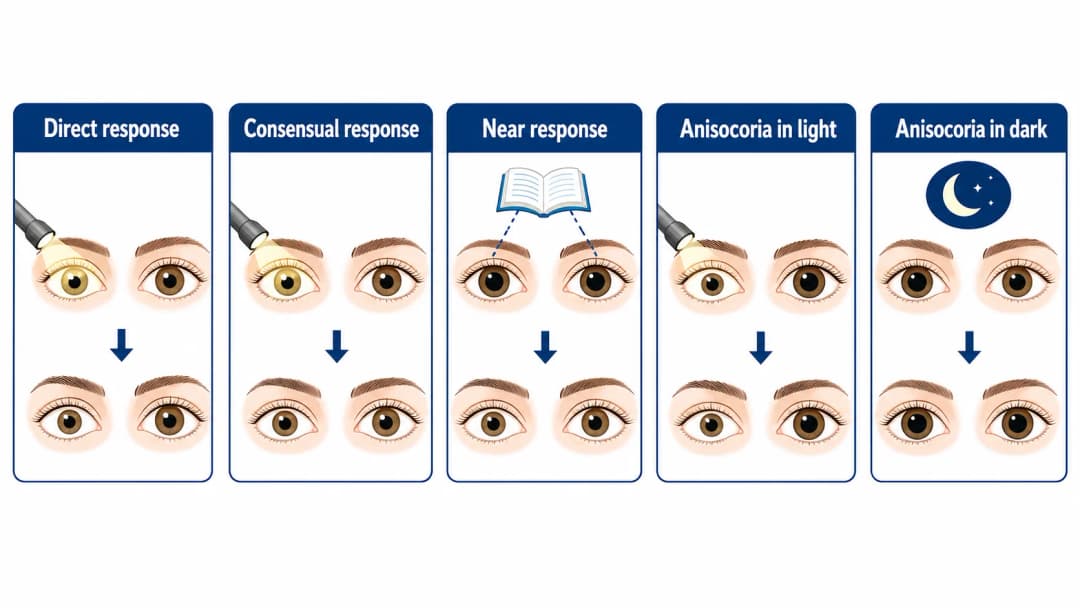
- Observes your pupils at rest - notes the size, shape, and symmetry of both pupils in dim and bright lighting
- Shines a light into one eye - watches both the direct response (that eye constricts) and the consensual response (the other eye constricts too)
- Repeats on the other eye - compares the speed and completeness of the response
- Performs the swinging flashlight test - alternates the light between eyes every 2-3 seconds, watching for a pupil that dilates instead of constricting when the light arrives (this is the hallmark of a relative afferent pupillary defect)
- Tests the near response - asks you to look at a distant target and then shift focus to your own finger or a small object held close; both pupils should constrict with near focus
- Records measurements - pupil size is noted in millimeters, and any differences between eyes (anisocoria) are documented in both light and dark conditions
The entire exam takes about 2-5 minutes and involves no contact with your eye.
What's Tested
Size and Shape
- Measured in millimeters, typically 2-8 mm depending on lighting
- Compared between the two eyes - a difference of more than 1 mm may be significant (anisocoria)
- Noted in both bright light and dim light, because some conditions cause the difference to change with lighting
Light Reaction
- Direct response - when light enters one eye, that eye's pupil constricts
- Consensual response - the opposite eye's pupil also constricts, because the signal crosses to both sides in the brainstem
- The speed, completeness, and symmetry of the response are all assessed
Near Response
- Pupils constrict when you shift focus to a near object (the "near triad" - convergence, accommodation, and pupil constriction)
- This pathway is different from the light reflex, which is why some conditions affect one but not the other
- A pupil that reacts poorly to light but well to near focus is called "light-near dissociation" - seen in Argyll Robertson pupils and other conditions
Swinging Flashlight Test
- The most important part of the neuro-ophthalmic pupil exam
- The light is alternated between the two eyes every 2-3 seconds
- In a healthy person, both pupils stay constricted regardless of which eye the light is in
- If one optic nerve is damaged, the pupil dilates when the light swings to that eye - this is a relative afferent pupillary defect (RAPD), also called a Marcus Gunn pupil
Key Findings
Relative Afferent Pupillary Defect (RAPD)
- Also called a Marcus Gunn pupil
- The pupil dilates (instead of constricting) when the light swings to the affected eye
- Indicates that the optic nerve on that side is transmitting less signal than the other - from conditions like optic neuritis, ischemic optic neuropathy, glaucoma, or compressive optic neuropathy
- An RAPD is one of the most important signs in neuro-ophthalmology and often prompts imaging (MRI) and further testing (OCT, visual field test)
Horner Syndrome
- Small pupil (miosis) on the affected side - more obvious in dim lighting
- Mild ptosis (drooping upper eyelid)
- Anhidrosis (reduced sweating on the affected side of the face) - may or may not be noticeable
- Caused by disruption of the sympathetic nerve pathway, which can occur in the brainstem, spinal cord, chest, neck, or along the carotid artery
- Depending on the suspected location, the workup may include MRI, CTA, or chest imaging to look for a cause (e.g., carotid dissection, Pancoast tumor)
Third Nerve Palsy
- Large, poorly reactive pupil on the affected side
- Often associated with ptosis and eye movement limitation (double vision)
- A dilated pupil with a third nerve palsy is taken very seriously - it can indicate compression by an aneurysm (posterior communicating artery), which is a neurosurgical emergency
- Urgent CTA or MRA is typically ordered the same day to evaluate
Adie's Tonic Pupil
- Large pupil with a poor or sluggish light reaction
- Slow, "tonic" constriction to near focus
- Usually a benign condition caused by damage to the ciliary ganglion (a nerve relay near the eye)
- Confirmed with pharmacologic testing (see below)
Pharmacologic Testing
When the cause of a pupil abnormality is uncertain, specialized eye drops can help pinpoint the diagnosis:
For Adie's Tonic Pupil
- Dilute pilocarpine (0.1%) is instilled in both eyes
- A normal pupil does not respond to this weak concentration, but a denervated Adie's pupil constricts because it has become hypersensitive to the drug
- Results are visible within 30-45 minutes
- The drops may cause temporary brow ache or dimming of vision
For Horner Syndrome
- Apraclonidine (0.5-1%) drops are placed in both eyes
- The Horner's pupil may dilate (reversal of anisocoria) while the normal pupil slightly constricts - this supports Horner syndrome, though timing and clinical context matter
- Alternatively, cocaine drops (4-10%) can be used - a Horner's pupil fails to dilate, while the normal pupil dilates
- Hydroxyamphetamine (1%) can be used in a separate visit to help localize whether the Horner's is preganglionic or postganglionic, which changes the workup
- Results from pharmacologic testing are typically visible within 30-60 minutes
When Pupil Findings Prompt Urgent Workup
Some pupil findings are reassuring and require no urgent action. Others demand same-day evaluation:
Call 911 now:
- A new dilated, poorly reactive pupil with ptosis and double vision, especially with severe sudden headache, vomiting, confusion, fainting, weakness, numbness, trouble speaking, or trouble walking
- New unequal pupils after head trauma or with a sudden "worst headache"
Go to the emergency department the same day:
- A dilated, poorly reactive pupil with ptosis and eye movement problems - third nerve palsy with pupil involvement needs urgent CTA or MRA to rule out aneurysm
- A new Horner syndrome with neck, face, or head pain needs imaging to evaluate for carotid artery dissection
- An RAPD with sudden vision loss needs urgent workup to evaluate the optic nerve and retina
Usually not urgent:
- Mild, stable anisocoria that has been present for years - often a normal variant (physiologic anisocoria), present in up to 20% of people
- Adie's tonic pupil - typically a benign condition managed with reassurance and, if needed, reading glasses to compensate for the accommodation deficit
- Known, stable RAPD from a previous optic nerve event that is already being monitored
Your doctor will explain which category your findings fall into and what, if anything, needs to be done next.
Frequently Asked Questions
Does the pupil exam hurt?
No. The exam involves shining a bright light into your eyes, which can be briefly uncomfortable or cause you to squint, but it is not painful. There is no contact with your eye during the basic exam. If pharmacologic drops are used, you may feel a mild sting for a few seconds.
Why are my pupils different sizes?
Mild pupil size differences (up to about 1 mm) are a normal variant called physiologic anisocoria, seen in roughly 20% of people. If the difference is new, larger, or associated with other symptoms like ptosis, double vision, or vision loss, your doctor will investigate further with the tests described above.
What is an APD or Marcus Gunn pupil?
An APD (afferent pupillary defect), also called a Marcus Gunn pupil, means one optic nerve is carrying less signal than the other. It is detected by the swinging flashlight test - the affected pupil dilates instead of constricting when the light swings to it. This is a key sign of optic nerve disease and does not mean the pupil itself is abnormal.
Should I be worried if my doctor found something abnormal?
Not necessarily. Many pupil findings, such as Adie's tonic pupil and physiologic anisocoria, are benign. Your doctor will explain the significance of your specific finding, whether further testing is needed, and what the next steps are. If the finding requires urgent evaluation, your doctor will arrange it promptly.
Should I bring old photos?
Yes, if one pupil has looked different for a long time. Driver's license photos, passport photos, family pictures, or phone selfies can help show whether anisocoria or a droopy lid is new. A longstanding stable difference is often less concerning than a new change with pain, double vision, or neurologic symptoms.
How long do the diagnostic eye drops last?
It depends on the drop used. Pilocarpine effects can last several hours, causing the pupil to be smaller and near vision slightly blurred. Apraclonidine effects typically wear off within a few hours. Your doctor will let you know what to expect and whether the drops might temporarily affect your vision.
Is it normal for one pupil to be slightly larger than the other?
Yes - up to 20% of people have a small, stable difference in pupil size (physiologic anisocoria) that is completely normal. The key distinction is whether the difference is new, changing, or accompanied by other symptoms. Old photos can sometimes help confirm whether a pupil asymmetry has been longstanding.
Medical Disclaimer: This information is for educational purposes only and does not replace professional medical advice.
Sources:
- American Academy of Ophthalmology. Relative Afferent Pupillary Defect.
- StatPearls. Cranial Nerve III Palsy. NCBI Bookshelf.
- Wilhelm H. Disorders of the pupil. Handb Clin Neurol. 2011;102:427-466.
- Thompson HS, Kardon RH. The Argyll Robertson pupil. J Neuroophthalmol. 2006;26(2):134-138.