

Horner Syndrome
A constellation of findings including a smaller pupil, droopy eyelid, and sometimes facial sweating changes, indicating a problem in the sympathetic nerve pathway.
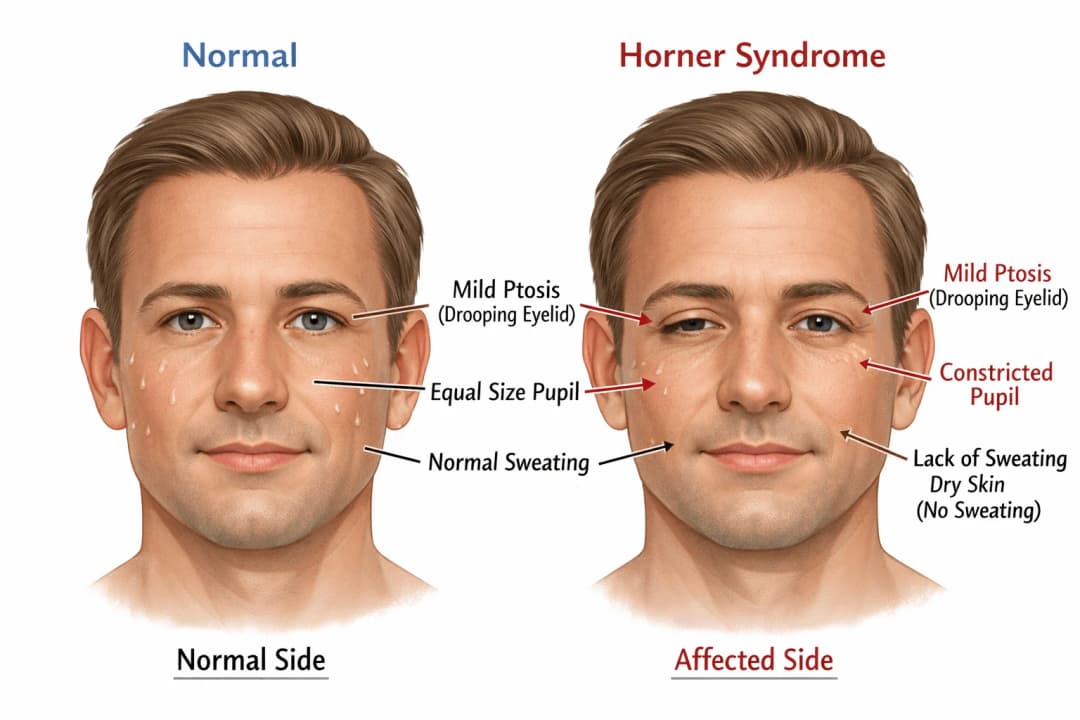
Horner syndrome is a combination of signs caused by damage to the sympathetic nerve pathway-the nerves that control pupil dilation, eyelid elevation, and facial sweating. The classic triad is a smaller pupil (miosis), mild droopy eyelid (ptosis), and reduced facial sweating (anhidrosis).
Key Takeaways
- Classic signs: smaller pupil, mild ptosis, sometimes decreased sweating
- Not a disease itself-it's a sign pointing to a problem somewhere along the sympathetic pathway
- Requires workup to find the underlying cause
- Causes range from benign to serious (including lung cancer, carotid dissection)
- Acute Horner syndrome especially with pain or neurological symptoms is urgent
Understanding the Sympathetic Pathway
The sympathetic nerves travel a long, three-part pathway:
- First-order (central): Brain to spinal cord (neck)
- Second-order: Spinal cord, over lung apex, to superior cervical ganglion
- Third-order: Along carotid artery, into skull, to eye
Damage anywhere along this pathway causes Horner syndrome. The location of damage determines what evaluation is needed.
Signs of Horner Syndrome
The Classic Triad
Miosis (smaller pupil)
- Affected pupil is smaller
- Difference more noticeable in dim lighting
- Pupil still reacts to light (just smaller)
Ptosis (droopy eyelid)
- Mild-usually only 1-2mm
- Affects upper lid (from Müller's muscle weakness)
- May also have "upside-down ptosis" (lower lid slightly elevated)
Anhidrosis (decreased sweating)
- May notice decreased sweating on affected side of face
- Depends on which part of pathway is affected
Other Features
- Dilation lag-pupil dilates slowly in darkness
- Apparent enophthalmos-eye appears sunken (due to ptosis)
- Facial flushing on opposite side (affected side doesn't flush)
- In infants: heterochromia (different colored iris)
Causes by Location
First-Order (Central)
- Stroke (brainstem)-may have double vision, nystagmus
- Demyelination (multiple sclerosis)-may have optic neuritis
- Tumor
- Spinal cord lesion
- Syringomyelia
Second-Order
- Lung tumor (Pancoast tumor)-important cause
- Trauma
- Thyroid surgery
- Central line placement
- Neuroblastoma (in children)
- Lymphadenopathy
Third-Order
- Carotid artery dissection-important, potentially dangerous, may cause headache
- Cavernous sinus lesions-may have third nerve palsy, sixth nerve palsy
- Cluster headache (temporary Horner during attacks)-with severe eye pain
- Middle ear infection
- Nasopharyngeal cancer
Warning Signs
Seek urgent evaluation for Horner syndrome with:
- Pain (neck, face, or headache)-may indicate carotid dissection
- Recent trauma
- New neurological symptoms
- Arm/hand weakness
- New onset in adults
Carotid dissection can cause stroke and requires immediate treatment.
Diagnosis
Confirming Horner Syndrome
Pharmacologic testing with apraclonidine (or cocaine)
- Drops put in both eyes
- In Horner syndrome: affected pupil dilates more (reversal of anisocoria)
- Supports diagnosis in the right clinical context
Localizing the Lesion
Hydroxyamphetamine test
- Helps distinguish third-order from first/second-order
- Third-order: affected pupil doesn't dilate
- First/second-order: affected pupil does dilate
- Guides imaging
Imaging
Depends on suspected location:
- First-order: MRI brain and cervical spine, visual field testing if visual symptoms
- Second-order: CT chest (looking for Pancoast tumor), MRI spine
- Third-order: MRA/CTA neck (looking for carotid dissection), MRI skull base
General Workup
- Complete neurological examination
- Carotid imaging (especially if acute, painful, or no clear cause)
- Chest imaging in adults (rule out lung tumor)
Treatment
Horner syndrome itself doesn't need treatment-it's the underlying cause that needs addressing:
For Carotid Dissection
- Blood thinners (anticoagulation or antiplatelet)
- Sometimes intervention
- Stroke prevention is priority
For Tumor
- Treatment of the cancer
- Surgery, radiation, chemotherapy as appropriate
For Benign Causes
- May need no specific treatment
- Ptosis usually mild and not visually significant
Prognosis
- Depends entirely on underlying cause
- Horner signs may persist even after treating cause
- The mild ptosis and pupil difference rarely cause functional problems
- Finding the cause is more important than treating the signs
Frequently Asked Questions
Is Horner syndrome dangerous?
Horner syndrome itself isn't dangerous-the danger is in what's causing it. Some causes (like carotid dissection or lung cancer) are serious and need urgent treatment.
Will my pupil and eyelid go back to normal?
Sometimes, depending on the cause and how much nerve damage occurred. Even if permanent, the changes are usually mild and don't affect vision or function significantly.
Why is carotid dissection so important?
Carotid dissection (a tear in the wall of the carotid artery) can cause stroke if not treated. Horner syndrome with neck pain or headache needs urgent evaluation to rule this out.
Can Horner syndrome be present from birth?
Yes. Congenital Horner syndrome can occur from birth trauma or other causes. It may cause heterochromia (different colored irises) and is usually benign.
Do I need imaging if my Horner syndrome has been present for years?
If it's truly longstanding and previous workup was negative, extensive repeat imaging may not be needed. However, if there's any doubt about duration or if new symptoms develop, evaluation is warranted.
References
Medical Disclaimer: This information is for educational purposes only and does not replace professional medical advice, diagnosis, or treatment. If you have concerns about Horner syndrome or any symptoms, please consult a qualified healthcare provider.
Sources:
- Martin TJ. Horner syndrome: a clinical review. ACS Chem Neurosci. 2018;9(2):177-186.
- MedlinePlus. Horner Syndrome.
- Walton KA, Buono LM. Horner syndrome. Curr Opin Ophthalmol. 2003;14(6):357-363.
- American Academy of Ophthalmology EyeWiki. Horner Syndrome.