

Entropion
A condition where the eyelid turns inward, causing eyelashes to rub against the cornea. Learn about types, corneal damage risk, and surgical repair options.
Entropion is a condition in which the eyelid (usually the lower lid) turns inward, causing the eyelashes and skin to rub against the surface of the eye. This constant friction can cause significant discomfort and, if untreated, can damage the cornea through abrasion, scarring, and potential infection.
Key Takeaways
- The eyelid turns inward, causing lashes to rub against the eye
- Most common cause is aging (involutional entropion) - weakened eyelid muscles and tissues
- Lash-cornea contact causes pain, redness, tearing, and foreign body sensation
- Can damage the cornea - corneal abrasion, scarring, infection
- Eyelid surgery is the definitive treatment
- Temporary measures (taping, botulinum toxin) can protect the eye while awaiting surgery
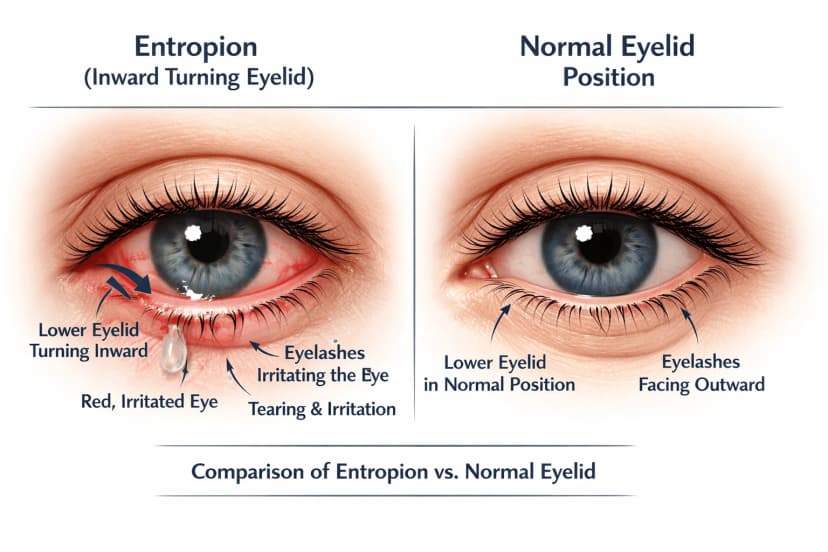
Entropion vs. Ectropion
| Feature | Entropion | Ectropion |
|---|---|---|
| Lid position | Turns inward | Turns outward |
| Lashes | Rub against the eye | Point away from the eye |
| Main problem | Corneal abrasion and scarring | Corneal exposure and dryness |
| Primary symptom | Foreign body sensation, pain | Tearing (epiphora) |
| Both common in | Elderly patients | Elderly patients |
Types of Entropion
Involutional (Most Common)
- Caused by age-related changes: weakening of the lower eyelid retractors, orbicularis muscle override, and horizontal lid laxity
- The lid intermittently or constantly rolls inward
- Most common in patients over 60
- Worsens with squeezing or rubbing the eyes
Cicatricial
- Caused by scarring of the inner eyelid surface (tarsal conjunctiva)
- Scar tissue contracts and pulls the lid margin inward
- Causes include: trachoma (leading cause worldwide), chemical burns, ocular cicatricial pemphigoid, Stevens-Johnson syndrome, chronic blepharitis
- Can affect the upper or lower lid
- May be very difficult to treat
Spastic (Acute)
- Sudden onset, often triggered by:
- Eye irritation or inflammation
- Recent eye surgery
- Eye rubbing
- Blepharospasm
- The orbicularis muscle spasms and rolls the lid inward
- May resolve when the underlying irritation is treated
Congenital
- Present at birth (rare)
- Often affects the lower lid
- May be associated with a prominent lower lid fold of skin (epiblepharon), which is more common in Asian children and usually resolves with growth
Symptoms
- Foreign body sensation - feeling like something is in the eye (from lashes rubbing)
- Pain and discomfort - from chronic corneal irritation
- Redness of the eye
- Excessive tearing
- Mucous discharge
- Light sensitivity
- Blurred vision - from corneal damage or excessive tearing
- Crusting on the eyelid
- Symptoms worsen with blinking or squeezing
Corneal Complications
Untreated entropion can cause serious corneal damage:
- Corneal abrasion - lashes scratch the corneal surface
- Corneal scarring - from repeated abrasions
- Corneal thinning and ulceration
- Secondary infection - damaged cornea is vulnerable to bacterial keratitis
- Permanent vision loss if scarring affects the central cornea
If you have entropion with eye pain, redness, or vision changes, seek prompt evaluation.
Causes and Risk Factors
- Aging - the most common cause; weakening of eyelid muscles and supporting tissues
- Eye surgery - can trigger spastic entropion
- Eye infection or inflammation - trachoma (the leading infectious cause of blindness worldwide), ocular pemphigoid
- Chemical or thermal burns - cause cicatricial (scarring) entropion
- Chronic eye rubbing
- Blepharospasm - involuntary eyelid squeezing
Diagnosis
- Clinical examination - the inturned lid and misdirected lashes are visible on inspection
- Provocation - asking the patient to squeeze their eyes shut may reveal intermittent entropion
- Corneal examination - slit-lamp exam with fluorescein staining reveals corneal abrasions or damage from lash contact
- Eyelid assessment - checking for laxity, retractor weakness, and scarring
- Assessment of underlying cause - especially if cicatricial entropion is suspected
Treatment
Temporary Measures
While awaiting surgery or in patients unfit for surgery:
- Taping - the lower lid is taped downward and outward to pull lashes away from the eye
- Lubricating drops and ointment - protect the corneal surface
- Botulinum toxin injection - into the orbicularis muscle; temporarily weakens the muscle that is rolling the lid inward; lasts 2-3 months
- Temporary sutures (Quickert sutures) - everting sutures placed through the lid to rotate it outward; simple office procedure; lasts weeks to months
- Epilation - removing individual lashes that are touching the cornea (temporary, as lashes regrow)
Surgical Repair (Definitive Treatment)
Eyelid surgery is the standard treatment:
For involutional entropion:
- Lower lid retractor reinsertion with lateral tarsal strip - the most common approach
- Reattaches the weakened lower lid retractors
- Tightens the lid horizontally
- Outpatient procedure under local anesthesia
- High success rate (>90%)
For cicatricial entropion:
- Tarsal fracture or tarsal rotation - internal incision through the scarred tarsal plate to rotate the lid margin outward
- Mucous membrane grafting - replaces scarred conjunctival tissue
- More complex and may have higher recurrence rates
For spastic entropion:
- Treat the underlying cause (inflammation, irritation)
- If persistent, surgical repair similar to involutional entropion
Recovery After Surgery
- Mild bruising and swelling for 1-2 weeks
- Antibiotic ointment for several days
- Sutures removed or dissolve within 1-2 weeks
- Most patients notice immediate relief from lash rubbing
- Return to normal activities within about 1 week
When to See a Doctor
See an eye doctor if:
- You feel eyelashes rubbing against your eye
- Your eye is persistently red, tearing, or irritated
- You notice your lower eyelid turning inward
- Symptoms worsen when you blink or squeeze your eyes
Seek urgent care if:
- Significant eye pain with vision changes (possible corneal ulcer)
- White spot on the eye surface (corneal infection)
- Rapid worsening of symptoms
Frequently Asked Questions
How effective is entropion surgery?
Involutional entropion surgery has a success rate of over 90%. Cicatricial entropion surgery is more complex and may have a higher recurrence rate depending on the underlying cause.
Is entropion the same as trichiasis?
No, though they are related. Entropion is the inward turning of the entire lid margin, while trichiasis is misdirected lashes rubbing against the eye without the lid being turned inward. Entropion causes secondary trichiasis, but trichiasis can also occur independently.
Can entropion be treated without surgery?
Temporary measures (taping, botulinum toxin, everting sutures) can provide relief but are not permanent solutions. Surgery is the definitive treatment for persistent entropion.
What's the difference between entropion and ectropion?
Entropion is the eyelid turning inward (lashes rub the eye), while ectropion is the eyelid turning outward (exposing the inner lid surface). Both are common in elderly patients, and both can cause corneal problems, though by different mechanisms.
Will my entropion come back after surgery?
Recurrence is possible but uncommon with modern surgical techniques. The surgery is designed to address the underlying structural weakness causing the entropion.
References
Medical Disclaimer: This information is for educational purposes only and does not replace professional medical advice, diagnosis, or treatment. If you have symptoms of entropion, please consult a qualified healthcare provider.
Sources:
- StatPearls. Entropion. NCBI Bookshelf.
- Vallabhanath P, Carter SR. Ectropion and entropion. Curr Opin Ophthalmol. 2000;11(5):345-351.
- Scheepers MA, et al. Randomized controlled trial comparing lateral tarsal strip with the Quickert procedure for involutional entropion repair. Ophthalmology. 2010;117(2):352-357.
- Collin JR. A Manual of Systematic Eyelid Surgery. 3rd ed. Butterworth-Heinemann; 2006.
- American Academy of Ophthalmology EyeWiki. Entropion.