

Epiretinal Membrane
A thin layer of scar tissue on the macula surface causing distorted or blurred vision. Learn about causes, when surgery is needed, and what to expect.
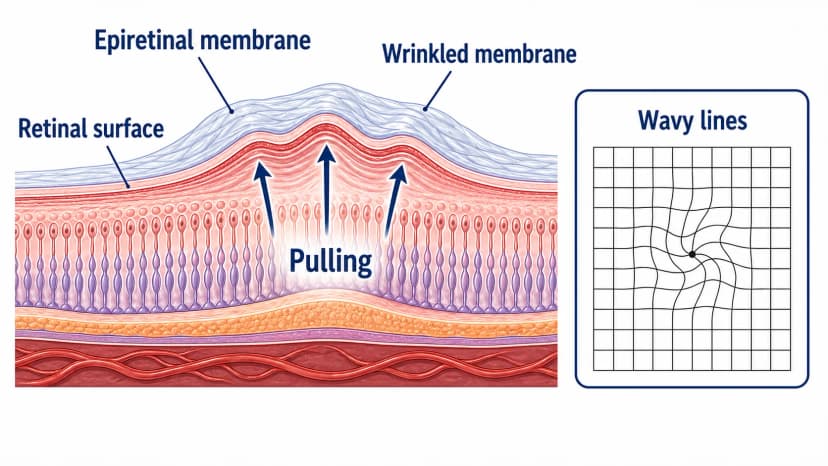
An epiretinal membrane (ERM), also called a macular pucker or cellophane maculopathy, is a thin layer of fibrous scar tissue that forms on the surface of the macula. It can contract and wrinkle the retina underneath, causing distorted or blurred central vision. Many ERMs are mild and require no treatment, but significant cases may benefit from surgical removal.
Key Takeaways
- Thin scar tissue on the macula surface that can wrinkle the retina
- Very common - found in up to 20% of adults over age 60
- Most are mild and asymptomatic, requiring only monitoring
- Causes metamorphopsia (distortion) and blurred central vision when significant
- OCT scan is the primary diagnostic tool
- Vitrectomy with membrane peel is performed for visually significant cases
- No drops or medications can treat an epiretinal membrane
Overview
Epiretinal membranes are one of the most common macular conditions. They develop when cells migrate onto the macular surface and form a thin, transparent-to-translucent membrane. In mild cases, the membrane sits quietly on the surface without affecting vision. In more significant cases, the membrane contracts, wrinkling the underlying retina and distorting vision.
Symptoms
Mild ERM (Often Asymptomatic)
Many people with an ERM have no symptoms at all and the membrane is found incidentally during a routine eye exam.
Significant ERM
- Distorted vision (metamorphopsia) - straight lines appear wavy or bent
- Blurred central vision
- Difficulty reading fine print
- Double vision in one eye (monocular diplopia)
- Objects may appear larger (macropsia) or smaller (micropsia) than they are
- Decreased contrast
Use the Amsler grid to monitor for changes in distortion at home. Cover one eye and look at the grid's center dot. Wavy, distorted, or missing lines may indicate worsening of the membrane and should be reported to your eye doctor.
Causes and Risk Factors
How ERMs Form
Most epiretinal membranes are idiopathic (no specific cause), developing from:
- Posterior vitreous detachment (PVD) - as the vitreous gel separates from the retina, it can leave behind cells or trigger cell migration onto the macular surface
- These cells proliferate and form a membrane
- The membrane may contract, pulling on and wrinkling the retina
Secondary Causes
ERMs can also develop after:
- Retinal tears or detachment (and their repair)
- Eye surgery (cataract surgery, retinal surgery)
- Eye inflammation (uveitis)
- Retinal vascular diseases (diabetic retinopathy, retinal vein occlusion)
- Eye trauma
Risk Factors
- Age over 50 - prevalence increases with age
- Previous PVD
- History of eye surgery or retinal disease
- Diabetes
Diagnosis
- Optical coherence tomography (OCT) - the essential test; shows the membrane on the macular surface, any retinal wrinkling or thickening, and helps track changes over time
- Amsler grid - documents distortion
- Visual acuity testing - may be mildly reduced or normal
- Dilated fundus exam - membrane may be visible as a glistening, cellophane-like sheen on the macula
Treatment
Observation (Most Cases)
The majority of epiretinal membranes are mild and stable:
- Regular monitoring with OCT every 6-12 months
- No treatment needed if vision is good and stable
- Many ERMs remain stable for years without significant progression
Surgery: Vitrectomy with Membrane Peel
Indicated when the ERM significantly affects vision or quality of life:
- Vitrectomy - removal of the vitreous gel
- Membrane peeling - the surgeon carefully peels the membrane from the retinal surface using micro-forceps
- ILM peeling - the internal limiting membrane may also be removed to reduce recurrence risk
- Outpatient procedure under local anesthesia
- No gas bubble or face-down positioning required in most cases (unlike macular hole surgery)
Success rate:
- Vision improves in about 80-90% of cases
- Distortion typically improves significantly
- Improvement is gradual, often continuing for 3-6 months or longer
When to Consider Surgery
- Vision impaired enough to affect daily activities (reading, driving)
- Significant distortion that bothers you
- Progressive worsening on OCT despite observation
- Generally, earlier surgery (before the macula is severely thickened) yields better outcomes
When to See a Doctor
See your eye doctor if you notice:
- New distortion of straight lines (doorframes, text)
- Blurred central vision in one eye
- Difficulty reading that isn't corrected by new glasses
- Changes on your Amsler grid home monitoring
Frequently Asked Questions
Will my epiretinal membrane get worse?
Many ERMs remain stable for years and never require treatment. Some do slowly progress. Regular OCT monitoring helps detect changes early so surgery can be planned if needed.
Can an epiretinal membrane go away on its own?
Rarely, an ERM can spontaneously separate from the retina, particularly after a posterior vitreous detachment. However, this is uncommon, and most persistent membranes that affect vision will require surgery if improvement is desired.
How long does recovery from membrane peel surgery take?
Most people return to normal activities within 1-2 weeks. Vision improvement is gradual, with most improvement occurring over 3-6 months. Some patients continue to notice improvement for up to a year.
Will the membrane come back after surgery?
Recurrence is uncommon, occurring in about 5-10% of cases. Peeling the internal limiting membrane (ILM) along with the epiretinal membrane further reduces recurrence risk.
Is epiretinal membrane the same as macular degeneration?
No. An epiretinal membrane is a membrane growing on top of the macula, while macular degeneration is degeneration of the retinal tissue itself. They are different conditions with different treatments.
References
Medical Disclaimer: This information is for educational purposes only and does not replace professional medical advice, diagnosis, or treatment. If you have concerns about your vision, please consult a qualified healthcare provider.
Sources:
- StatPearls. Epiretinal Membrane. NCBI Bookshelf.
- Bu SC, et al. Idiopathic epiretinal membrane. Retina. 2014;34(12):2317-2335.
- Stevenson W, et al. Epiretinal membrane: optical coherence tomography-based diagnosis and classification. Clin Ophthalmol. 2016;10:527-534.
- Sandali O, et al. Epiretinal membrane recurrence: incidence, risk factors, and clinical characteristics. Retina. 2022;42(4):770-777.
- American Academy of Ophthalmology EyeWiki. Epiretinal Membrane.