

Ptosis (Droopy Eyelid)
Drooping of the upper eyelid, which can be present from birth or develop later in life. Causes range from age-related changes to serious neurological conditions.
Ptosis is drooping of the upper eyelid below its normal position. It can affect one or both eyes and ranges from barely noticeable to severe enough to block vision. The causes vary widely, from normal aging to serious neurological conditions, making proper evaluation important.
Key Takeaways
- Upper eyelid droops below normal position
- Many causes-from aging to neurological disease
- May be present from birth (congenital) or develop later (acquired)
- Important to determine cause-some are serious
- Treatment depends on cause-observation, surgery, or treating underlying condition
Understanding Ptosis
The upper eyelid is lifted by the levator palpebrae superioris muscle, controlled by the third cranial nerve, with assistance from Müller's muscle (controlled by sympathetic nerves). Ptosis occurs when these muscles or their nerve supply are weakened or damaged.
Types of Ptosis
By Age of Onset
Congenital (from birth):
- Present at birth or early infancy
- Usually due to levator muscle underdevelopment
- Often stable throughout life
Acquired (develops later):
- Multiple possible causes
- May indicate underlying condition
By Cause
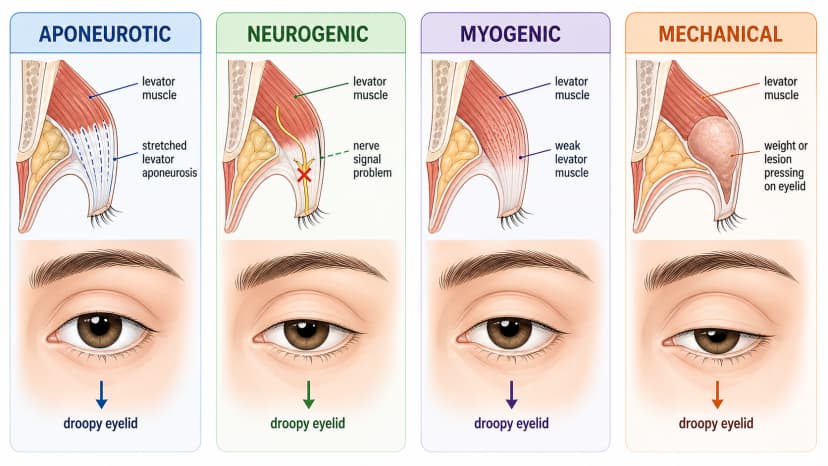
Aponeurotic (most common in adults)
- Age-related stretching of muscle tendon
- Contact lens wear
- Post-eye surgery
Neurogenic
- Third nerve palsy
- Horner syndrome
- Myasthenia gravis
Myogenic (muscle disease)
- CPEO
- Muscular dystrophies
- Myasthenia gravis
Mechanical
- Heavy eyelid (tumor, swelling)
- Scarring pulling lid down
Symptoms
Visual Symptoms
- Drooping eyelid blocking vision
- Need to lift chin to see under lid
- Raising eyebrows to help open eyes
- Tired appearance
- May cover pupil (severe ptosis)
Associated Symptoms (Depend on Cause)
With third nerve palsy:
- Eye turned outward and down
- Double vision
- Dilated pupil
With Horner syndrome:
- Small pupil on same side
- Reduced sweating on face
With myasthenia:
- Fatigue-ptosis worsens through the day
- Variable symptoms
- May affect both eyes differently
Red Flags
Seek urgent evaluation if ptosis is accompanied by:
- Dilated pupil and double vision (possible aneurysm)
- Sudden severe headache
- New double vision
- Progressive worsening
- Other neurological symptoms
Diagnosis
Clinical Examination
- Measure lid height (margin reflex distance)
- Check levator function
- Pupil examination
- Eye movement testing
- Fatigue testing (for myasthenia)
- Check for variability
Key Distinctions
| Type | Key Features |
|---|---|
| Aponeurotic | High lid crease, good levator function, elderly |
| Third nerve | Ptosis + eye turned out/down, ± pupil dilation |
| Horner | Ptosis + small pupil same side |
| Myasthenia | Variable, fatigable, may be bilateral |
| Congenital | Present since birth, poor levator function |
Testing
For myasthenia:
- Acetylcholine receptor antibodies
- Single-fiber EMG
- Ice pack test
For Horner syndrome:
- Pharmacologic testing (apraclonidine, cocaine)
- Imaging neck and chest
For third nerve palsy:
- MRI/MRA brain
- CTA if aneurysm suspected
Treatment
Treat Underlying Cause First
- Myasthenia: immunotherapy
- Third nerve palsy from aneurysm: urgent neurosurgical evaluation
- Horner: find and treat cause
Surgery (for Appropriate Cases)
Levator advancement/resection
- For aponeurotic ptosis
- Tightens the lifting muscle
- Good results if levator function adequate
Frontalis sling
- For poor levator function
- Connects lid to forehead muscle
- Uses brow elevation to lift lid
Müller's muscle resection
- For mild ptosis
- Horner syndrome (if cause treated/stable)
Non-Surgical Options
- Ptosis crutches on glasses
- Eyelid tape
- Observation (if mild)
Special Considerations
Children
- Congenital ptosis may need surgery to prevent amblyopia
- Timing of surgery important
- Monitor for vision development
Variable Ptosis
If ptosis varies during the day or with activity, consider myasthenia gravis-do not proceed with surgery until this is ruled out.
Frequently Asked Questions
Is my droopy eyelid dangerous?
The ptosis itself isn't dangerous, but the underlying cause might be. That's why evaluation is important-especially if the ptosis came on suddenly, is accompanied by other symptoms, or is progressing.
Will I need surgery?
Not necessarily. If the ptosis is mild and not affecting vision, observation may be fine. If an underlying condition is causing it, treating that condition may resolve the ptosis. Surgery is an option when the lid blocks vision or for cosmetic improvement.
Why is one eyelid droopy?
Unilateral (one-sided) ptosis has many causes. The most common in adults is age-related weakening of the lid's lifting mechanism. However, it's important to rule out neurological causes like third nerve palsy or Horner syndrome.
Can ptosis come back after surgery?
Yes, ptosis can recur after surgery, especially over many years. However, modern surgical techniques generally provide good, lasting results. If ptosis recurs, revision surgery may be possible.
My ptosis is worse at night-is that significant?
Ptosis that worsens with fatigue, especially late in the day, is a hallmark of myasthenia gravis. This should be tested for before considering surgery.
References
Medical Disclaimer: This information is for educational purposes only and does not replace professional medical advice, diagnosis, or treatment. If you have concerns about droopy eyelids or any symptoms, please consult a qualified healthcare provider.
Sources:
- Finsterer J. Ptosis: causes, presentation, and management. Aesthetic Plast Surg. 2003;27(3):193-204.
- Anderson RL, et al. Classification and treatment of ptosis. Ophthalmology. 1980;87(7):697-710.
- American Academy of Ophthalmology. Ptosis.
- American Academy of Ophthalmology. What Is Ptosis?.