

Ice Test for Myasthenia Gravis
A simple bedside test using ice on the eyelid to help diagnose myasthenia gravis.
The ice test is a simple, non-invasive bedside test that can help diagnose myasthenia gravis in patients with ptosis (droopy eyelid). By applying cold to the eyelid, the test temporarily improves myasthenic weakness, providing a rapid and cost-free clue to the diagnosis.
Key Takeaways
- Simple bedside test for myasthenia gravis-no equipment needed beyond ice
- Ice pack on closed eyelid for 2 minutes improves myasthenic ptosis
- High sensitivity (80-90%) for ocular myasthenia
- Not definitive-a positive test suggests myasthenia but needs clinical correlation and additional testing
- Very low risk when done properly - keep ice wrapped and do not press hard on the eye
- Useful when ptosis is present-does not work for double vision alone
Why the Ice Test Works
Mechanism
In myasthenia gravis, antibodies block acetylcholine receptors at the neuromuscular junction, preventing normal muscle activation. When ice is applied:
- Cold temperature reduces the activity of acetylcholinesterase (the enzyme that breaks down acetylcholine)
- More acetylcholine accumulates at the neuromuscular junction
- This overcomes some of the receptor blockade
- Muscle function temporarily improves
This effect is specific to myasthenic weakness. Other causes of ptosis (such as third nerve palsy or Horner syndrome) do not improve with cooling.
Why It's Specific
- Cold affects the enzyme that degrades acetylcholine
- It doesn't strengthen normal muscles
- It doesn't fix nerve problems (like sixth nerve palsy or fourth nerve palsy)
- Only helps when the problem is at the neuromuscular junction
When to Use the Ice Test
Indications
- Ptosis (droopy eyelid) of unknown cause
- Suspected myasthenia gravis
- Ptosis that varies during the day (worse with fatigue)
- Ptosis associated with fatigable double vision
- When rapid bedside assessment is needed
- When serology results are pending
Not Useful For
- Double vision without ptosis (ice doesn't help eye alignment)
- Known non-myasthenic ptosis
- Ruling out myasthenia completely (negative test doesn't exclude it)
How the Test Is Done
Materials Needed
- Ice pack, ice in a glove, or ice wrapped in a cloth
- Ruler or ptosis measurements (for before/after comparison)
- Timer
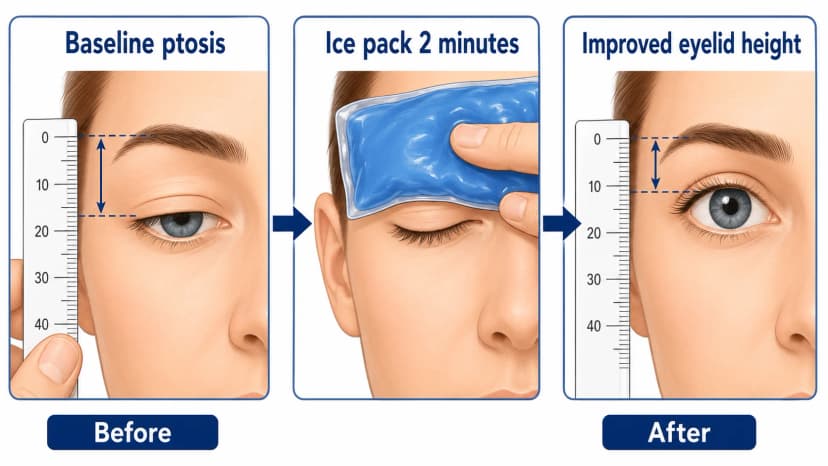
Procedure
-
Measure baseline ptosis
- Measure margin-reflex distance (MRD1): distance from upper lid margin to corneal light reflex
- Or simply note the width of the palpebral fissure
- Document which lid(s) are droopy and by how much
-
Apply cold
- Place ice pack (or ice in surgical glove) on the closed eyelid
- Keep ice wrapped in cloth or a glove; do not put bare ice or a chemical cold pack directly on skin or the eye
- Apply gentle pressure to ensure contact
- Hold for 2 minutes (some protocols use up to 5 minutes)
- Patient should keep eye closed during application
Stop the test if cold becomes painful, the skin burns or blanches, or pressure on the eye is uncomfortable. The goal is brief cooling of the closed eyelid, not freezing or pressing on the eyeball.
- Remove ice immediately and measure
- Remove the ice pack
- Have patient open eyes immediately
- Measure ptosis again right away (effect is temporary)
- Compare to baseline
What to Look For
Positive test:
- Improvement of ≥2 mm in eyelid position is typically considered positive
- The lid opens wider, showing more of the eye
- Patient may notice they can see better out of that eye
Negative test:
- No improvement or <2mm change
- Lid position unchanged after ice application
Interpreting Results
Positive Ice Test
Suggests myasthenia gravis-but confirmatory testing is needed:
- Acetylcholine receptor (AChR) antibody blood test
- MuSK antibody test (if AChR negative)
- LRP4 antibody test (if both negative)
- Repetitive nerve stimulation (EMG study)
- Single fiber EMG (most sensitive)
- CT chest to evaluate for thymoma
Negative Ice Test
Does not rule out myasthenia:
- Sensitivity is ~80-90%, not 100%
- Some patients with myasthenia will have a negative ice test
- Other diagnostic tests should still be pursued if clinical suspicion is high
False Positives
Rare, but possible if:
- Ptosis has other causes that coincidentally improve
- Measurement error
- Patient cooperation issues
False Negatives
May occur if:
- Very severe myasthenia (poor baseline function)
- Myasthenia with predominant diplopia rather than ptosis
- Ice not applied long enough or with poor contact
- Ptosis from non-myasthenic cause
Test Performance
Sensitivity and Specificity
| Study | Sensitivity | Specificity |
|---|---|---|
| Pooled data | 80-90% | 95-100% |
- High specificity: If positive, likely myasthenia
- Moderate sensitivity: Negative test doesn't exclude myasthenia
Advantages
- Zero cost-just need ice
- Very low risk when the ice is wrapped and pressure is gentle
- Immediate results
- Can be done anywhere-bedside, office, even at home as a screening tool
- No special equipment needed
- High specificity (few false positives)
Limitations
- Only works for ptosis (not double vision alone)
- Not 100% sensitive (negative doesn't exclude myasthenia)
- Requires measurable ptosis at time of test
- Effect is temporary-must measure immediately
- Results can vary with technique
Differential Diagnosis of Ptosis
When considering the ice test, remember other causes of ptosis:
| Condition | Ice Test | Other Features |
|---|---|---|
| Myasthenia gravis | Positive | Fatigable, variable, diplopia |
| Third nerve palsy | Negative | Pupil may be involved, eye turned out/down |
| Horner syndrome | Negative | Mild ptosis, small pupil, anhidrosis |
| Aponeurotic ptosis (aging) | Negative | High lid crease, common in elderly |
| Congenital ptosis | Negative | Present from birth, lid lag |
| Chronic progressive external ophthalmoplegia | Negative | Bilateral, progressive, limited eye movements |
What Happens After a Positive Ice Test
Support the Diagnosis
-
Blood tests
- AChR binding antibodies (positive in ~85% of generalized MG, ~50% of ocular MG)
- MuSK antibodies (if AChR negative)
- LRP4 antibodies (emerging)
-
Electrophysiology (if serology negative)
- Repetitive nerve stimulation
- Single fiber EMG (most sensitive)
-
Imaging
Begin Treatment Discussion
If myasthenia confirmed:
- Pyridostigmine (cholinesterase inhibitor)
- Immunosuppression considerations
- Thymectomy evaluation
- Monitoring for generalization (spread beyond eyes)
Frequently Asked Questions
Does the ice test hurt?
No. It's just cold. You may feel mild discomfort from the cold temperature, but it's not painful.
How long does the improvement last?
The effect is temporary-typically only a few minutes. That's why measurements must be taken immediately after removing the ice.
Can I do this test at home?
You can try it as a preliminary observation if you use wrapped ice gently on a closed eyelid for about 2 minutes. Do not use bare ice, do not press on the eye, and do not repeat prolonged cooling. If your eyelid opens better afterward, mention it to your doctor; the home test is not a diagnosis and should not delay formal evaluation.
If my ice test is positive, do I definitely have myasthenia?
A positive ice test strongly suggests myasthenia gravis, but blood tests and sometimes EMG studies are needed to support or confirm the diagnosis in context.
Why didn't my doctor do more testing if my ice test was positive?
The ice test is a screening tool. Your doctor likely ordered blood tests for myasthenia antibodies and possibly other studies to support or confirm the diagnosis before starting treatment.
Can the ice test help with double vision?
The ice test is designed for ptosis (droopy eyelid). It doesn't reliably improve eye alignment or double vision in myasthenia, so it's less useful when diplopia is the main symptom.
My ptosis varies throughout the day-when should I be tested?
Ideally when your ptosis is present and noticeable. If your eyelid is not droopy at the time of testing, there's nothing to measure improvement against.
References
Medical Disclaimer: This information is for educational purposes only and does not replace professional medical advice, diagnosis, or treatment.
Sources:
- Kubis KC, et al. The ice test versus the rest test in myasthenia gravis. Ophthalmology. 2000;107(11):1995-1998.
- Benatar M, Kaminski HJ. Evidence report: The medical treatment of ocular myasthenia. Neurology. 2007;68(24):2144-2149.
- StatPearls. Myasthenia Gravis. NCBI Bookshelf.
- North American Neuro-Ophthalmology Society. Myasthenia Gravis.
- Sethi KD, et al. Ice pack test for myasthenia gravis. Neurology. 1987;37(8):1383-1385.
- Kearsey C, et al. The use of the ice pack test in myasthenia gravis. JRSM Short Rep. 2010;1(1):14.