

Posterior Subcapsular Cataract (PSC)
A cataract at the back of the lens causing reading difficulty and glare, often progressing faster than other types. Common with steroid use and diabetes.
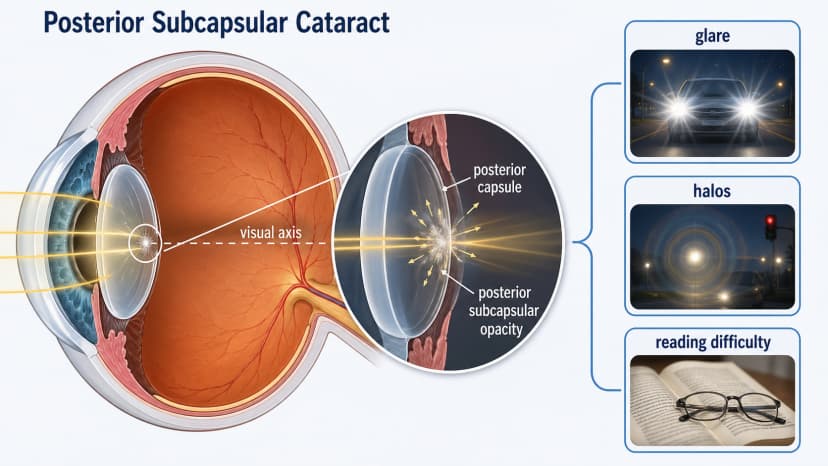
A posterior subcapsular cataract (PSC) develops at the back surface of the lens, just in front of the lens capsule. Unlike nuclear cataracts, which mainly affect distance vision, PSCs cause early difficulty with reading and significant glare. They often progress faster than other cataract types and are associated with steroid use, diabetes, and younger age of onset.
Key Takeaways
- Located at the back of the lens-directly in the visual pathway
- Causes reading difficulty early-affects near vision prominently
- Significant glare in bright light
- Faster progression than other cataract types
- Associations: steroid use, diabetes, trauma, radiation, uveitis
- May occur in younger patients (unlike most age-related cataracts)
What Is a Posterior Subcapsular Cataract?
Location and Structure
- Forms on the back (posterior) surface of the lens
- Just beneath the lens capsule
- Located centrally (in the visual axis)
- Appears as a plaque or granular opacity
Why PSCs Cause More Symptoms
Because PSCs are central and located where light converges, they cause disproportionate symptoms for their size.
Symptoms
Early Reading Difficulty
PSCs affect near vision early.
Unlike nuclear cataracts that blur distance vision first, PSCs often cause reading difficulty as an early symptom. When reading, the pupil constricts, directing light through the central opacity.
Glare
- Significant glare in bright light
- Difficulty with oncoming headlights at night
- Halos around lights
Other Symptoms
- Monocular double vision or ghosting
- Reduced contrast sensitivity
- Faster progression than other types
Causes and Associations
Steroid Use
Steroid medications are strongly associated with PSC formation.
Both systemic and topical steroids can cause PSCs with prolonged use. Risk increases with dose and duration.
Other Associations
- Diabetes-higher risk of PSC
- Uveitis (chronic eye inflammation)
- Trauma to the eye
- Radiation
- High myopia
- Retinitis pigmentosa
Diagnosis
Slit Lamp Examination
- Central, plaque-like opacity
- Located just in front of posterior capsule
- May have granular or vacuolar appearance
Glare Testing
- Often shows more impairment than standard acuity
- Helps justify surgery when standard acuity is good
Treatment
Cataract Surgery
Surgery is often needed earlier for PSC than other cataract types.
Due to central location and faster progression, PSCs frequently cause significant symptoms at smaller sizes. Patients often need surgery relatively early.
Cataract surgery removes the clouded lens with excellent results.
Special Considerations
Steroid Users
- Discuss with your doctor about lowest effective dose
- Regular eye exams to monitor for PSC
- Consider steroid-sparing alternatives when possible
Posterior Capsular Opacification (PCO)
After cataract surgery, the capsule can become cloudy. This is treatable with a quick YAG laser procedure.
Frequently Asked Questions
Why did I get a cataract at my age?
PSCs can develop in younger patients, especially with risk factors like steroid use, diabetes, or chronic eye inflammation.
Will stopping steroids reverse my cataract?
No. Once a PSC has formed, it won't reverse. However, stopping may slow progression. Never stop steroids abruptly-discuss with your prescribing doctor.
Why is my reading so much worse than my distance vision?
PSCs are located centrally. When you read, your pupil constricts, directing light right through the opacity.
References
Medical Disclaimer: This information is for educational purposes only and does not replace professional medical advice, diagnosis, or treatment. Discuss your cataract and any steroid use with your healthcare providers.
Sources: