

Posterior Vitreous Detachment (PVD)
A common age-related change where the vitreous gel separates from the retina, causing floaters and flashes. Learn what's normal and when to worry.
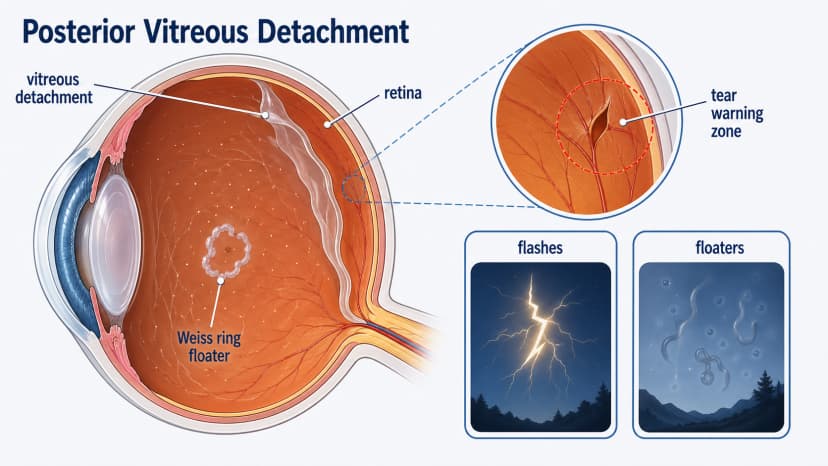
Posterior vitreous detachment (PVD) is a common, usually benign condition where the vitreous gel that fills the eye separates from the retina. It affects most people eventually, typically after age 50. While PVD itself is usually not dangerous, it can sometimes lead to a retinal tear, making it important to recognize the symptoms and seek prompt evaluation.
Key Takeaways
- PVD is common and usually benign-it happens to most people as they age
- Symptoms include new floaters and flashes of light
- Most cases resolve without complications over weeks to months
- Must rule out retinal tear-the main reason for urgent evaluation
- New symptoms require prompt eye exam even if you've had PVD before
What Is the Vitreous?
The vitreous is a clear, gel-like substance that fills the space between the lens and the retina-about 80% of the eye's volume. In youth, it has a firm, jelly-like consistency. With age:
- The vitreous becomes more liquid (liquefaction)
- It shrinks and pulls away from the retina
- This separation is posterior vitreous detachment
Symptoms
Typical PVD Symptoms
- New spots, strands, or cobwebs in vision
- May appear as rings or circles (Weiss ring)
- Move with eye movement
- More noticeable against bright backgrounds
- Brief flashes in peripheral vision
- Often occur with eye movement
- More noticeable in dark environments
- May look like lightning streaks
How Symptoms Change
- Flashes typically decrease over days to weeks
- Floaters persist but become less noticeable
- Brain learns to ignore stable floaters over months
- Symptoms may seem worse when tired
Who Gets PVD?
Age
- Uncommon before age 40
- About 25% of people in their 60s
- Over 60% of people by age 70
- Eventually happens to most people
Risk Factors for Earlier PVD
- High myopia (nearsightedness)
- Previous cataract surgery
- Eye trauma
- Previous eye inflammation (uveitis)
- Previous PVD in other eye (often occurs within 1-2 years)
When to Seek Care
Get a same-day dilated eye exam if you experience:
- Sudden onset of new floaters
- Shower or burst of many floaters
- New flashes of light
- Any shadow or curtain across your vision
- Any decrease in vision
- Symptoms after eye injury
These require urgent evaluation to rule out retinal tear or detachment.
The Concern: Retinal Tears
PVD itself is usually not dangerous, but as the vitreous separates, it can pull on areas where it's firmly attached to the retina. This traction can:
- Create a retinal tear (occurs in ~10-15% of PVD cases)
- Allow fluid to pass under the retina
- Lead to retinal detachment if untreated
This is why new PVD symptoms need evaluation-to catch and treat tears before they become detachments.
Diagnosis
Dilated Eye Examination
- Visual acuity-checking your vision
- Slit-lamp examination-viewing vitreous structure
- Dilated fundus exam-examining the retina
- Peripheral retinal examination-checking for tears
Additional Testing
- OCT-imaging the vitreous-retinal interface
- B-scan ultrasound-if vitreous hemorrhage blocks view
Treatment
Uncomplicated PVD
- No treatment needed-condition resolves naturally
- Follow-up examination-typically in 4-8 weeks
- Monitor for new symptoms-return if symptoms change
If Retinal Tear Found
- Laser photocoagulation-seals tear to prevent detachment
- Cryotherapy-freezing treatment as alternative
- Urgent treatment prevents progression
Managing Floaters
Most floaters improve with time:
- Brain adapts and filters them out
- Moving eyes quickly can shift floaters temporarily
- Floaters settle over weeks to months
Vitrectomy for floaters (surgical removal) is rarely recommended-reserved for severe cases significantly affecting quality of life. Surgery carries risks.
What to Expect
First Few Days to Weeks
- Floaters very noticeable
- Flashes may occur with eye movement
- Symptoms may seem overwhelming
- Normal activities usually not restricted
First Few Months
- Flashes typically stop
- Floaters settle and become less prominent
- Brain begins to adapt and ignore floaters
Long Term
- Floaters may persist but usually don't interfere with vision
- No ongoing treatment needed if no complications
- Increased awareness of future warning signs
Follow-Up Care
After Initial Diagnosis
Your doctor may recommend:
- Return visit in 4-8 weeks to recheck retina
- Earlier return if any new symptoms
- Eventual complete posterior vitreous separation
When to Return Urgently
Return immediately if you notice:
- Increase in floaters
- New flashes of light
- Shadow or curtain in vision
- Decrease in vision
Even if you've been told you have PVD, new symptoms need re-evaluation.
PVD in the Second Eye
If you've had PVD in one eye:
- The second eye often develops PVD within 1-2 years
- You'll recognize the symptoms
- Still need evaluation to rule out tears
- Don't assume it's "just PVD again"
Frequently Asked Questions
Is PVD the same as retinal detachment?
No. PVD is separation of the vitreous gel from the retina-usually benign. Retinal detachment is separation of the retina itself from the underlying tissue-a sight-threatening emergency. PVD can sometimes cause retinal detachment if a tear develops.
Will my floaters go away?
Floaters typically don't disappear completely, but they usually become much less noticeable over weeks to months. Your brain learns to filter them out. For most people, floaters eventually become a minor annoyance rather than a major problem.
Can I do anything to speed up recovery?
There's no way to speed up PVD completion or floater resolution. Time and patience are needed. Staying well-hydrated and maintaining good eye health may help, but won't change the natural course.
Should I restrict my activities?
Usually no restrictions are needed for uncomplicated PVD. Your doctor may advise avoiding heavy lifting or straining until your follow-up exam confirms no retinal tear.
Why do I need follow-up if it's benign?
Because retinal tears can develop days to weeks after initial PVD symptoms. The follow-up exam ensures no tear has formed and allows complete examination once the vitreous has cleared.
Can PVD happen more than once in the same eye?
No. Once the vitreous fully separates from the retina, PVD is complete. However, you might notice floaters shift or change position over time.
References
Medical Disclaimer: This information is for educational purposes only and does not replace professional medical advice, diagnosis, or treatment. If you have symptoms of PVD, please seek prompt evaluation.
Sources:
- American Academy of Ophthalmology. Posterior Vitreous Detachment.
- Bond-Taylor M, et al. Posterior vitreous detachment-prevalence of and risk factors for retinal tears. Clin Ophthalmol. 2017;11:1689-1695.
- National Eye Institute. Floaters.
- Coffee RE, et al. Symptomatic posterior vitreous detachment and the incidence of delayed retinal breaks. Am J Ophthalmol. 2007;144(3):409-413.