

Uveitis (Iritis)
Inflammation inside the eye affecting the uveal tract. Learn about types, autoimmune and infectious causes, steroid treatment, and potential complications.
Uveitis is inflammation of the uvea - the middle layer of the eye that includes the iris, ciliary body, and choroid. It is a potentially sight-threatening condition that requires prompt diagnosis and treatment. Anterior uveitis (iritis), the most common form, causes eye pain, redness, and light sensitivity and is a true ophthalmic urgency.
Key Takeaways
- Inflammation inside the eye affecting the iris, ciliary body, or choroid
- Anterior uveitis (iritis) is the most common type - causes pain, redness, and photophobia
- Causes include autoimmune conditions (HLA-B27, sarcoidosis), infections, and idiopathic
- Topical corticosteroids are the mainstay of treatment for anterior uveitis
- Chronic or recurrent uveitis may require steroid-sparing immunosuppressive therapy
- Complications include cataracts, glaucoma, and macular edema if not properly treated
- Pain + redness + photophobia = see an eye doctor urgently
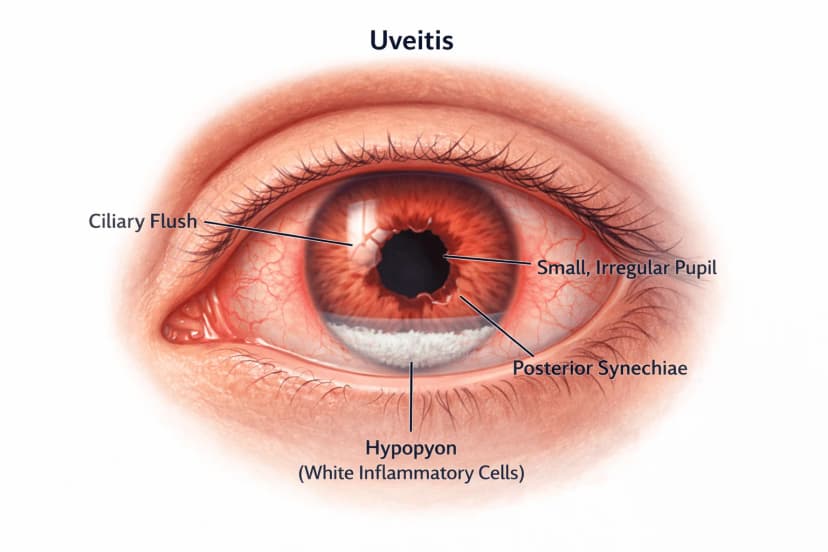
Types of Uveitis
| Type | Location | Common Causes | Symptoms |
|---|---|---|---|
| Anterior (iritis/iridocyclitis) | Iris and ciliary body | HLA-B27, idiopathic, herpes | Pain, redness, photophobia |
| Intermediate (pars planitis) | Vitreous and pars plana | Multiple sclerosis, sarcoidosis, idiopathic | Floaters, blurred vision |
| Posterior (choroiditis/retinitis) | Choroid and retina | Toxoplasmosis, CMV, sarcoidosis | Vision loss, floaters |
| Panuveitis | All layers | Behçet disease, sarcoidosis, Vogt-Koyanagi-Harada | Combined symptoms |
Symptoms
Anterior Uveitis (Most Common)
Seek urgent eye care if you experience:
- Eye pain - deep, aching
- Redness - often concentrated around the cornea (ciliary flush)
- Photophobia - sensitivity to light, including pain when the other eye is exposed to light (consensual photophobia)
- Blurred vision
- Tearing
- Small or irregular pupil on the affected side
This combination warrants same-day ophthalmologic evaluation.
Intermediate and Posterior Uveitis
- Floaters - often prominent
- Blurred vision - may be painless
- Vision loss - can be gradual or sudden
- May have little or no redness or pain
Causes and Risk Factors
Autoimmune and Inflammatory
- HLA-B27-associated - linked to ankylosing spondylitis, reactive arthritis, inflammatory bowel disease, psoriatic arthritis
- Sarcoidosis - can cause any type of uveitis
- Juvenile idiopathic arthritis (JIA) - important cause in children, often silent (no pain or redness)
- Behçet disease - severe panuveitis with hypopyon
- Vogt-Koyanagi-Harada (VKH) - bilateral panuveitis with neurologic and skin findings
- Multiple sclerosis - associated with intermediate uveitis
Infectious
- Toxoplasmosis - most common infectious cause of posterior uveitis
- Herpes simplex and herpes zoster - anterior uveitis with characteristic findings
- Cytomegalovirus (CMV) - retinitis in immunocompromised patients
- Tuberculosis - granulomatous uveitis
- Syphilis - "the great imitator," can cause any type of uveitis
Idiopathic
About 30-50% of uveitis cases have no identifiable cause despite workup.
Diagnosis
Eye Examination
- Slit-lamp exam - the essential tool; reveals cells and flare (protein) in the anterior chamber, keratic precipitates on the corneal endothelium, and posterior synechiae (iris adhesions to the lens)
- Dilated fundus exam - checks for posterior involvement (vitritis, retinal lesions, macular edema)
- OCT - detects macular edema, a common cause of vision loss in uveitis
- Intraocular pressure measurement - uveitis can cause elevated or low eye pressure
Laboratory Workup
Depending on presentation, may include:
- HLA-B27 testing
- Chest X-ray or CT (sarcoidosis, tuberculosis)
- ACE and lysozyme levels (sarcoidosis)
- Syphilis serology (RPR/VDRL, FTA-ABS)
- TB testing (QuantiFERON or PPD)
- Complete blood count, inflammatory markers
- Additional testing based on clinical suspicion
Treatment
Anterior Uveitis
Topical corticosteroid drops - the mainstay:
- Prednisolone acetate 1% - started frequently (every 1-2 hours) then tapered slowly
- Never stop steroid drops abruptly - rebound inflammation is common
- Typical taper over 4-8 weeks
Cycloplegic drops (atropine, cyclopentolate):
- Dilate the pupil and relax the ciliary muscle
- Relieve pain from ciliary spasm
- Prevent posterior synechiae (iris sticking to the lens)
Intermediate, Posterior, and Chronic Uveitis
Periocular or intravitreal steroid injections:
- For cases not responding to drops or with macular edema
- Triamcinolone, dexamethasone implant (Ozurdex)
Systemic corticosteroids:
- Oral prednisone for severe bilateral or posterior uveitis
- Used as a bridge while steroid-sparing agents take effect
Steroid-sparing immunosuppressive therapy - for chronic or recurrent uveitis:
- Methotrexate
- Mycophenolate mofetil
- Azathioprine
- Biologic agents: adalimumab (Humira - FDA-approved for non-infectious uveitis), infliximab
Treating the Underlying Cause
- Infectious uveitis requires appropriate antimicrobial therapy (not steroids alone)
- Systemic inflammatory diseases may require rheumatologic co-management
Complications
If not adequately treated, uveitis can lead to:
- Cataracts - from chronic inflammation and/or steroid use
- Glaucoma - from inflammation, synechiae, or steroid response
- Cystoid macular edema - fluid in the macula causing vision loss
- Posterior synechiae - iris adhering to the lens, causing irregular pupil
- Band keratopathy - calcium deposits on the cornea
- Hypotony - dangerously low eye pressure in chronic cases
- Permanent vision loss if untreated
When to See a Doctor
Seek same-day eye care if you have:
- Eye pain with redness and light sensitivity
- Sudden decrease in vision with pain
- Red eye that doesn't respond to standard pink eye treatment
- Known uveitis with new flare-up symptoms
Uveitis can cause permanent vision loss if not treated promptly.
Frequently Asked Questions
Is uveitis contagious?
No. Even when uveitis is caused by an infection (like toxoplasmosis), the eye inflammation itself is not contagious.
Will my uveitis keep coming back?
Many patients with anterior uveitis have one or a few episodes that resolve completely. However, some forms are recurrent or chronic. HLA-B27-associated uveitis tends to recur. Your ophthalmologist will discuss long-term management based on your specific situation.
Can uveitis cause blindness?
Untreated or inadequately treated uveitis can lead to permanent vision loss from complications like glaucoma, macular edema, or cataracts. With proper treatment, most patients maintain good vision.
Why do I need blood tests for an eye problem?
Uveitis can be the first sign of a systemic disease (like sarcoidosis, ankylosing spondylitis, or syphilis). Blood tests help identify an underlying cause so it can be treated appropriately and future flare-ups can be prevented.
How long will I need steroid drops?
A typical anterior uveitis episode requires 4-8 weeks of tapered steroid drops. Stopping too quickly causes rebound inflammation. Always follow the taper schedule prescribed by your ophthalmologist - never stop on your own.
Can children get uveitis?
Yes. Juvenile idiopathic arthritis (JIA) is an important cause of uveitis in children. Uniquely, JIA-related uveitis is often "white and quiet" - meaning the eye may not look red or painful - making regular screening essential for children with JIA.
References
Medical Disclaimer: This information is for educational purposes only and does not replace professional medical advice, diagnosis, or treatment. If you have symptoms of uveitis, please seek urgent care from a qualified eye care provider.
Sources:
- American Academy of Ophthalmology. Uveitis.
- Jabs DA, et al. Standardization of uveitis nomenclature. Am J Ophthalmol. 2005;140(3):509-516.
- Levy-Clarke G, et al. Expert panel recommendations for the use of anti-TNF biologic agents in patients with ocular inflammatory disorders. Ophthalmology. 2014;121(3):785-796.
- Seve P, et al. Uveitis: diagnostic work-up. A literature review and recommendations from an expert committee. Autoimmun Rev. 2017;16(12):1254-1264.
- National Eye Institute. Uveitis.