

Pterygium
A wedge-shaped growth of tissue on the white of the eye that can extend onto the cornea. Learn about causes, when surgery is needed, and prevention.
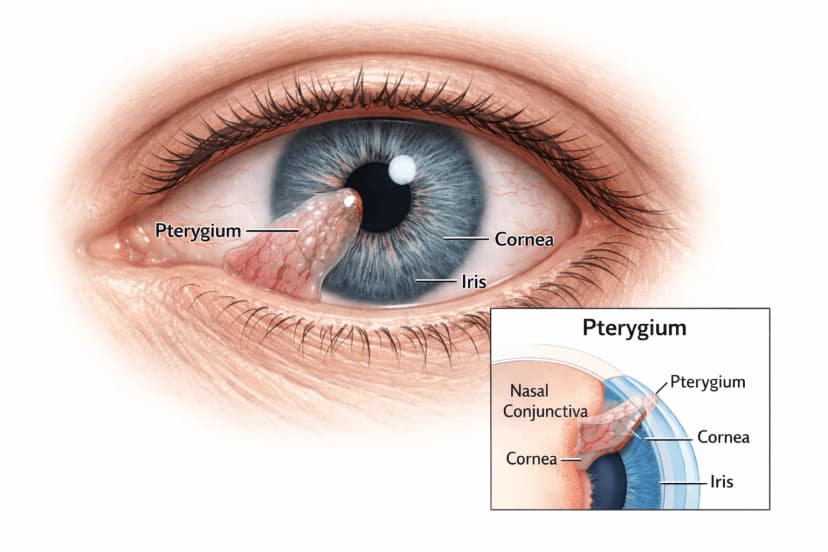
A pterygium (pronounced "teh-RIJ-ee-um") is a wedge-shaped, fleshy growth of conjunctival tissue that extends from the white of the eye onto the cornea. Often called "surfer's eye," it is strongly associated with ultraviolet (UV) light exposure. While typically benign and slow-growing, a pterygium can cause irritation, cosmetic concern, and vision problems if it grows across the visual axis or induces significant astigmatism.
Key Takeaways
- Fleshy, wedge-shaped growth from the conjunctiva onto the cornea
- Caused primarily by UV light exposure, wind, and dust
- Usually grows from the nasal (inner) side of the eye
- Can induce astigmatism by pulling on the cornea
- Surgery is needed if it threatens vision, causes significant astigmatism, or is cosmetically bothersome
- Conjunctival autograft technique reduces recurrence to <5%
- Prevention: UV-blocking sunglasses and hats
Pterygium vs. Pinguecula
| Feature | Pterygium | Pinguecula |
|---|---|---|
| Location | Extends onto the cornea | Stays on the conjunctiva only |
| Shape | Wedge/wing-shaped | Raised yellow bump |
| Growth | Can grow progressively across cornea | Rarely grows significantly |
| Vision effect | Can cause astigmatism, block vision | Rarely affects vision |
| Surgery | More often needed | Rarely needed |
A pinguecula can sometimes progress to become a pterygium, though this is not common.
Symptoms
- Visible fleshy growth on the white of the eye (usually nasal side)
- Redness and irritation around the growth
- Gritty or foreign body sensation
- Dryness in the affected area
- Blurred vision if the growth induces astigmatism or approaches the pupil
- Cosmetic concern - many patients seek treatment for appearance
- May be asymptomatic in early stages
Causes and Risk Factors
Primary Cause
UV light exposure is the dominant risk factor. UV radiation damages the conjunctival stem cells at the limbus (the border between cornea and conjunctiva), triggering abnormal tissue growth.
Risk Factors
- Prolonged sun exposure - outdoor occupations, tropical/equatorial climates
- Wind and dust exposure
- Dry, arid environments
- Male sex (due to higher occupational sun exposure)
- Ages 20-50 (develops from cumulative UV exposure)
- Not wearing sunglasses regularly
- Living near the equator (within the "pterygium belt" - 37°N to 37°S latitude)
Diagnosis
- Slit-lamp examination - clearly visualizes the growth, its extent onto the cornea, and any iron deposition (Stocker line)
- Corneal topography - measures the astigmatism induced by the pterygium pulling on the cornea
- Visual acuity testing - to document any vision impact
- Photography - to document size and track growth over time
Treatment
Conservative Management
For small, asymptomatic pterygia:
- Lubrication - artificial tears for irritation and dryness
- Anti-inflammatory drops - short courses of mild steroid drops for inflamed, irritated pterygia (pingueculitis/pterygium inflammation)
- UV protection - sunglasses and hats to slow progression
- Monitoring - periodic measurement to track growth
Surgical Removal
Indications for surgery:
- Growing toward or onto the central cornea (threatening the visual axis)
- Inducing significant astigmatism (confirmed on corneal topography)
- Chronic irritation not controlled with drops
- Cosmetic concern
- Restricting eye movement (rare, very large pterygia)
Preferred technique - Pterygium excision with conjunctival autograft:
- The pterygium is carefully dissected from the cornea and conjunctiva
- A thin graft of healthy conjunctiva (from under the upper eyelid) is placed over the bare area
- The graft is secured with tissue glue (fibrin) or fine sutures
- This technique has the lowest recurrence rate (<5%)
Alternative: Pterygium excision with mitomycin C (MMC):
- Anti-metabolite applied to the surgical bed
- Reduces recurrence by inhibiting regrowth
- Used when autograft tissue is limited or in revision surgery
Recurrence is the main concern after pterygium surgery. Older "bare sclera" techniques (removal without graft) had recurrence rates of 30-70%. Modern conjunctival autograft techniques have reduced this to less than 5%.
Recovery After Surgery
- Mild discomfort for several days
- Eye may be red for 2-4 weeks
- Avoid dusty/windy environments during healing
- Steroid and antibiotic drops for several weeks
- Full healing takes 1-2 months
- Final cosmetic result improves over months
When to See a Doctor
See an eye doctor if:
- You notice a growth on the white of your eye extending toward the cornea
- An existing pterygium is growing or causing new symptoms
- Your vision is becoming blurred or distorted
- You have chronic redness and irritation from the growth
Prevention
- Wear UV-blocking sunglasses outdoors - wraparound styles offer the best protection
- Wear a wide-brimmed hat
- Avoid unnecessary sun exposure, especially midday
- Protect eyes from wind and dust
- Use lubricating drops if your eyes are frequently dry or irritated outdoors
Frequently Asked Questions
Is a pterygium cancerous?
No. Pterygia are benign growths. However, rarely, other growths on the eye surface can mimic a pterygium. Your ophthalmologist can distinguish between them. Tissue removed during surgery is typically sent for pathological examination.
Will my pterygium grow back after surgery?
With modern conjunctival autograft technique, the recurrence rate is less than 5%. Recurrence is more likely in younger patients and those with continued heavy UV exposure. Wearing sunglasses after surgery is important.
Can I just leave it alone?
Many pterygia are small, stable, and asymptomatic - these can be safely monitored. Surgery is recommended when the growth threatens vision, causes significant symptoms, or is cosmetically bothersome.
Does a pterygium affect contact lens wear?
Yes. A pterygium can make contact lenses uncomfortable or cause them to fit poorly. It may also prevent fitting of some lens types. After surgical removal and healing, contact lens wear can usually resume.
How long does pterygium surgery take?
The procedure typically takes 30-45 minutes and is performed under local anesthesia as an outpatient procedure. Most patients return to normal activities within a week, though complete healing takes longer.
References
Medical Disclaimer: This information is for educational purposes only and does not replace professional medical advice, diagnosis, or treatment. If you have a growth on your eye, please consult a qualified healthcare provider.
Sources:
- StatPearls. Pterygium. NCBI Bookshelf.
- Hirst LW. The treatment of pterygium. Surv Ophthalmol. 2003;48(2):145-180.
- Clearfield E, et al. Conjunctival autograft for pterygium. Cochrane Database Syst Rev. 2016;(2):CD011349.
- Liu L, et al. Geographic prevalence of pterygium: a systematic review and meta-analysis. BMJ Open. 2021;11(12):e052261.
- American Academy of Ophthalmology EyeWiki. Pterygium.