

Proliferative Diabetic Retinopathy (PDR)
Advanced diabetic eye disease where fragile new retinal blood vessels grow, bleed, scar, and can lead to severe vision loss.
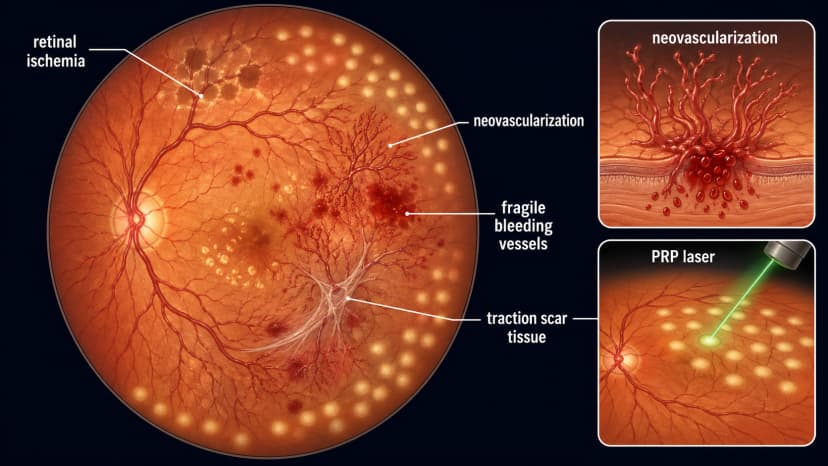
PDR is the advanced stage of diabetic retinopathy in which poor retinal blood flow stimulates abnormal new blood vessel growth on the retinal surface or optic nerve. These vessels are fragile and can bleed, form scar tissue, and pull on the retina. Major complications include vitreous hemorrhage, tractional retinal detachment, and neovascular glaucoma. Prompt treatment aims to prevent these complications before vision is severely damaged.
Key Takeaways
- PDR is advanced diabetic retinopathy, driven by poor retinal blood flow
- Fragile new vessels grow on the retina or optic nerve, then bleed and scar easily
- Vision can drop suddenly from vitreous hemorrhage or more slowly from traction and macular damage
- Laser and anti-VEGF injections can prevent blindness, especially before major bleeding or detachment
- Major complications include vitreous hemorrhage, tractional retinal detachment, and neovascular glaucoma
- Prompt treatment matters; this is not the stage to miss appointments
What Happens in PDR
Why New Vessels Grow
When the retina becomes severely oxygen-deprived (ischemic):
- Retinal cells release growth factors (especially VEGF)
- These factors stimulate new blood vessel growth
- The body is trying to resupply blood to ischemic areas
- But these new vessels are abnormal and cause problems
The Problem with Neovascularization
The new blood vessels are fragile and poorly formed:
- Thin walls prone to leaking and bleeding
- Grow into the vitreous cavity (should stay in retina)
- Cause bleeding into the vitreous (vitreous hemorrhage)
- Develop scar tissue that contracts
- Pull on the retina (tractional retinal detachment)
- Can grow on the iris (neovascular glaucoma)
Types of Neovascularization
Neovascularization of the Disc (NVD)
- New vessels growing on or near the optic nerve head
- High-risk feature
- Greater risk of severe vision loss
Neovascularization Elsewhere (NVE)
- New vessels growing on the retina away from the disc
- Also dangerous but slightly less than NVD
- Can still cause severe complications
Neovascularization of the Iris (NVI)
- New vessels on the iris
- Can block the drainage angle
- Causes neovascular glaucoma
- Requires urgent treatment
High-Risk Characteristics
High-risk PDR has very high probability of severe vision loss without treatment:
- NVD greater than 1/4 disc area
- Any NVD with vitreous or preretinal hemorrhage
- NVE greater than 1/2 disc area with vitreous or preretinal hemorrhage
These findings require prompt treatment.
Symptoms
When New Vessels Haven't Bled
- May have no symptoms
- Vision may still be good
- Detected on routine exam
When Bleeding Occurs (Vitreous Hemorrhage)
- Sudden onset of floaters
- Shower of floaters
- Cobweb or veil in vision
- Vision may become very cloudy or red
- May see only light (if dense hemorrhage)
With Retinal Detachment
- Shadow or curtain over vision
- Flashes of light
- Severe vision loss
Complications
Vitreous Hemorrhage
What Happens:
- Fragile new vessels bleed into the vitreous cavity
- Blood clouds the normally clear vitreous
- Light can't reach the retina
Symptoms:
- Sudden floaters, often a shower of them
- Cloudy or hazy vision
- May see only light
Treatment:
- May clear on its own (over weeks to months)
- Anti-VEGF injections speed clearing
- Vitrectomy surgery if doesn't clear
Tractional Retinal Detachment
What Happens:
- Scar tissue forms along new vessels
- Scar tissue contracts
- Pulls the retina away from its normal position
Types:
- Extramacular: doesn't involve central vision-may observe
- Macular: involves macula-needs surgery
- Combined tractional-rhegmatogenous: needs urgent surgery
Treatment:
- Vitrectomy surgery to remove scar tissue and reattach retina
Neovascular Glaucoma
Neovascular glaucoma is a serious complication:
- New vessels grow on the iris
- Block the drainage angle
- Eye pressure rises severely
- Painful
- Can cause rapid, permanent vision loss
Requires urgent treatment with anti-VEGF injections and pressure-lowering, often followed by laser.
Diagnosis
Clinical Examination
- Dilated fundus exam
- Look for new vessels on disc and retina
- Assess vitreous for hemorrhage
- Check for retinal detachment
- Examine iris for neovascularization
- Check eye pressure
Imaging
Fluorescein Angiography:
- Shows leaking new vessels
- Defines extent of ischemia
- Essential for treatment planning
OCT:
- Detects macular edema
- Shows vitreoretinal interface
- May show early tractional changes
Ultrasound:
- If vitreous hemorrhage blocks view
- Assesses whether retina is attached
Treatment
Anti-VEGF Injections
Anti-VEGF injections are often first-line for PDR:
- Aflibercept (Eylea)
- Ranibizumab (Lucentis)
- Bevacizumab (Avastin, off-label)
Benefits:
- Rapid regression of new vessels
- Help clear vitreous hemorrhage
- Reduce macular edema if present
- Can be done immediately
Limitations:
- Effect is temporary (needs repeat injections)
- May need laser as well
Panretinal Photocoagulation (PRP)
The Mainstay of Treatment:
- Laser applied to peripheral retina
- 1,000-2,000 or more laser spots
- Destroys ischemic retina
- Reduces oxygen demand
- Reduces VEGF production
- Causes new vessels to regress
Side Effects:
- Reduced peripheral vision
- Reduced night vision
- Usually well tolerated given the alternative (blindness)
Effectiveness:
- Reduces severe vision loss by ~50%
- Proven benefit in landmark clinical trials
- Remains essential treatment
Vitrectomy Surgery
Indications:
- Non-clearing vitreous hemorrhage
- Tractional retinal detachment involving or threatening the macula
- Combined tractional-rhegmatogenous detachment
What's Done:
- Small instruments enter the eye
- Vitreous gel is removed
- Blood is cleared
- Scar tissue is removed
- Retina is reattached if needed
- Laser is applied during surgery
- Gas or silicone oil may be placed
Outcomes:
- Many patients improve, but visual recovery depends on retinal damage and timing
- Better outcomes with earlier surgery
- Some patients need multiple surgeries
Treatment Approach
Modern management often combines:
- Anti-VEGF injection first (quick effect)
- PRP laser (longer-lasting prevention)
- Vitrectomy if complications occur
- Ongoing treatment of macular edema
Prognosis
With Treatment
- Severe vision loss reduced by ~50% or more
- Many patients maintain useful vision
- Better outcomes with earlier treatment
- Better outcomes with good systemic control
Without Treatment
- Approximately 50% develop severe vision loss within 2 years
- PDR is a leading cause of blindness
Factors Affecting Outcome
- Severity at diagnosis
- Presence of complications
- Response to treatment
- Systemic control (blood sugar, blood pressure)
- Adherence to follow-up
Living with PDR
What You Can Do
Systemic Control:
- Blood sugar management remains important
- Blood pressure control - both diabetes and high blood pressure damage retinal vessels, and understanding how each contributes to your eye changes can help guide management
- These affect progression and treatment response
Adhere to Treatment:
- Keep all appointments
- Get scheduled injections
- Complete laser treatment
- Don't delay surgery if recommended
Know Warning Signs:
- New floaters (may indicate bleeding)
- Sudden vision loss
- Shadow or curtain over vision
- Seek immediate care for these symptoms
Emotional Support
- PDR diagnosis can be frightening
- Vision loss can change work, driving, reading, and independence
- Support groups can help
- Counseling may be beneficial
- Low vision services if needed
Prevention
Preventing PDR (If You Have NPDR)
- Excellent blood sugar control
- Blood pressure control
- Regular eye exams
- Treat severe NPDR before it progresses
For Those with Diabetes
- Annual dilated eye exams
- Work with your diabetes care team
- Don't smoke
- Control all risk factors
Frequently Asked Questions
Will I go blind?
With timely treatment, systemic control, and reliable follow-up, many patients avoid severe vision loss. However, PDR is serious and requires prompt treatment. The key is getting treatment early and following through with all recommended care.
Is laser treatment painful?
You may feel some discomfort during PRP laser treatment. Anesthetic drops and sometimes injections are used. Discomfort is usually tolerable and temporary. The treatment is done to prevent blindness.
How many treatments will I need?
This varies. You may need multiple laser sessions to complete PRP. You may need ongoing anti-VEGF injections, especially if you have macular edema. Some patients need treatment for years.
Can the new blood vessels go away?
Yes. Anti-VEGF injections can cause rapid regression of new vessels. Laser treatment can provide more durable reduction in ischemic drive, but recurrence or progression can still occur if the underlying ischemia persists.
What if my eye bleeds?
Vitreous hemorrhage (bleeding) is common in PDR. It often clears on its own over weeks to months. Anti-VEGF injections can speed clearing. Surgery (vitrectomy) can remove blood if it doesn't clear. Many patients improve, but recovery depends on macular ischemia, traction, baseline vision, and timing.
Can I still drive?
This depends on your vision level. Some patients with PDR maintain excellent vision; others have significant loss. You'll be evaluated to determine if you meet legal requirements for driving. The goal of treatment is to preserve as much vision as possible.
References
Medical Disclaimer: This information is for educational purposes only and does not replace professional medical advice, diagnosis, or treatment. PDR is a serious condition requiring prompt medical attention.
Sources:
- American Academy of Ophthalmology. Proliferative Diabetic Retinopathy.
- Diabetic Retinopathy Study Research Group. Photocoagulation treatment of proliferative diabetic retinopathy: clinical application of DRS findings. Ophthalmology. 1981;88(7):583-600.
- Writing Committee for the Diabetic Retinopathy Clinical Research Network. Panretinal photocoagulation vs intravitreous ranibizumab for proliferative diabetic retinopathy: a randomized clinical trial. JAMA. 2015;314(20):2137-2146.
- National Eye Institute. Diabetic Retinopathy.