

Bulging Eye (Proptosis)
When one or both eyes protrude forward, it can indicate thyroid disease, orbital inflammation, or other conditions requiring evaluation.
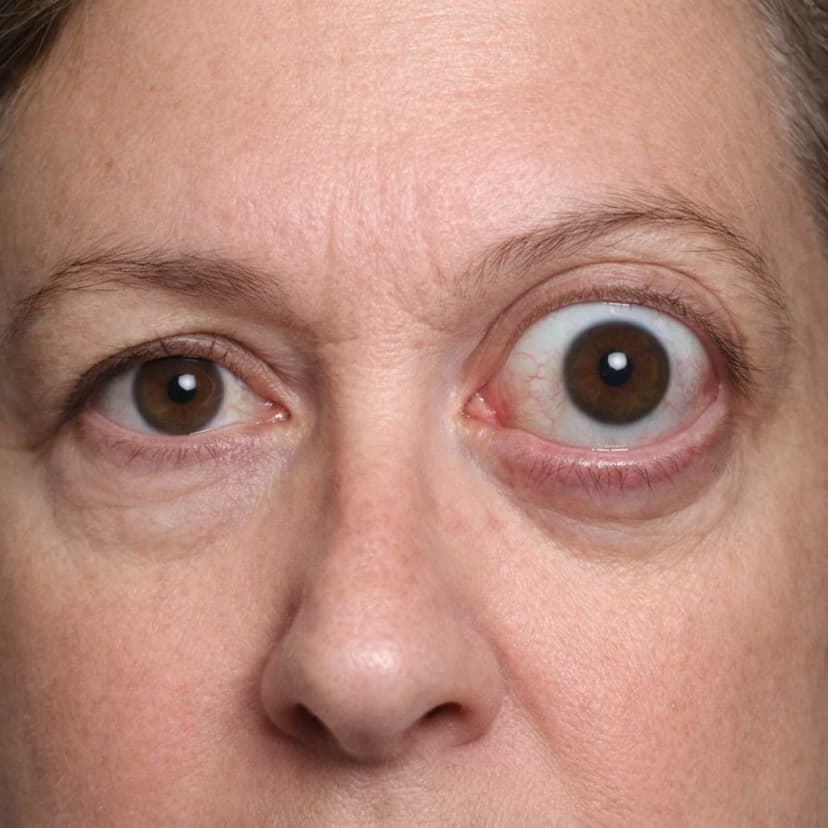
Proptosis (prop-TOE-sis), also called exophthalmos, means the eyeball is displaced forward from its usual position. It may first be noticed as a more prominent or "staring" appearance in photos. It can involve one eye or both; in adults, thyroid eye disease is the most common cause, but not the only one.
Key Takeaways
- Thyroid eye disease is the most common adult cause, especially when both eyes are involved
- One eye bulging more than the other usually needs imaging, because orbital masses and inflammation can hide behind the eye
- Rapid onset with pain, fever, or swollen lids needs emergency evaluation
- Proptosis can threaten vision by drying the cornea or compressing the optic nerve
What Proptosis Looks Like
People usually notice a change in eye shape rather than a single sensation. Signs include:
- Eye appearing more prominent or "staring"
- Visible white of eye (sclera) above or below iris
- Eyelids not fully closing (lagophthalmos)
- One eye appearing larger than the other
- Difficulty fully closing eyes during sleep
- Sensation of pressure behind the eye
- May have redness, swelling of eyelids
Causes of Proptosis
Bilateral (Both Eyes)
Thyroid eye disease (Graves' orbitopathy)
- Most common cause of bilateral proptosis
- Associated with hyperthyroidism (Graves' disease)
- Can occur with normal thyroid function too
- May have eyelid retraction, double vision
- Swelling of eye muscles and fat
Unilateral (One Eye)
One-sided proptosis needs a workup because the cause may be located deep in the orbit and cannot be assessed by appearance alone.
Inflammatory
- Orbital pseudotumor (idiopathic orbital inflammation)
- Thyroid eye disease (can be asymmetric)
- Sarcoidosis, granulomatosis with polyangiitis
Tumors
- Cavernous hemangioma (benign)
- Lymphoma
- Lacrimal gland tumors
- Meningioma
- Metastatic cancer
Vascular
- Carotid-cavernous fistula (pulsatile proptosis)
- Orbital varix (changes with position/straining)
- Arteriovenous malformation
Infection
- Orbital cellulitis-painful, red, swollen, urgent
Structural
- Shallow orbits (congenital)
- High myopia (eye naturally longer)
Rapid Onset-Emergency
Orbital cellulitis
- Pain, redness, swelling
- Fever
- Limited eye movement
- Can spread to brain-emergency
Warning Signs
Go to the emergency department the same day if proptosis occurs with:
- Fever
- Rapid onset (hours to days)
- Severe pain
- Significant vision loss
- Inability to move eye
- Red, swollen eyelids
- Headache
- Recent sinus infection or dental infection
Orbital cellulitis is a medical emergency requiring IV antibiotics. Call 911 immediately if proptosis occurs with confusion, fainting, rapidly worsening vision, or severe sudden headache.
Schedule prompt evaluation for:
- New or progressive proptosis
- Proptosis affecting only one eye
- Double vision with proptosis
- Vision changes
- Difficulty closing eyes
Complications of Proptosis
Exposure Problems
When the eye protrudes, lids may not protect it:
- Dry eye-surface exposed, not well lubricated
- Corneal damage-exposure keratopathy
- Infection risk-inadequate protection
- Cosmetic concerns
Vision Threat
- Optic nerve compression-enlarged muscles can compress nerve
- Corneal ulceration-from exposure
- Double vision-from muscle involvement
How Proptosis Is Evaluated
Clinical Examination
- Exophthalmometry-measuring how far eye protrudes
- Comparison between eyes
- Eyelid position assessment
- Eye movement testing
- Vision and pupil examination
- Checking for pulsation or bruit (abnormal sound)
Imaging
- CT orbits-shows bone and soft tissue well
- MRI orbits-better soft tissue detail
- Helps identify tumors, inflammation, vascular lesions
Blood Tests
- Thyroid function-TSH, free T4
- Thyroid antibodies-TSI, TPO antibodies
- Inflammatory markers-if infection suspected
Treatment Options
Treatment depends on the cause, and the causes are very different from each other:
For Thyroid Eye Disease
Active/inflammatory phase:
- Smoking cessation-critical; smoking worsens disease
- Selenium supplements-may help mild cases
- Steroids-for moderate-severe inflammation
- Teprotumumab (Tepezza)-FDA-approved biologic
Stable/chronic phase:
- Orbital decompression surgery-removes bone to create room
- Strabismus surgery-for double vision
- Eyelid surgery-for retraction
For Inflammatory Conditions
- Steroids
- Steroid-sparing immunosuppressants
- Treatment of underlying condition
For Tumors
- Surgical removal when indicated
- May need radiation
- Depends on tumor type
For Infection (Orbital Cellulitis)
- IV antibiotics-urgent
- Surgical drainage-if abscess present
- Hospitalization-usually required
Supportive Care
- Lubricating drops and ointment-protect exposed surface
- Taping eyelids at night-if incomplete closure
- Moisture chambers-special goggles
- Elevating head of bed-may reduce swelling
Frequently Asked Questions
Can thyroid eye disease occur with normal thyroid levels?
Yes. About 10% of people with thyroid eye disease have normal thyroid function (euthyroid). Thyroid antibodies may still be present.
Will my proptosis go away?
It depends on why the eye is pushed forward. Inflammatory proptosis can improve with treatment. Thyroid eye disease often stabilizes or improves after the active inflammatory phase, but some proptosis may remain and sometimes needs surgery. Tumor-related proptosis requires diagnosis and treatment of the tumor.
Is proptosis the same as prominent eyes?
Prominent eyes can be due to true proptosis, eyelid retraction, or both. Thyroid eye disease commonly causes both, which is why the appearance can be noticeable.
Can I go blind from proptosis?
Vision loss can occur if the optic nerve is compressed or if the cornea is severely damaged from exposure. This is why evaluation and treatment are important. Most people maintain good vision with appropriate care.
Does everyone with Graves' disease get proptosis?
No. About 25-50% of people with Graves' disease develop eye involvement (thyroid eye disease). Not everyone with thyroid eye disease develops significant proptosis.
References
Medical Disclaimer: This information is for educational purposes only and does not replace professional medical advice, diagnosis, or treatment. If you have concerns about bulging eyes or any symptoms, please consult a qualified healthcare provider.
Sources:
- NHS. Bulging eyes (exophthalmos).
- American Thyroid Association. Graves' Eye Disease.
- Bartley GB. The epidemiologic characteristics and clinical course of ophthalmopathy associated with autoimmune thyroid disease. Trans Am Ophthalmol Soc. 1994;92:477-588.