

Medical Conditions That Cause Dry Eye
Systemic diseases that cause or worsen dry eye - Sjogren's syndrome, thyroid disease, diabetes, lupus, rosacea, and neurological conditions explained.
Dry eye syndrome isn't always a standalone problem. In many patients, it's a sign of a systemic disease affecting the body's ability to produce or maintain healthy tears. Identifying an underlying condition changes both the treatment approach and the long-term outlook. If your dry eye is severe, started at a young age, or doesn't respond well to standard treatments, your doctor may order blood tests or a Schirmer test to investigate deeper causes.
Key Takeaways
- Autoimmune diseases are the most common systemic cause - Sjögren's syndrome directly attacks tear-producing glands
- Thyroid disease affects the eyelids and ocular surface - lid retraction and proptosis increase tear evaporation
- Diabetes reduces corneal nerve sensitivity - the eye doesn't detect dryness properly, leading to inadequate tear production
- Rosacea causes meibomian gland dysfunction - up to 60% of rosacea patients develop eye involvement
- Neurological conditions affect blinking - reduced blink rate or incomplete lid closure leads to exposure dryness
- Blood tests can identify the underlying cause - ANA, SSA/SSB, RF, and other autoantibody panels help diagnose systemic conditions
Why Systemic Conditions Cause Dry Eye
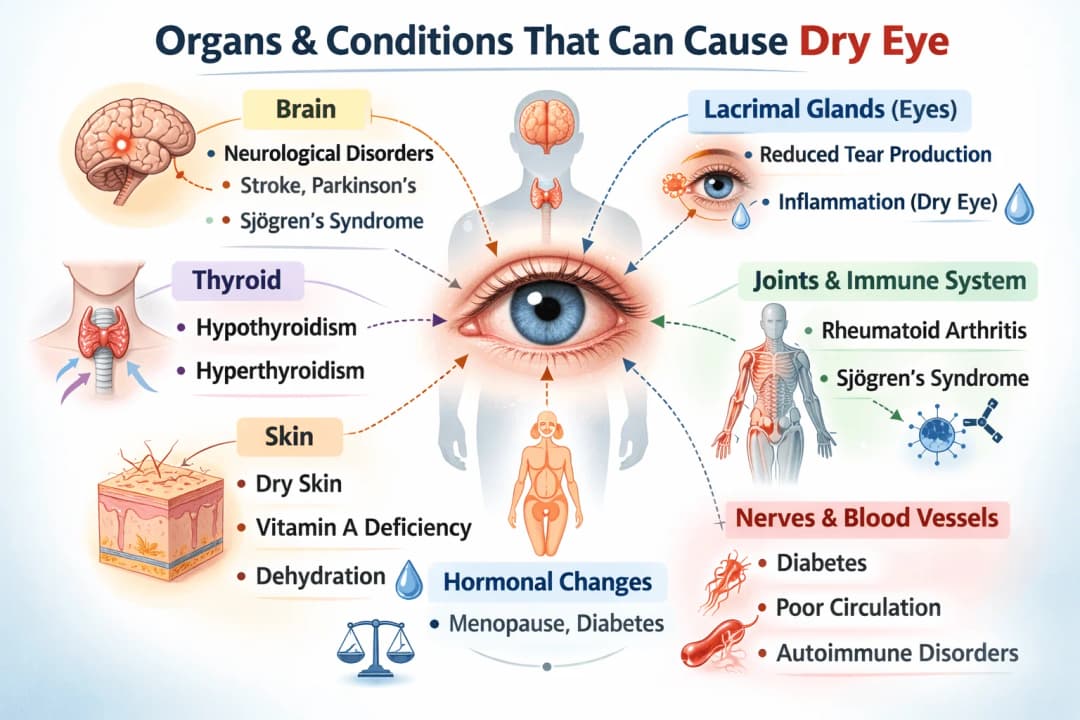
The tear system depends on many body systems working together - the immune system to protect glands from autoimmune attack, the nervous system to regulate blinking and tear secretion, the endocrine system to maintain hormonal balance, and the skin to support healthy eyelid margins.
When any of these systems is disrupted by a medical condition, the tear film suffers. Identifying the underlying cause matters because:
- Treatment of the systemic condition often improves the dry eye
- Standard dry eye treatments may be insufficient without addressing the root cause
- Dry eye may be the first sign of a previously undiagnosed systemic disease
- Monitoring needs differ - disease-related dry eye may require more frequent follow-up
Autoimmune Conditions
Sjögren's Syndrome
Sjögren's syndrome is the most important systemic cause of dry eye. It's an autoimmune disease in which the immune system attacks the lacrimal (tear) glands and salivary glands, causing dry eyes and dry mouth together.
- Affects 0.5-1% of the population, predominantly women (9:1 ratio)
- Can occur alone (primary Sjögren's) or alongside another autoimmune disease like rheumatoid arthritis or lupus (secondary Sjögren's)
- Diagnosed with SSA (Ro) and SSB (La) antibodies, lip biopsy, and tear/saliva production tests
- Dry eye from Sjögren's tends to be more severe and harder to manage than typical dry eye
- Treatment includes aggressive lubrication, prescription anti-inflammatory drops, punctal plugs, and sometimes systemic immunosuppressive medications
Rheumatoid Arthritis
Approximately 25% of patients with rheumatoid arthritis develop dry eye, often through secondary Sjögren's syndrome. The chronic systemic inflammation also directly affects the lacrimal gland and ocular surface.
- Dry eye can precede joint symptoms in some patients
- Patients on methotrexate or other immunosuppressants should be monitored for ocular effects
- Severe cases can develop peripheral ulcerative keratitis - a sight-threatening corneal condition
Lupus (Systemic Lupus Erythematosus)
Lupus causes ocular surface inflammation and can lead to secondary Sjögren's syndrome. About 20% of lupus patients develop clinically significant dry eye.
- The inflammatory process affects both tear production and tear quality
- Lupus patients may also develop other eye problems including retinal vasculitis and optic neuropathy
- Dry eye management in lupus requires coordination between the ophthalmologist and rheumatologist
Scleroderma
Scleroderma can cause lacrimal gland fibrosis (scarring) and tight facial skin that affects eyelid closure. Both mechanisms lead to dry eye.
- Tight skin around the eyelids can cause incomplete blink or lagophthalmos
- Lacrimal gland involvement reduces aqueous tear production
- Often co-occurs with other autoimmune conditions
Endocrine and Metabolic Conditions
Thyroid Disease and Graves' Disease
Thyroid eye disease is one of the most common endocrine causes of dry eye. In Graves' disease, autoantibodies cause inflammation and swelling of the tissues behind the eyes, leading to:
- Proptosis (bulging eyes) - increases the exposed eye surface area
- Lid retraction - the upper lid pulls back, leaving more of the eye exposed to air
- Incomplete lid closure - the eyelids can't fully cover the eye, especially during sleep
- Lacrimal gland inflammation - may directly reduce tear production
Even patients with mild thyroid eye disease can experience significant dryness due to increased tear evaporation from a larger exposed ocular surface.
Diabetes
Diabetic retinopathy is a well-known complication of diabetes, but diabetic dry eye is often overlooked. Diabetes causes dry eye through:
- Corneal neuropathy - high blood sugar damages corneal nerves, reducing sensitivity. The eye doesn't detect dryness, so it doesn't trigger adequate tear production.
- Lacrimal gland dysfunction - diabetes-related microvascular changes can impair the lacrimal gland
- Slower wound healing - the compromised corneal surface takes longer to repair
Studies show that 40-55% of diabetic patients have some degree of dry eye. Good blood sugar control helps preserve corneal nerve function.
Menopause and Hormonal Changes
Declining androgen levels during menopause directly affect meibomian gland function, reducing the oil layer of the tear film. Estrogen changes also influence tear production and ocular surface inflammation.
- Dry eye is significantly more common in post-menopausal women
- Hormone replacement therapy (HRT) may improve or worsen dry eye depending on the formulation
- Androgens play a protective role in meibomian gland health - their decline is a key factor
Dermatologic Conditions
Rosacea
Ocular rosacea is one of the most underdiagnosed causes of dry eye. Up to 60% of patients with facial rosacea develop eye involvement, and in some cases, ocular symptoms appear before the skin findings.
- Causes chronic meibomian gland dysfunction (MGD) and blepharitis
- Eyelid inflammation leads to poor oil secretion and rapid tear evaporation
- May cause recurrent chalazia and corneal complications
- Treated with warm compresses, lid hygiene, oral doxycycline, and sometimes IPL therapy
Neurological Conditions
Bell's Palsy
Bell's palsy causes temporary paralysis of one side of the face, including the muscles that close the eyelid. The resulting lagophthalmos (inability to fully close the eye) leads to exposure keratopathy and severe dryness.
- The cornea is exposed and vulnerable, especially during sleep
- Aggressive lubrication is critical - frequent preservative-free drops during the day and thick ointment at bedtime
- Taping the eyelid shut at night or using moisture chambers may be needed
- Most Bell's palsy cases recover, but dry eye management is essential during the recovery period
Parkinson's Disease
Parkinson's reduces the spontaneous blink rate from a normal 15-20 blinks per minute to as few as 1-2 blinks per minute. Infrequent blinking means the tear film isn't redistributed across the eye surface, leading to rapid evaporation and dry patches.
- Blink incompleteness (not closing the lid fully during a blink) further worsens the problem
- Anti-Parkinson medications can add anticholinergic effects that reduce tear production
- Treatment includes artificial tears, reminders to blink consciously, and sometimes punctal plugs
Summary Table
| Condition | Mechanism | Additional Eye Risks | Key Diagnostic Test |
|---|---|---|---|
| Sjögren's syndrome | Autoimmune lacrimal gland destruction | Corneal ulceration, filamentary keratitis | SSA/SSB antibodies, lip biopsy |
| Rheumatoid arthritis | Lacrimal inflammation, secondary Sjögren's | Peripheral ulcerative keratitis, scleritis | RF, anti-CCP, ANA |
| Lupus (SLE) | Ocular surface inflammation, secondary Sjögren's | Retinal vasculitis, optic neuropathy | ANA, anti-dsDNA, complement levels |
| Scleroderma | Lacrimal fibrosis, tight eyelid skin | Lagophthalmos | ANA, anti-Scl-70 |
| Thyroid / Graves' disease | Proptosis, lid retraction, exposure | Optic neuropathy, diplopia | TSH, thyroid antibodies, orbital imaging |
| Diabetes | Corneal neuropathy, lacrimal dysfunction | Retinopathy, macular edema | HbA1c, fasting glucose |
| Rosacea | MGD, eyelid inflammation | Corneal neovascularization, chalazia | Clinical diagnosis (skin + eye findings) |
| Bell's palsy | Lagophthalmos (incomplete lid closure) | Exposure keratopathy, corneal ulcer | Clinical diagnosis |
| Parkinson's disease | Reduced blink rate (1-2/min) | Blepharospasm, visual hallucinations | Clinical diagnosis |
When to Suspect an Underlying Condition
Not every case of dry eye has a systemic cause. However, certain red flags suggest your doctor should look deeper:
- Severe dry eye in a young patient (under 50) - particularly with dry mouth
- Dry eyes plus dry mouth together - classic Sjögren's presentation
- Joint pain, skin rashes, or unexplained fatigue alongside dry eye - may suggest an autoimmune condition
- Poor response to standard dry eye treatment - may indicate a systemic driver that hasn't been addressed
- Family history of autoimmune disease - increases the likelihood of conditions like Sjögren's, lupus, or rheumatoid arthritis
Blood tests for autoimmune screening can help identify systemic causes. Common tests include ANA (antinuclear antibody), SSA/SSB (Sjögren's antibodies), RF (rheumatoid factor), anti-CCP, ESR, and CRP. Your eye doctor or primary care physician can order these tests, and if results are positive, a rheumatologist can help with diagnosis and treatment.
Frequently Asked Questions
Can Sjögren's syndrome be cured?
There is no cure for Sjögren's syndrome, but it can be effectively managed. Treatment focuses on relieving dryness (aggressive lubrication, prescription drops, punctal plugs) and controlling systemic inflammation with immunosuppressive medications when needed. Many patients maintain stable symptoms and daily function with consistent treatment.
Does thyroid disease always cause dry eye?
Not always, but dry eye is very common in thyroid eye disease - especially Graves' disease with lid retraction or proptosis. Even mild thyroid eye disease can cause significant dryness due to increased tear evaporation from a larger exposed eye surface. Thyroid patients should be screened for dry eye regularly.
Can diabetes cause dry eyes?
Yes. Studies show 40-55% of diabetic patients have dry eye. Diabetes damages corneal nerves (reducing sensation and tear reflex) and can impair lacrimal gland function. Good blood sugar control helps preserve corneal nerve function and may reduce dry eye severity.
If I treat the underlying condition, will my dry eye go away?
It depends on the condition and how long the dry eye has been present. Treating the systemic disease often improves dry eye symptoms, but may not eliminate them completely - especially if structural damage (like meibomian gland atrophy or lacrimal gland scarring) has occurred. Most patients need ongoing dry eye management in addition to treating the underlying cause.
Should I see a rheumatologist for my dry eye?
If your eye doctor suspects an autoimmune cause - especially if you have dry mouth, joint pain, skin changes, or positive autoantibody tests - a rheumatology referral is appropriate. The rheumatologist manages the systemic disease while your eye doctor manages the ocular surface.
Can lupus cause dry eye?
Yes. About 20% of lupus patients develop clinically significant dry eye, either from direct ocular surface inflammation or secondary Sjögren's syndrome. Lupus can also cause other eye problems, so regular eye exams are important for lupus patients.
Does menopause make dry eye worse?
Yes. Declining androgen levels during menopause affect meibomian gland function, and hormonal changes influence tear production and ocular surface inflammation. Dry eye is significantly more common in post-menopausal women. Treatment focuses on standard dry eye management plus discussing hormonal factors with your gynecologist.
How do I know if my dry eye is caused by a medical condition?
Red flags include severe dry eye at a young age, dry mouth accompanying dry eyes, joint pain or skin rashes, poor response to standard treatment, and family history of autoimmune disease. Your eye doctor can order blood tests and refer you to appropriate specialists if a systemic cause is suspected.
References
Medical Disclaimer: This information is for educational purposes only and does not replace professional medical advice, diagnosis, or treatment. If you suspect your dry eye may be related to an underlying medical condition, please consult a qualified healthcare provider.
Sources:
- Sjögren's Foundation. About Sjögren's.
- MedlinePlus. Sjögren's Syndrome.
- American Academy of Ophthalmology. Dry Eye Preferred Practice Pattern.
- Bron AJ, et al. TFOS DEWS II Pathophysiology Report. Ocul Surf. 2017;15(3):438-510.
- Stapleton F, et al. TFOS DEWS II Epidemiology Report. Ocul Surf. 2017;15(3):334-365.