

B-Scan Ultrasound
An imaging test that uses sound waves to visualize the structures inside the eye when the view is blocked by blood, cataracts, or other opacities.
B-scan ultrasound is an imaging technique that uses high-frequency sound waves to create a two-dimensional cross-sectional view of the eye and orbit. It's especially valuable when the doctor cannot see the back of the eye directly-for example, when a vitreous hemorrhage, dense cataract, or other opacity blocks the view.
Key Takeaways
- Uses sound waves to image the inside of the eye
- Essential when the view is blocked by hemorrhage, cataract, or other opacity
- Detects retinal detachment, tumors, and vitreous abnormalities
- Quick, painless, and non-invasive
- Performed in the office with immediate results
Why It's Done
B-scan ultrasound is performed to:
- Evaluate the retina when vitreous hemorrhage blocks the view
- Detect retinal detachment
- Assess posterior vitreous detachment (PVD)
- Evaluate intraocular tumors (size, location, characteristics)
- Assess the eye after trauma
- Evaluate vitreous opacities causing photopsia or floaters
- Plan surgery when direct visualization isn't possible
What to Expect
Before the Test
- No special preparation needed
- No fasting required
- Contact lenses should be removed
- Numbing drops may or may not be used (depends on technique)
During the Test
- You sit or recline comfortably
- A small amount of gel is applied to the closed eyelid (or directly to the eye with numbing drops)
- A small probe is gently placed on the eyelid or eye surface
- The probe sends and receives sound waves
- Images appear on a screen in real time
- The doctor moves the probe to view different sections
- Takes approximately 10-15 minutes
After the Test
- Wipe away gel
- No recovery time needed
- Resume normal activities immediately
- If numbing drops were used, avoid rubbing eyes briefly
What It Shows
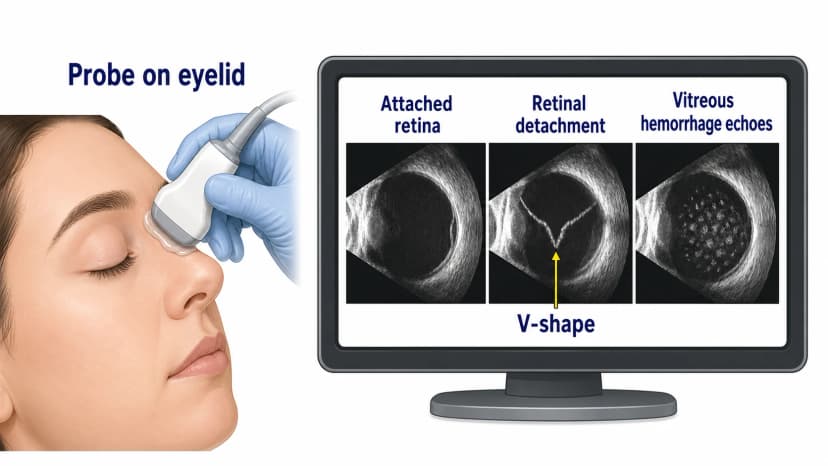
Normal Findings
- Clear vitreous cavity
- Attached retina
- Normal optic nerve and orbital structures
- Normal eye wall thickness
Abnormal Findings
Retinal Detachment:
- Membrane attached to the optic nerve head
- Characteristic V-shape pattern in total detachment
- Helps distinguish from vitreous detachment
Vitreous Hemorrhage:
- Echoes (dots) within the vitreous cavity
- Cannot see the retina directly, but ultrasound shows it
Posterior Vitreous Detachment:
- Membrane in the vitreous cavity
- Not attached to the optic nerve (unlike retinal detachment)
Tumors:
- Solid mass on or within the eye wall
- Characteristic shapes and internal echoes
- Can measure tumor size for monitoring
Other Findings:
- Vitreous opacities
- Foreign bodies after trauma
- Orbital masses behind the eye
B-Scan vs. Other Imaging
| Test | Best For |
|---|---|
| B-scan ultrasound | Viewing through opacities; retinal detachment |
| OCT | Detailed retinal layers (requires clear media) |
| Fundus photography | Documenting retinal appearance (requires clear media) |
| MRI | Orbital and brain structures |
Frequently Asked Questions
Is B-scan ultrasound painful?
No. When performed over the closed eyelid, you'll feel gentle pressure but no pain. If done with the probe on the eye surface, numbing drops are used first and you'll feel only mild pressure.
Why can't the doctor just look in my eye?
When blood (vitreous hemorrhage), a dense cataract, or other opacity is present, the doctor cannot see through to the retina. Sound waves pass through these opacities, allowing visualization of the structures behind them.
How is this different from OCT?
OCT uses light waves and provides very detailed images of retinal layers, but requires a clear view into the eye. B-scan uses sound waves and can see through opacities, but provides less detailed structural information.
Will I need this test more than once?
Possibly. If you have a vitreous hemorrhage, serial B-scans may be done to monitor for retinal detachment while waiting for the blood to clear. For tumors, regular monitoring may be needed.
Can B-scan detect all retinal detachments?
B-scan is very good at detecting retinal detachments, but small or shallow detachments may be harder to see. Your doctor will correlate ultrasound findings with your symptoms and other examination findings.
Medical Disclaimer: This information is for educational purposes only and does not replace professional medical advice, diagnosis, or treatment. Discuss your results with your eye care provider.
Sources:
- American Academy of Ophthalmology. Echography (Ultrasound).
- National Eye Institute. Retinal Detachment.