

Vitreous Hemorrhage
Blood inside the vitreous gel can cause sudden floaters, cobwebs, red haze, or vision loss. Prompt exam looks for retinal tears, diabetic retinopathy, and other causes.
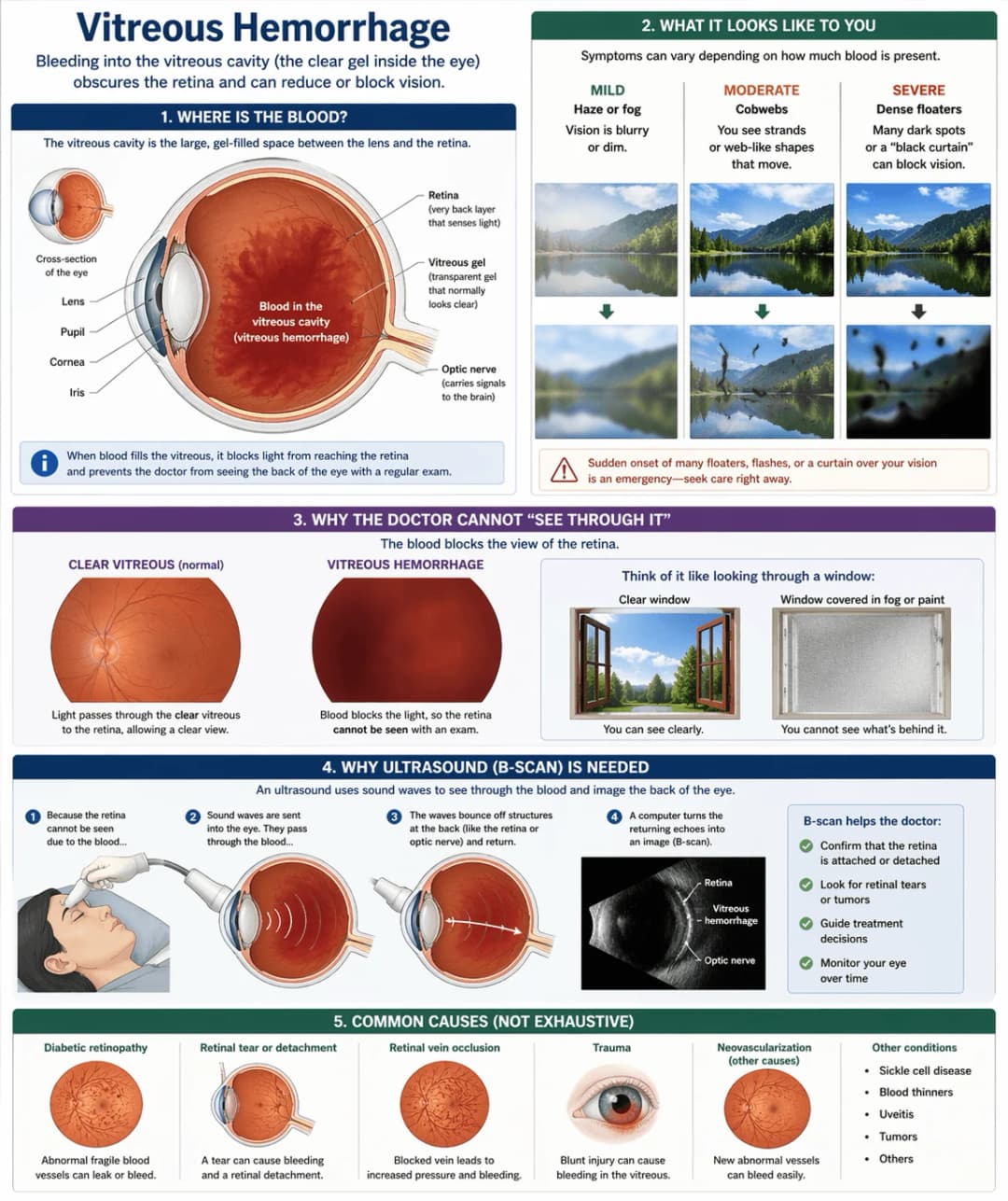
Vitreous hemorrhage should be considered when floaters appear suddenly, vision develops a red or dark haze, or vision drops without pain. Blood has entered the vitreous cavity, the clear gel-filled space in the middle of the eye. A small hemorrhage may cause floaters or mild haze; a dense hemorrhage can block the view of the retina and cause severe vision loss. The amount of blood matters, but the underlying cause matters more. Retinal tear, proliferative diabetic retinopathy, vein occlusion, trauma, and retinal detachment must be evaluated promptly.
Key Takeaways
- Blood in the vitreous blocks and scatters light, so vision may look smoky, red-brown, obscured by cobweb-like shadows, or suddenly dim
- Proliferative diabetic retinopathy is the leading adult cause, followed by retinal tears and vein occlusions
- A retinal tear has to be ruled out, especially when flashes and a shower of new floaters arrive together
- B-scan ultrasound is the backup view when blood hides the retina during the exam
- Mild bleeds may clear, while dense or non-clearing hemorrhage may need vitrectomy
- Seek urgent eye care for a sudden shower of floaters or red haze because the underlying retinal cause may be sight-threatening
Seek urgent eye care if you experience:
- Sudden shower of new floaters or dark spots
- A red, dark, or smoky haze across your vision that appeared suddenly
- Rapid, painless loss of vision in one eye
- Flashes of light accompanied by new floaters
- Any of these symptoms in an eye with known diabetic retinopathy
Vitreous hemorrhage can be a sign of retinal detachment or other emergencies. Do not wait for symptoms to improve on their own.
Understanding Vitreous Hemorrhage
Anatomy of the Vitreous
The vitreous humor is a transparent, gel-like substance that fills approximately 80% of the eye's volume. It is composed of about 99% water, along with a network of collagen fibrils and hyaluronic acid that give it structure. Under normal conditions, the vitreous is completely clear, allowing light to pass through unobstructed to reach the retina.
The vitreous is enclosed by the vitreous membrane (hyaloid membrane) and is attached to several structures, including the retina at its base (vitreous base), around the optic nerve head, and at the macula. These attachment points become important in understanding how vitreous hemorrhage develops, particularly in the context of posterior vitreous detachment.
How Blood Enters the Vitreous
Blood can enter the vitreous cavity through several mechanisms:
- Abnormal new blood vessels (neovascularization): In conditions like proliferative diabetic retinopathy, oxygen-deprived retinal tissue stimulates the growth of fragile new blood vessels. These vessels lack normal structural support and rupture easily, bleeding into the vitreous.
- Retinal tears: When the vitreous separates from the retina (posterior vitreous detachment), it can tear a retinal blood vessel, causing hemorrhage. The torn vessel bleeds into the vitreous cavity.
- Existing vessel rupture: Normal retinal blood vessels can rupture due to increased pressure (as in vein occlusions) or structural abnormalities (as in macroaneurysms).
- Extension from other sources: Blood from subretinal hemorrhage, choroidal hemorrhage, or subarachnoid hemorrhage (Terson syndrome) can break through into the vitreous.
Once blood enters the vitreous, it scatters and absorbs light, blocking the clear visual pathway between the lens and the retina. A small amount of blood can cause floaters and mild haziness, while a large hemorrhage can reduce vision to the ability to perceive only light.
Causes
Identifying the cause of vitreous hemorrhage is the most important step in management because treatment is directed at the underlying condition.
Proliferative Diabetic Retinopathy (Most Common)
Proliferative diabetic retinopathy (PDR) is the leading cause of vitreous hemorrhage in adults, accounting for approximately 30-40% of all cases. In PDR, chronic high blood sugar damages the retinal blood vessels, leading to widespread retinal ischemia (oxygen deprivation). The ischemic retina releases VEGF and other growth factors that stimulate the growth of new, abnormal blood vessels (neovascularization) on the retinal surface and optic disc.
These new vessels are structurally fragile-they lack the tight junctions and smooth muscle support of normal vessels. They can rupture spontaneously or with minor physiological events such as changes in blood pressure, straining, coughing, or even during sleep. The bleeding may range from a small amount causing a few new floaters to a massive hemorrhage that fills the entire vitreous cavity.
Vitreous hemorrhage is often the first symptom that alerts a patient to the presence of proliferative diabetic retinopathy, underscoring the importance of regular dilated eye examinations for all people with diabetes.
Retinal Tears and Posterior Vitreous Detachment
A retinal tear associated with posterior vitreous detachment (PVD) is the second most common cause of vitreous hemorrhage. As the vitreous gel liquefies and separates from the retina with age, it can tear the retina, especially at points of firm vitreous-retinal adhesion. If a retinal blood vessel crosses the site of the tear, it too can be torn, causing bleeding into the vitreous cavity.
This is a particularly important cause to identify because a retinal tear can progress to a retinal detachment if not treated promptly. The vitreous hemorrhage itself may obscure the view of the retina, making it difficult to see the tear on clinical examination-this is why B-scan ultrasound is so important in these cases.
Patients typically report the sudden onset of floaters, often described as a "shower of spots," along with flashes of light, followed by blurred or darkened vision as the hemorrhage spreads.
Retinal Vein Occlusion
Central retinal vein occlusion (CRVO) and branch retinal vein occlusion (BRVO) can cause vitreous hemorrhage through two mechanisms. In the acute phase, the blocked vein causes increased pressure in the retinal capillaries, which may rupture and bleed. In the chronic phase, ischemia from the vein occlusion can trigger neovascularization (similar to diabetic retinopathy), and these new vessels can bleed into the vitreous.
Neovascular glaucoma is a feared complication of ischemic CRVO that may accompany vitreous hemorrhage and requires urgent treatment.
Trauma
Ocular trauma-both blunt and penetrating-is a common cause of vitreous hemorrhage, particularly in younger patients. Blunt trauma can cause bleeding through several mechanisms:
- Direct rupture of retinal or choroidal blood vessels from the concussive force
- Retinal tears caused by traumatic vitreous traction
- Choroidal rupture with secondary hemorrhage
- Commotio retinae with associated vascular damage
Penetrating injuries can directly disrupt blood vessels. In severe trauma, vitreous hemorrhage may be accompanied by other injuries such as lens dislocation, hyphema (blood in the front of the eye), and globe rupture.
Shaken baby syndrome (abusive head trauma) in infants frequently causes bilateral vitreous hemorrhages and is a critical diagnostic finding.
Wet Age-Related Macular Degeneration
Wet AMD involves the growth of abnormal blood vessels (choroidal neovascularization) beneath the retina. These vessels can leak fluid and blood. In some cases, a large bleed can break through the retina into the vitreous cavity, causing vitreous hemorrhage. This is sometimes called a "breakthrough" vitreous hemorrhage and typically indicates an advanced or aggressive form of the disease.
Sickle Cell Retinopathy
In patients with sickle cell disease-particularly sickle cell SC disease (HbSC) and sickle cell thalassemia (HbS-Thal)-abnormally shaped red blood cells can block small retinal blood vessels, causing peripheral retinal ischemia and neovascularization. These fragile new vessels are prone to bleeding. Sickle cell retinopathy is a significant cause of vitreous hemorrhage in younger patients of African descent.
Other Causes
- Retinal arterial macroaneurysm - an outpouching of a retinal artery that can rupture and bleed at multiple levels, including into the vitreous
- Terson syndrome - vitreous hemorrhage associated with subarachnoid hemorrhage (bleeding around the brain), caused by a sudden increase in intracranial pressure
- Blood dyscrasias - conditions affecting blood clotting, including leukemia, thrombocytopenia, and anticoagulant therapy, can increase the risk of vitreous hemorrhage
- Retinal vasculitis - inflammatory conditions affecting retinal blood vessels (e.g., Eales disease)
- Systemic infections - such as malaria causing retinal hemorrhage
- Tumors - retinal or choroidal tumors with associated neovascularization
Symptoms
The symptoms of vitreous hemorrhage depend on the amount and location of blood within the vitreous cavity.
Sudden Floaters
New floaters are often the first symptom. Patients may describe:
- A sudden "shower of spots" or "swarm of gnats"
- Cobweb-like strands or threads drifting across vision
- Dark spots or clumps that move with eye movement
- Floaters that are much larger, darker, or more numerous than any previously experienced
Red or Dark Haze
As more blood disperses through the vitreous, patients typically notice:
- A red, reddish-brown, or dark haze across the visual field
- Vision that looks as if seen through a red or smoky filter
- The haze may fluctuate-often worse upon waking (blood settles with gravity during sleep and is then redistributed with eye movement upon waking)
Painless Vision Loss
Vitreous hemorrhage is characteristically painless. Vision loss can range from:
- Mild blurring with a few floaters (small hemorrhage)
- Significant reduction requiring large-print reading (moderate hemorrhage)
- Vision reduced to perceiving only light (dense hemorrhage filling the entire vitreous cavity)
The painless nature is an important distinguishing feature. If significant eye pain accompanies the hemorrhage, this may indicate additional pathology such as neovascular glaucoma, trauma-related injury, or endophthalmitis.
Severity Classification
Ophthalmologists classify vitreous hemorrhage based on density and the ability to visualize the retina, which directly affects management decisions.
Mild
- Scattered blood cells in the vitreous
- Floaters are the primary symptom
- The fundus (retina) can still be clearly seen on examination
- Visual acuity mildly reduced or near normal
- The underlying retina can be assessed directly
Moderate
- Greater amount of blood obscuring some retinal detail
- Significantly blurred vision
- Major retinal features (optic disc, large vessels) are visible but detail is reduced
- May be difficult to fully assess the peripheral retina
- Cause may or may not be identifiable on clinical exam
Severe (Dense)
- Vitreous filled with blood; no fundus view possible
- Vision may be reduced to hand motions or light perception only
- Cannot see the retina on clinical examination
- B-scan ultrasound is essential to assess for retinal detachment and other pathology
- Requires careful monitoring or surgical intervention
Diagnosis
Diagnosing vitreous hemorrhage itself is usually straightforward, but identifying the underlying cause is the critical challenge.
Dilated Fundus Examination
A thorough dilated fundus exam is the first step. The ophthalmologist will:
- Assess the density of the hemorrhage and whether the retina can be visualized
- Look for signs of the underlying cause (neovascularization, retinal tears, vein occlusion)
- Examine the fellow eye-findings in the unaffected eye often provide clues to the diagnosis (e.g., diabetic retinopathy, retinal vein occlusion)
- Check intraocular pressure-elevated pressure may indicate neovascular glaucoma
- Examine the anterior segment for rubeosis iridis (new blood vessels on the iris)
B-Scan Ultrasound
B-scan ultrasound is the most important diagnostic tool when a dense vitreous hemorrhage prevents direct visualization of the retina. This painless imaging technique uses sound waves to create a two-dimensional cross-sectional image of the eye's interior.
B-scan ultrasound can:
- Detect retinal detachment - the most urgent finding to rule out; a detached retina appears as a bright, mobile membrane within the vitreous cavity
- Identify posterior vitreous detachment - seen as a thin, mobile membrane separate from the retinal surface
- Assess for masses or tumors - elevated lesions along the eye wall
- Evaluate the extent of hemorrhage - determine whether blood is confined to the vitreous or extends to other spaces
- Monitor for progression - serial ultrasounds track whether the hemorrhage is clearing or worsening
B-scan ultrasound should be performed at the initial visit and repeated periodically (typically every 1-2 weeks) until the retina can be visualized directly.
Optical Coherence Tomography (OCT)
OCT is useful when the vitreous hemorrhage is mild enough to allow imaging through the blood. It can:
- Evaluate the macula for edema, epiretinal membrane, or other pathology
- Assess the vitreoretinal interface
- Provide baseline imaging before treatment
- In cases of cleared or clearing hemorrhage, identify subtle structural changes
Fluorescein Angiography
Fluorescein angiography is performed once the hemorrhage has cleared sufficiently to allow retinal photography. It is particularly valuable for:
- Identifying neovascularization and guiding laser treatment
- Detecting retinal ischemia that may drive new vessel growth
- Evaluating retinal vein occlusions and their complications
- Planning treatment for the underlying cause
Additional Evaluation
Depending on the suspected cause, additional testing may include:
- Blood tests - hemoglobin A1c (diabetes control), complete blood count, coagulation studies, sickle cell screening
- Blood pressure measurement - hypertension is a risk factor for many causes of vitreous hemorrhage
- Review of medications - anticoagulants and antiplatelet agents may contribute to bleeding
Treatment
The treatment strategy for vitreous hemorrhage is guided by the underlying cause, the severity of the hemorrhage, and whether a sight-threatening condition (such as retinal detachment) is present.
Observation
For mild to moderate vitreous hemorrhage without retinal detachment, observation is often the initial approach:
- Blood in the vitreous is gradually resorbed by the body's natural processes
- The clearing process typically takes weeks to months, depending on the amount of blood
- Activity modifications: Head elevation during sleep (using an extra pillow) encourages blood to settle inferiorly by gravity, clearing the visual axis
- Avoiding blood thinners: When medically safe, temporary discontinuation or reduction of anticoagulant medications may be considered (only under the guidance of the prescribing physician)
- Serial monitoring: Regular follow-up every 1-4 weeks with B-scan ultrasound to ensure no retinal detachment develops as the blood clears
Observation is most appropriate when:
- The cause is known and not immediately sight-threatening
- No retinal detachment is present on ultrasound
- The patient has useful vision in the other eye
- The hemorrhage appears to be clearing on follow-up visits
Treating the Underlying Cause
Addressing the cause of the bleeding is essential to prevent recurrence:
- Diabetic retinopathy: Optimize blood sugar control, manage blood pressure and lipids, and treat the proliferative disease with laser or anti-VEGF therapy once the hemorrhage clears enough to allow treatment
- Retinal tears: Prompt laser or cryotherapy to seal the tear and prevent retinal detachment
- Retinal vein occlusion: Monitor for neovascularization and treat with anti-VEGF injections or laser as needed
- Wet AMD: Initiate or continue anti-VEGF therapy
- Sickle cell retinopathy: Laser photocoagulation to ischemic retina; hematologic management
Vitrectomy Surgery
Pars plana vitrectomy-surgical removal of the vitreous gel and blood-is indicated when:
- Vitreous hemorrhage does not clear after an appropriate observation period (typically 1-3 months for diabetic hemorrhage, shorter for other causes)
- Retinal detachment is present or suspected - urgent vitrectomy is needed
- The underlying cause requires visualization - for example, a retinal tear needs to be identified and treated
- Dense bilateral hemorrhage - causing significant functional impairment
- Recurrent hemorrhage - repeated episodes despite treatment of the underlying cause
- Associated conditions - such as ghost cell glaucoma (elevated eye pressure from old blood cells clogging the drainage system)
During vitrectomy, the surgeon:
- Makes small incisions (typically 23- or 25-gauge) through the pars plana
- Removes the blood-filled vitreous gel using a specialized cutting instrument
- Identifies and treats the cause of bleeding (laser to tears, membrane peeling, etc.)
- Replaces the vitreous with balanced salt solution, gas, or silicone oil depending on the findings
- Applies endolaser photocoagulation as needed
Modern small-gauge vitrectomy techniques have made the surgery safer and recovery faster, with most patients going home the same day.
Anti-VEGF Injections
Anti-VEGF injections play several roles in the management of vitreous hemorrhage:
- Pre-operative adjunct: Injected before vitrectomy surgery in eyes with proliferative diabetic retinopathy to reduce active neovascularization and intraoperative bleeding, making surgery safer
- Treatment of the underlying neovascularization: In cases where the hemorrhage is clearing and neovascularization is visible, anti-VEGF injections can cause regression of the abnormal vessels
- Treatment of associated macular edema: Many conditions that cause vitreous hemorrhage also cause macular edema, which can be treated with anti-VEGF agents
Commonly used agents include ranibizumab, aflibercept, and bevacizumab, as described for other retinal conditions.
Panretinal Photocoagulation (PRP)
Panretinal photocoagulation is a laser treatment applied to the peripheral retina to treat the ischemia driving neovascularization. It is a cornerstone treatment for:
- Proliferative diabetic retinopathy - PRP reduces oxygen demand of the peripheral retina, causing regression of neovascularization and reducing the risk of future vitreous hemorrhage
- Ischemic retinal vein occlusion with neovascularization - prevents progression to vitreous hemorrhage and neovascular glaucoma
- Sickle cell retinopathy - treats peripheral ischemia and neovascularization
PRP is typically performed once the vitreous hemorrhage has cleared enough to allow safe and accurate laser delivery. In some cases, it can be performed during vitrectomy surgery (endolaser photocoagulation). The treatment is highly effective at preventing recurrent hemorrhage when the underlying cause is ischemia-driven neovascularization.
Prognosis
The visual prognosis after vitreous hemorrhage depends primarily on the underlying cause and whether the retina remains healthy.
Favorable Outcomes
- Retinal tear without detachment: If the tear is identified and treated promptly with laser or cryotherapy, and the blood clears, vision typically returns to baseline
- Mild diabetic vitreous hemorrhage: With successful treatment of the underlying PDR (anti-VEGF and/or PRP), and no macular involvement, good visual recovery is expected
- Post-PVD hemorrhage without retinal tear: Blood resorbs over weeks to months with full visual recovery
- Traumatic hemorrhage without retinal damage: Vitreous blood clears and vision recovers
Guarded Outcomes
- Dense hemorrhage requiring vitrectomy: Outcomes depend on the underlying retinal health; vitrectomy itself has a high success rate for clearing blood, but visual recovery depends on the macula
- Diabetic retinopathy with macular involvement: Even after clearing the hemorrhage, diabetic macular edema or macular ischemia may limit visual recovery
- Retinal detachment: If detachment is discovered, visual prognosis depends on whether the macula is involved and how quickly surgical repair is performed
- Recurrent hemorrhage: Repeated episodes may indicate ongoing disease activity that is difficult to control
Timeline for Clearing
- Small hemorrhages may clear in 2-4 weeks
- Moderate hemorrhages typically clear in 1-3 months
- Dense hemorrhages may take 3-6 months or longer to clear without surgery
- If the hemorrhage is not clearing or the cause requires treatment, vitrectomy should not be delayed indefinitely
Frequently Asked Questions
How long does it take for vitreous hemorrhage to clear on its own?
The time for vitreous blood to resorb depends on the amount of bleeding. A small hemorrhage may clear in a few weeks, while a dense hemorrhage can take three to six months or even longer. During this time, your ophthalmologist will monitor you regularly with examinations and B-scan ultrasound to ensure no retinal detachment is present. If the blood is not clearing at an expected rate, or if the underlying cause requires treatment, vitrectomy surgery may be recommended.
Is vitreous hemorrhage an emergency?
Vitreous hemorrhage itself is not always a surgical emergency, but it always requires urgent evaluation-ideally within 24 hours. The urgency stems from the need to rule out retinal detachment, which is a true emergency requiring prompt surgical repair. Even when no detachment is found, identifying the underlying cause allows timely treatment that can prevent further bleeding and protect your vision.
Can vitreous hemorrhage cause permanent vision loss?
The vitreous hemorrhage itself does not usually cause permanent damage-once the blood clears or is surgically removed, light can again reach the retina. However, the underlying condition causing the hemorrhage may cause permanent damage. For example, a retinal detachment that goes undetected behind a dense hemorrhage, or chronic macular ischemia from diabetic retinopathy, can lead to irreversible vision loss. This is why identifying and treating the underlying cause is so important.
What should I do if I suddenly see floaters and a red haze?
Contact your ophthalmologist or go to an emergency room with ophthalmology services immediately. Sudden floaters with a red or dark haze are classic symptoms of vitreous hemorrhage and require prompt evaluation. While waiting for your appointment, avoid strenuous activity and heavy lifting. Sleeping with your head elevated may help the blood settle. Do not ignore these symptoms-an underlying retinal tear or detachment may need urgent treatment.
Will I need surgery for vitreous hemorrhage?
Not always. Many cases of vitreous hemorrhage, particularly mild ones, can be managed with observation alone as the blood gradually resorbs. However, surgery (vitrectomy) is recommended if the hemorrhage does not clear within an appropriate timeframe, if retinal detachment is present or suspected, if the cause of the hemorrhage needs to be identified and treated, or if both eyes are affected and the hemorrhage is limiting the patient's ability to function. Your ophthalmologist will discuss the best approach for your specific situation.
References
Medical Disclaimer: This information is for educational purposes only and does not replace professional medical advice, diagnosis, or treatment. If you experience sudden floaters, a red haze, or vision loss, seek urgent eye care.
Sources:
- StatPearls. Vitreous Hemorrhage. NCBI Bookshelf.
- American Academy of Ophthalmology EyeWiki. Vitreous Hemorrhage.
- Spraul CW, Grossniklaus HE. Vitreous Hemorrhage. Surv Ophthalmol. 1997;42(1):3-39.
- Lean JS, Gregor ZJ. The Acute Vitreous Hemorrhage. Br J Ophthalmol. 1980;64(7):469-471.
- National Eye Institute. Diabetic Retinopathy.
- Diabetic Retinopathy Clinical Research Network. Panretinal Photocoagulation vs Intravitreous Ranibizumab for Proliferative Diabetic Retinopathy (Protocol S). JAMA. 2015;314(20):2137-2146.