

Photopsia (Flashes of Light)
Seeing flashes of light when there is no external source. Learn what causes light flashes in your vision, when they're serious, and when to seek emergency care.
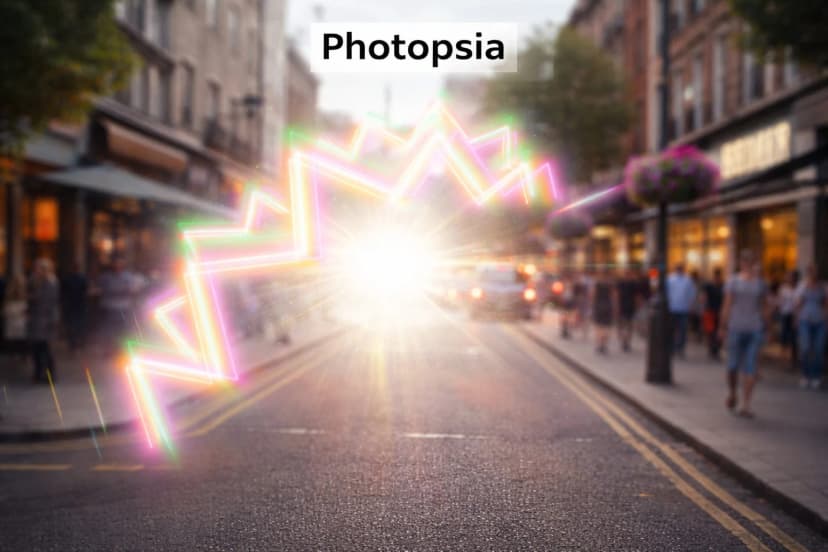
Photopsia means seeing flashes when there is no outside light making them. People call them sparks, camera flashes, lightning streaks, arcs, or flickers. Many are harmless, but new flashes - especially with floaters - need prompt evaluation because a retinal tear can start this way.
Key Takeaways
- New flashes plus new floaters should be checked the same day
- Posterior vitreous detachment, migraine, and retinal traction are common causes
- One-eye flashes lean toward an eye problem; both-eye patterns may be migraine aura
- Most flashes are not sight-threatening, but retinal tears and detachment must be ruled out
- Fast evaluation can prevent vision loss if a tear is found before retinal detachment
What Photopsia Looks Like
People describe flashes in several ways:
- Brief sparks or stars at the edge of vision
- Lightning bolt streaks especially with eye movement
- Arc or crescent-shaped flashes in peripheral vision
- Flickering or shimmering lights
- Camera flash-like bursts
- Flashes that occur in darkness or with eyes closed
- Flashes triggered by eye movement or position change
Common Causes
Posterior Vitreous Detachment (PVD)
The most common cause of new photopsia in adults over 50:
- The vitreous gel inside the eye shrinks with age
- As it separates from the retina, it tugs and stimulates photoreceptors
- Causes brief flashes, often in peripheral vision
- Usually accompanied by new floaters
- Flashes typically decrease over weeks to months
- Generally benign but must rule out retinal tear
Retinal Tear or Detachment
A serious cause requiring immediate treatment:
- Vitreous traction creates a tear in the retina
- Flashes may be more persistent or pronounced
- Often accompanied by shower of new floaters
- May progress to vision loss if untreated
- Risk factors: high myopia, previous eye surgery, trauma, family history
Migraine
A common cause of visual symptoms:
- Migraine aura causes flashing lights in both eyes
- Typically zigzag or scintillating patterns
- Lasts 20-60 minutes
- Often followed by headache
- Ocular migraine may cause flashes without headache
Optic Nerve Conditions
- Optic neuritis can cause phosphenes (light flashes with eye movement)
- Flashes triggered by moving the eyes
- Associated with eye pain and vision loss
Other Causes
- Pressure on the eye (rubbing, compression)
- Posterior vitreous detachment without complications
- Vitreous hemorrhage
- Ocular blood vessel spasm
- Digitalis toxicity (medication side effect)
- Low blood pressure or standing up quickly
When to Seek Emergency Care
Seek same-day or emergency evaluation if you experience:
- Sudden onset of new flashes, especially with new floaters
- Shower or curtain of floaters
- Shadow or curtain coming across your vision
- Sudden decrease in vision
- Flashes after eye injury or trauma
- Flashes with eye pain
These may indicate a retinal tear or detachment requiring immediate treatment.
What You'll Be Asked in Clinic
Your doctor will want to understand your flashes:
About the flashes:
- When did they start?
- One eye or both eyes?
- Where in your vision do they appear?
- What triggers them (eye movement, position change)?
- How long does each flash last?
- Are they becoming more or less frequent?
Associated symptoms:
Risk factors:
- Are you nearsighted (myopia)?
- Previous eye surgery or trauma?
- Family history of retinal detachment?
- History of migraine?
How Photopsia Is Diagnosed
Eye Examination
- Visual acuity-checking your vision
- Pupil examination-looking for nerve problems
- Dilated fundus exam-critical for viewing the retina
- Slit-lamp examination-examining the vitreous
- Peripheral retina examination-checking for tears or detachment
Additional Tests
Depending on findings:
- OCT (Optical Coherence Tomography)-detailed retinal imaging
- B-scan ultrasound-if vitreous hemorrhage blocks view
- Visual field testing-if vision loss present
- MRI-if optic nerve problem suspected
Treatment Options
Treatment depends on what is triggering the flash:
For PVD Without Complications
- Observation-most resolve without treatment
- Follow-up examination-ensure no retinal tear develops
- Activity precautions-may be advised temporarily
- Flashes typically decrease over weeks
For Retinal Tears
- Laser photocoagulation-seals tear to prevent detachment
- Cryotherapy-freezing treatment around tear
- Urgent treatment prevents progression to detachment
For Retinal Detachment
- Surgical repair-pneumatic retinopexy, scleral buckle, or vitrectomy
- Earlier treatment generally means better visual outcome
For Migraine-Related Flashes
- Migraine management-preventive and acute treatments
- See migraine for treatment options
For Optic Neuritis
- IV steroids may speed recovery
- See optic neuritis for details
Living with Photopsia
If You Have PVD
- Flashes usually improve over 4-6 weeks
- Floaters may persist but become less noticeable
- Know the warning signs of retinal problems
- Attend scheduled follow-up appointments
Monitoring for Changes
Return promptly if you notice:
- Increase in flashes
- New shower of floaters
- Any shadow or curtain in your vision
- Decrease in vision
Frequently Asked Questions
Are flashes of light always serious?
Not always. Occasional brief flashes can happen, especially with age-related vitreous changes. But new, sudden, persistent, or one-eye flashes - particularly with floaters - should be evaluated to rule out a retinal tear.
How can I tell if my flashes are from migraine or my eye?
Migraine aura typically affects both eyes (though may seem one-sided), lasts 20-60 minutes, often has zigzag or scintillating patterns, and may be followed by headache. Eye-related flashes typically affect one eye, are brief, may be triggered by eye movement, and are often accompanied by floaters.
Will the flashes go away?
With PVD, flashes typically decrease significantly within weeks to months as the vitreous completely separates. Migraine-related flashes resolve after each episode. Persistent or worsening flashes need re-evaluation.
Can I prevent retinal detachment?
You cannot prevent PVD, but prompt evaluation of flashes allows early detection and treatment of retinal tears before they progress to detachment. This is why urgent evaluation of new symptoms is so important.
Should I avoid activities with photopsia?
Your doctor will advise based on your specific situation. Generally, while being evaluated for new flashes, avoiding heavy lifting, straining, or contact sports may be recommended until retinal problems are ruled out.
References
Medical Disclaimer: This information is for educational purposes only and does not replace professional medical advice, diagnosis, or treatment. If you have concerns about flashes of light or any visual symptoms, please consult a qualified healthcare provider promptly.
Sources:
- American Academy of Ophthalmology. Flashes of Light.
- Hollands H, et al. Acute-onset floaters and flashes: is this patient at risk for retinal detachment? JAMA. 2009;302(20):2243-2249.
- National Eye Institute. Floaters and Flashes.
- American Society of Retina Specialists. Posterior Vitreous Detachment.