

Contrast Sensitivity Testing
A test measuring your ability to distinguish objects from their background, often affected in optic nerve conditions.
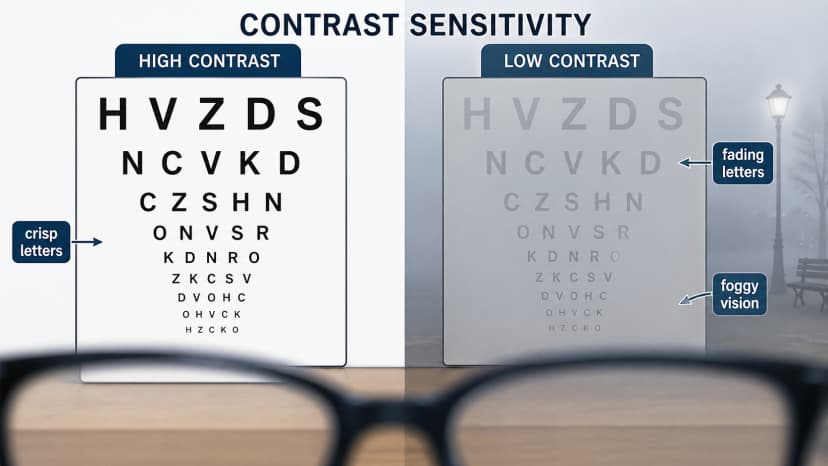
Contrast sensitivity testing measures how well you can distinguish objects that don't stand out clearly from their background-like seeing a gray car on a foggy day. This can be reduced even when standard visual acuity is normal.
Key Takeaways
- Measures ability to see low-contrast objects
- Often abnormal in optic nerve disease
- May be affected even with good acuity
- Explains difficulty in dim lighting, fog
- Quick office test
Why It's Done
- Detect optic nerve dysfunction not seen on acuity testing
- Monitor optic neuritis recovery
- Evaluate MS-related visual problems
- Assess functional vision more completely
- Explain visual complaints despite "good" acuity
What It Tests
Standard visual acuity charts use high contrast (black letters on white). But real life has many low-contrast situations:
- Driving in fog or rain
- Dim lighting
- Faces in shadows
- Gray objects on gray backgrounds
Types of Tests
Pelli-Robson Chart
- Letters decrease in contrast (fade to gray)
- Easy to perform
- Most common clinical test
Contrast Sensitivity Function (CSF)
- Tests different sizes and contrasts
- More detailed assessment
- Research and specialty settings
Low-Contrast Letter Charts
- Like standard acuity chart but gray letters
- Sloan low-contrast charts common
What to Expect
- Similar to regular eye chart reading
- Letters or patterns at decreasing contrast
- Each eye tested separately
- Takes 5-10 minutes
Interpreting Results
Normal
- Can read low-contrast targets
- Good real-world vision expected
Reduced
- Difficulty with low-contrast targets
- May explain visual complaints
- Common in optic nerve disease
- May persist after acuity recovers
Why It Matters When Acuity Is Normal
Standard acuity is a high-contrast test: black letters on a white background. Some optic nerve and retinal conditions leave that score looking good while reducing the ability to see faded edges, low light, or motion in clutter. That is why someone recovering from optic neuritis may read 20/20 yet still struggle with night driving, gray stairs, or faces in shadow.
Your doctor may compare contrast sensitivity with color vision testing, visual field testing, and OCT to decide whether symptoms reflect optic nerve dysfunction, retinal disease, cataract, or dry-eye-related blur.
Frequently Asked Questions
Can contrast sensitivity be poor even if I read 20/20?
Yes. A 20/20 eye chart result does not measure every part of visual function. Low-contrast testing can capture real-world difficulty that a standard chart misses.
Is reduced contrast sensitivity always from the optic nerve?
No. Optic nerve disease is one cause, but cataracts, macular disease, dry eye, uncorrected glasses prescription, and neurologic disease can also reduce contrast.
Can contrast sensitivity improve?
Sometimes. It may improve as inflammation, dry eye, cataract, or refractive blur is treated. If the cause is permanent optic nerve or retinal damage, improvement may be limited, but testing can still help document stability.
Medical Disclaimer: This information is for educational purposes only and does not replace professional medical advice.
Sources:
- StatPearls. Optic Neuritis. NCBI Bookshelf.
- StatPearls. Multiple Sclerosis. NCBI Bookshelf.
- Pelli DG, Bex P. Measuring contrast sensitivity. Vision Research. 2013;90:10-14.