

Visual Field Defects (Patterns)
Patterns of vision loss that help localize where in the visual pathway damage has occurred.
Visual field defects are patterns of vision loss that help identify where in the visual pathway damage has occurred. Different locations cause characteristic patterns.
Key Takeaways
- Pattern reveals location of damage
- Helps diagnose underlying condition
- Monitored with visual field testing
- May be noticed by patient or found on testing
- Important for tracking progression
Common Patterns
Central Scotoma

- Blind spot in center of vision
- Causes: optic neuritis, macular disease
- Significantly affects reading, detail vision
Arcuate Defect
- Arc-shaped defect above or below fixation
- Causes: glaucoma, ischemic optic neuropathy
- Follows nerve fiber bundle pattern
Altitudinal Defect
- Loss of upper or lower half of vision
- Causes: ischemic optic neuropathy, branch retinal artery occlusion
- Respects horizontal midline
Hemianopia
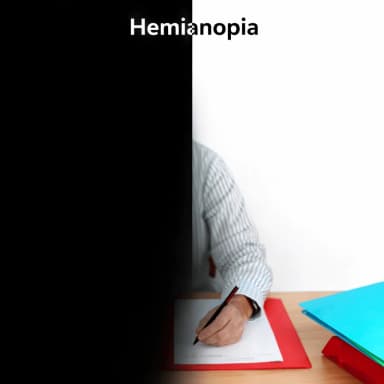
- Loss of right or left half of vision
- Homonymous-same side affected in both eyes (brain lesion)
- Causes: stroke, tumor, trauma
Bitemporal Hemianopia
- Outer (temporal) fields lost in both eyes
- Causes: pituitary tumor, chiasmal compression
- Affects both outer visual fields
Quadrantanopia
- One quarter of visual field affected
- Localizes to specific area of visual pathway
Generalized Constriction
- Peripheral vision lost all around
- Causes: glaucoma, retinal disease, papilledema
Localization
| Defect | Location |
|---|---|
| Central scotoma | Optic nerve, macula |
| Bitemporal hemianopia | Optic chiasm |
| Homonymous hemianopia | Brain (opposite side) |
| Altitudinal | Optic nerve, retina |
Monitoring
Regular visual field testing tracks:
- Stability vs progression
- Response to treatment
- Need for intervention
How to Use the Pattern
The pattern is a clue, not a final diagnosis. A central scotoma may come from the optic nerve or macula, so OCT and a dilated retinal exam matter. A bitemporal hemianopia points to the chiasm and usually triggers MRI. A homonymous hemianopia points behind the chiasm and is often evaluated as a brain or stroke problem.
Reliability also matters. Fatigue, droopy lids, lens rim artifact, poor fixation, and learning effect can create misleading defects, so doctors often repeat tests before calling a subtle change real.
Frequently Asked Questions
Does a visual field defect mean I am going blind?
Not necessarily. Some defects are stable, some improve, and some need urgent treatment. The cause, pattern, and trend over time are what determine risk.
Why did my doctor repeat the same visual field test?
Repeat testing helps confirm whether a defect is real and whether it is changing. First tests are often less reliable because the task is unfamiliar.
Can a normal eye exam miss a field defect?
Yes. Many field defects are not obvious from a basic eye chart. Formal visual field testing maps areas away from the exact center of vision.
Medical Disclaimer: This information is for educational purposes only and does not replace professional medical advice.
Sources:
- American Academy of Ophthalmology. Standard Automated Perimetry. EyeWiki.