
Eye Movement Examination
Assessment of how the eyes move together, essential for diagnosing causes of double vision and eye misalignment.
The eye movement examination tests how well your eyes move and work together. It's essential for diagnosing the cause of double vision and identifying which muscles or nerves are affected.
Key Takeaways
- Tests all directions of eye movement
- Identifies which muscles/nerves affected
- Essential for diagnosing double vision causes
- Includes alignment and tracking tests
- Performed in office with no special equipment
What's Tested
Versions (Eye Movements Together)
- Both eyes move in same direction
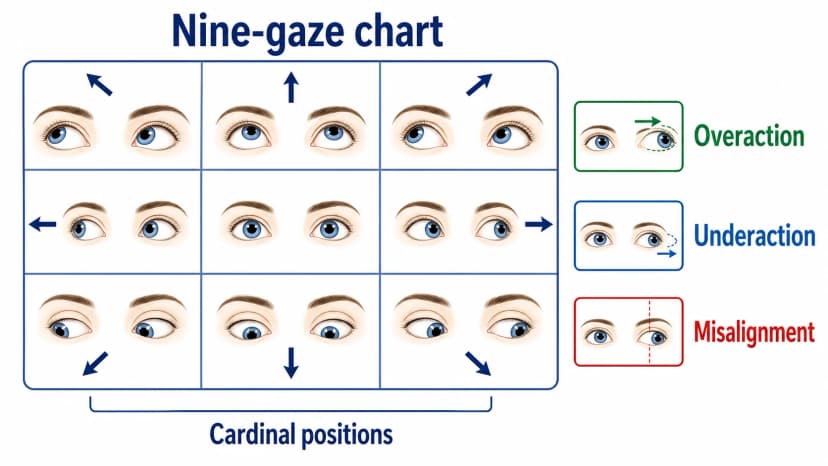
- Test gaze in all nine positions
- Identify limited movements
Ductions (Single Eye Movement)
- One eye at a time
- Cover other eye
- Assess full range of motion
Alignment
- Cover/uncover test
- Prism measurements
- Assess for strabismus
Smooth Pursuit
- Follow moving target
- Assess smoothness
Saccades
- Quick jumps between targets
- Speed and accuracy
Testing Positions
Eyes tested looking:
- Straight ahead (primary position)
- Up, down
- Left, right
- Up-right, up-left
- Down-right, down-left
Identifying the Problem
Which Nerve?
- Third nerve-affects up, down, in
- Fourth nerve-affects down-in, head tilt
- Sixth nerve-can't look outward
Muscle vs Nerve
- Thyroid eye disease-muscle restriction
- Myasthenia-variable, fatigable weakness
Special Tests
Parks-Bielschowsky Three-Step Test
- For vertical double vision
- Identifies which muscle affected
- Head tilt component
Forced Ductions
- Manually move eye (with anesthesia)
- Distinguishes restriction from weakness
Head Position
- Compensatory head turn or tilt
- Minimizes double vision
What the Examiner Is Looking For
The goal is to separate weakness, restriction, and coordination problems:
- Weakness suggests a cranial nerve palsy, myasthenia gravis, or a brainstem disorder.
- Restriction means the eye is mechanically limited, as can happen with thyroid eye disease, orbital inflammation, or an orbital fracture.
- Coordination problems can point to internuclear ophthalmoplegia, nystagmus, skew deviation, or stroke-related eye movement pathways.
This is why the exam may feel repetitive. Looking right, left, up, down, and diagonally creates a map of which movement fails and whether the pattern changes with fatigue or gaze direction.
Call 911 immediately if new eye movement trouble or double vision occurs with BE-FAST stroke symptoms: balance trouble, new vision loss or double vision, face droop, arm weakness, speech trouble, confusion, trouble walking, or sudden severe headache. A new droopy eyelid with a larger pupil, or severe eye pain with a bulging eye, needs emergency department evaluation the same day.
Frequently Asked Questions
Is an eye movement exam the same as a regular vision test?
No. A vision test measures how clearly you see letters. An eye movement exam checks how the two eyes align, move, track, and hold fixation together.
Why does my doctor ask whether double vision changes in different directions?
Different muscles and nerves are stressed in different gaze positions. The direction that makes double vision worse can help localize the affected nerve, muscle, or brain pathway.
Will this exam hurt?
The office exam should not hurt. You may feel eye strain or notice double vision during testing because the examiner is intentionally looking for the position where the problem appears.
Medical Disclaimer: This information is for educational purposes only and does not replace professional medical advice.
Sources:
- American Academy of Ophthalmology EyeWiki. Basic Approach to Diplopia.
- American Academy of Ophthalmology EyeWiki. Sensory and Motor Testing.