

Maddox Rod Test
A simple bedside test that uses a striped lens to dissociate the eyes and quantify the direction and amount of double vision.
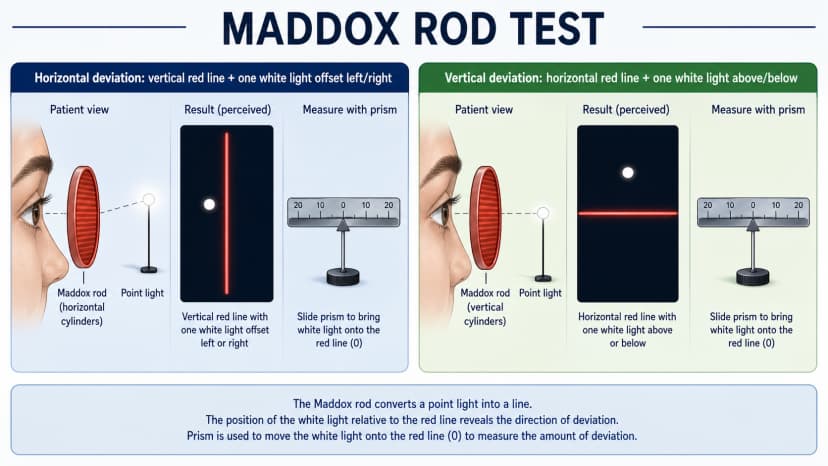
The Maddox rod is a small striped lens, usually red, used in clinic to quantify double vision. When the patient looks at a point light through a Maddox rod, the rod converts the point into a perpendicular line that is seen only by the eye behind the rod. The other eye sees the unchanged point of light. By comparing the perceived position of the line to the point, the examiner determines how the two eyes are misaligned and by how much.
Key Takeaways
- The Maddox rod converts a point light into a streak seen only by the eye behind the rod
- Used to measure horizontal, vertical, and torsional misalignment quickly at the bedside
- The "double Maddox rod" test uses different-colored rods over each eye to specifically measure ocular torsion
- Particularly useful in cranial nerve palsy evaluation, where torsional misalignment is a key clue
- Quick and well-tolerated - usually takes a couple of minutes
How the Test Works
The Maddox rod is placed over one eye (typically the right). The line the patient sees is perpendicular to the cylinders in the rod:
- When the cylinders are aligned horizontally, the patient sees a vertical line - used for measuring horizontal misalignment (the patient reports whether the vertical line is to the right or left of the point)
- When the cylinders are aligned vertically, the patient sees a horizontal line - used for measuring vertical misalignment (line above or below the point)
- Tilting of the line indicates ocular torsion
The eye behind the rod sees the line; the other eye sees the unchanged point. Because the rod fully dissociates the eyes (one eye sees a line, the other a point - fusion is impossible), the test reveals the total deviation - both manifest tropias and latent phorias. The amount of separation can be measured with a prism bar held over the other eye, giving a quantitative result in prism diopters.
Common Uses
- Acute diplopia - quick characterization of the pattern
- Fourth nerve palsy - both vertical and torsional components
- Sixth nerve palsy - primarily horizontal deviation
- Skew deviation - distinguishing skew from fourth nerve palsy by torsion direction
- Phorias and intermittent strabismus - measurement at distance and near
- Pre-operative measurement before strabismus surgery
Double Maddox Rod for Torsion
A specialized variation uses red rod over one eye and white rod over the other, both oriented vertically. The patient adjusts each rod independently until both lines appear horizontal, and the examiner reads the torsional offset directly from the trial frame. This is one of the most precise bedside measurements of cyclotorsion.
The double Maddox rod helps distinguish skew deviation from fourth nerve palsy by the direction of torsion of the higher (hypertropic) eye. In a fourth nerve (superior oblique) palsy, the higher eye is excyclotorted (because the SO is the primary intortor and is paretic). In skew deviation as part of the ocular tilt reaction, the higher eye is incyclotorted and the lower eye is excyclotorted. This is one of the most useful bedside features distinguishing peripheral CN IV palsy from a central skew.
In suspected fourth nerve palsy, Maddox rod measurements in primary gaze, contralateral gaze, and on head tilt to each shoulder (Bielschowsky three-step test) help characterize the pattern and support the diagnosis.
Frequently Asked Questions
Why is the rod red?
The red color makes it easy to identify which eye sees the line. White rods are used in some testing but red is the historical standard.
Can I see only the line and not the point?
That can happen if there is suppression in the non-tested eye, particularly in patients with long-standing strabismus or amblyopia. Suppression makes the test less useful.
How is this different from the cover test?
The cover test detects misalignment by occluding one eye and watching the other. The Maddox rod uses dissociation through optics rather than occlusion. The two are complementary; the Maddox rod is particularly useful for detecting and measuring torsional components.
References
Medical Disclaimer: This information is for educational purposes only and does not replace professional medical advice.
Sources:
- American Academy of Ophthalmology EyeWiki. Maddox Rod.
- Wright KW, Spiegel PH. Pediatric Ophthalmology and Strabismus. 2nd ed. Springer; 2003.