

Laser Peripheral Iridotomy (LPI)
A quick iris laser that creates a bypass opening for fluid in pupillary-block angle closure and certain narrow-angle eyes.
Laser peripheral iridotomy (LPI) makes a small opening in the far edge of the iris, usually tucked under the upper lid. That opening lets fluid bypass the pupil when pupillary block is crowding the drainage angle. It is standard treatment for pupillary-block angle closure and is used preventively in selected narrow-angle eyes when the anatomy fits.
Key Takeaways
- Creates a small bypass opening in the iris
- Treats pupillary-block angle closure and reduces risk in selected narrow-angle eyes
- Usually takes less than 10 minutes
- Recovery is minimal, but follow-up confirms the opening is patent and the angle is safer
- Does not fix every angle-closure mechanism, especially plateau iris
- The fellow eye is often treated because anatomy is usually similar
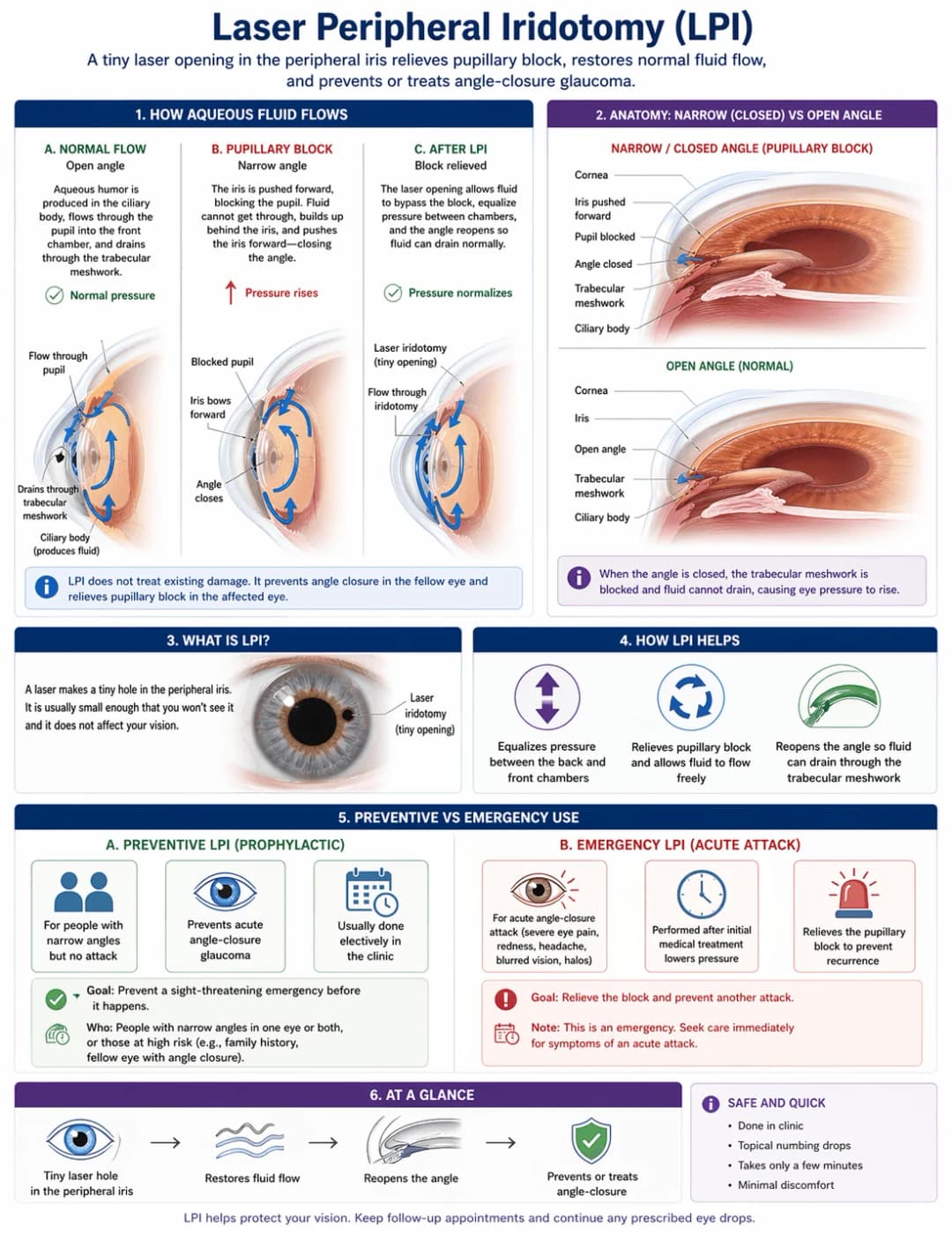
How LPI Works
The Problem: Pupillary Block
In angle closure:
- The iris bows forward
- Blocks the drainage angle
- Fluid cannot exit the eye
- Eye pressure rises (potentially very high)
This often happens because fluid has trouble passing between the iris and lens. Pressure builds behind the iris, the iris bows forward, and the drainage angle narrows or closes.
The Solution
LPI creates a small hole in the peripheral iris:
- Allows fluid to flow directly through the iris
- Bypasses the blockage at the pupil
- Equalizes pressure in front and behind the iris
- Iris falls back, opening the drainage angle
Who Needs LPI
Treatment
- Acute angle-closure glaucoma-after pressure lowered medically
- Chronic angle-closure glaucoma-if pupillary block component present
Prevention (Prophylactic)
- Narrow angles at risk for closure
- Fellow eye if one eye had angle closure
- Before cataract surgery in select cases (less common now)
- Before dilating eyes if at-risk (so that future dilation is often safer after the angle is reassessed)
Assessment
Your doctor determines if LPI is needed through:
- Gonioscopy-examining the drainage angle
- Anterior segment imaging
- Assessment of closure risk
The Procedure
Before LPI
- No fasting required
- Take regular medications
- Pilocarpine drops often given to constrict pupil (makes iris easier to treat)
- May receive pressure-lowering drops
During LPI
What happens:
- Numbing drops applied to eye
- Special contact lens placed on eye
- Laser applied to peripheral iris (usually upper portion, under eyelid)
- You may see bright flashes
- May feel slight sting or snapping sensation
- Takes 5-10 minutes
After LPI
- Vision temporarily blurry
- May have mild discomfort or aching
- Light sensitivity common initially
- Anti-inflammatory drops prescribed for several days
- Pressure checked 30-60 minutes after procedure
- Can usually resume normal activities same day
Recovery
First Few Hours
- Mild blurry vision
- Light sensitivity
- Mild discomfort
- Eye pressure checked before leaving
First Few Days
- Use prescribed eye drops
- Light sensitivity improves
- Vision returns to baseline
- Mild redness may persist briefly
Follow-Up
- Usually checked within 1-2 weeks
- Gonioscopy repeated to confirm angle is open
- Pressure monitored
- May need ongoing glaucoma monitoring
Effectiveness
Success Rates
- Very effective at preventing angle closure from pupillary block
- Over 90% technical success rate
- Reduces risk of acute angle-closure attack dramatically
Limitations
- Some patients have angle closure from mechanisms other than pupillary block (plateau iris)
- May not fully open chronically closed angles with scarring
- Some patients still develop glaucoma requiring treatment
What LPI Does NOT Do
- Does not lower eye pressure in open-angle glaucoma
- Does not treat already damaged optic nerve
- May not prevent all mechanisms of angle closure
Risks and Complications
Common (Usually Temporary)
- Mild pain or discomfort
- Transient eye pressure spike
- Light sensitivity
- Blurry vision
- Small amount of bleeding (usually reabsorbs)
- Inflammation
Uncommon
- Visual symptoms from iridotomy (glare, halos, ghost images)-usually hidden by upper lid
- Pressure spike requiring additional treatment
- Iridotomy closure (may need repeat procedure)
- Corneal damage
Rare
- Significant damage to lens (cataract)
- Retinal damage
- Persistent visual disturbances
- Infection
Contact your doctor if you experience:
After LPI: What Changes
Medications That Become Safer
Before LPI, certain medications can trigger angle closure in at-risk patients. After a patent (open) LPI:
- Many pupil-dilating medications become safer when the angle-opening mechanism was pupillary block
- Antihistamines, decongestants, antidepressants: risk is often significantly reduced after confirmed patent LPI, but confirm with your ophthalmologist
- Eye dilation for exams: often safer, but the angle should be reassessed because plateau iris, synechial closure, or other non-pupillary-block mechanisms can persist
Always remind healthcare providers about your eye history. LPI helps, but it does not erase every medication or dilation concern in every narrow-angle patient.
Ongoing Care
- Regular eye exams remain important
- Some patients still need glaucoma monitoring
- Cataract surgery, when eventually needed, often deepens the angle and substantially lowers angle-closure risk, though monitoring may still be needed
Both Eyes
If you have angle closure or narrow angles, both eyes are typically at similar risk:
- LPI usually performed on both eyes
- Sometimes done on same day, sometimes separate visits
- Fellow eye LPI critical after acute closure in one eye
Frequently Asked Questions
Does LPI hurt?
Most patients describe a mild snapping or stinging sensation during the laser. With numbing drops, it is usually tolerable. A brief ache afterward can happen, but severe pain requires prompt medical evaluation.
Will I see the hole in my iris?
The opening is placed in the peripheral iris, usually hidden under the upper eyelid. You typically cannot see it in the mirror or notice it cosmetically.
Can LPI close up?
Rarely, an iridotomy can close over time and need to be repeated. Your doctor will check that it remains open at follow-up visits.
Will LPI cure my glaucoma?
LPI treats or prevents angle-closure mechanism but doesn't cure glaucoma. Some patients need ongoing monitoring and treatment for glaucoma even after LPI.
Do I need LPI in both eyes?
Usually yes, if your anatomy puts both eyes at risk. If one eye has had angle closure, the other is very likely to have a similar event.
Can I drive after LPI?
Vision is often blurry initially from drops and the procedure. Arrange a ride home. Most patients can drive the next day, but ask your doctor.
What if I have symptoms after LPI?
LPI dramatically reduces but doesn't eliminate risk of angle closure, especially if done for narrow angles rather than after an acute attack. Know the symptoms and seek care if they occur.
References
Medical Disclaimer: This information is for educational purposes only and does not replace professional medical advice, diagnosis, or treatment. If you have narrow angles or angle-closure glaucoma, please discuss treatment with your ophthalmologist.
Sources:
- American Academy of Ophthalmology. Laser Peripheral Iridotomy.
- Prum BE Jr, et al. Primary Angle Closure Preferred Practice Pattern. Ophthalmology. 2016;123(1):P1-P40.
- He M, et al. Laser peripheral iridotomy for the prevention of angle closure: a single-centre, randomised controlled trial. Lancet. 2019;393(10181):1609-1618.
- American Academy of Ophthalmology EyeWiki. Laser Peripheral Iridotomy.