

Acute Angle-Closure Glaucoma
A sudden, painful eye emergency caused by blocked fluid drainage. Learn the symptoms, risk factors, and why immediate treatment is critical.
Acute angle-closure glaucoma is an ophthalmic emergency. It occurs when the drainage angle of the eye suddenly becomes completely blocked, causing a rapid, dangerous rise in eye pressure. Without immediate treatment, permanent vision loss can occur within hours to days.
Key Takeaways
- This is an eye emergency-seek immediate care
- Classic symptoms: severe eye pain, blurred vision, halos around lights, headache, nausea/vomiting
- Risk factors include farsightedness, older age, family history, and certain medications
- Treatment lowers pressure quickly and opens the drainage angle
- Laser peripheral iridotomy (LPI) prevents recurrence
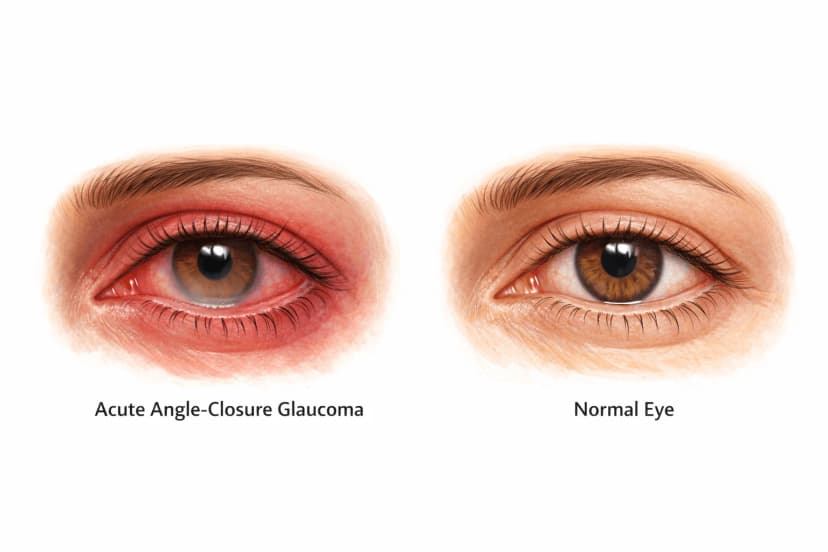
What Happens in Acute Angle Closure
The front of the eye contains fluid (aqueous humor) that constantly circulates:
- Produced behind the iris
- Flows through the pupil
- Drains through the angle where iris meets cornea
In angle closure:
- The iris bows forward and blocks the drainage angle
- Fluid cannot escape
- Pressure rises rapidly-can exceed 50-60 mmHg (normal: 10-21)
- High pressure damages the optic nerve and cornea
Symptoms
Seek emergency care immediately if you experience:
- Sudden, severe eye pain
- Sudden blurry or hazy vision
- Rainbow halos around lights
- Red eye
- Severe headache (often same side as affected eye)
- Nausea and vomiting
- Mid-dilated pupil that doesn't react to light
This is a sight-threatening emergency.
Classic Presentation
- Symptoms often start suddenly
- May occur in evening or dark environments
- One eye typically affected (though other eye at risk)
- Vision markedly decreased
- Eye feels hard to touch
Atypical Presentations
Some cases present with:
- Intermittent episodes that resolve spontaneously
- Mainly headache (may be mistaken for migraine)
- Nausea/vomiting (may seem like stomach problem)
- Mild symptoms ("subacute" attacks)
Risk Factors
Anatomic Factors
- Hyperopia (farsightedness)-smaller eyes with crowded angles
- Shallow anterior chamber
- Thick, anteriorly positioned lens
- Short axial length of eye
Demographics
- Age over 40-lens thickens with age
- Female sex-more common in women
- Asian or Inuit ancestry-higher prevalence
- Family history of angle closure
Triggers
- Dim lighting-causes pupil dilation
- Certain medications (see below)
- Emotional stress
- Reading in dim light
- Eye drops that dilate pupil
Medications That Can Trigger Attacks
Alert your doctor and pharmacist to narrow angles. Medications that may trigger acute angle closure include:
- Anticholinergics (antihistamines, cold medications)
- Antidepressants (SSRIs, tricyclics)
- Anti-nausea medications
- Some urinary/bladder medications
- Topiramate (causes different mechanism)
- Sulfa-based drugs
- Decongestants
After a confirmed patent LPI, medications that trigger pupillary block are often safer, but drugs such as topiramate can still cause secondary angle closure through other mechanisms. Confirm medication safety with your ophthalmologist.
Diagnosis
Clinical Examination
- Elevated IOP-often 40-80 mmHg
- Corneal edema-cloudy cornea
- Shallow anterior chamber
- Mid-dilated, fixed pupil
- Conjunctival injection-red eye
- Gonioscopy-closed angle (may need to lower IOP first)
Imaging
- Anterior segment OCT-shows angle configuration
- Ultrasound biomicroscopy (UBM)-detailed angle anatomy
Fellow Eye Examination
- The other eye often has similar anatomic risk
- Prophylactic treatment usually recommended
Treatment
Emergency Pressure Reduction
Medical Treatment (immediate):
- Topical medications: beta-blockers, alpha agonists (brimonidine), carbonic anhydrase inhibitors
- Oral acetazolamide-reduces fluid production
- IV mannitol-osmotic agent for severe cases
- Topical pilocarpine-constricts pupil (once IOP lower)
- Topical steroids-reduce inflammation
Goal is to lower IOP enough to:
- Relieve symptoms
- Clear cornea for examination and laser
- Prevent further optic nerve damage
Laser Treatment for Pupillary Block
Laser Peripheral Iridotomy (LPI)
- Creates small hole in peripheral iris
- Allows fluid to bypass pupillary block
- Reduces the risk of recurrent pupillary-block angle closure
- Performed once IOP controlled and cornea clear
- Usually done in both eyes (fellow eye prophylactically)
If Laser Cannot Be Performed:
- Surgical iridectomy
- Lens extraction (removes cause in many cases)
Chronic Angle Closure
If synechiae (scarring) have closed the angle:
- LPI may not be sufficient
- May need glaucoma surgery
- Long-term IOP-lowering medications
- Similar to POAG treatment
After Treatment
Immediate Follow-Up
- IOP monitoring
- Confirm LPI is patent (open)
- Assess for optic nerve damage
- Treat inflammation
Long-Term Considerations
- Regular glaucoma monitoring
- Visual field testing and OCT
- May need ongoing IOP treatment if damage occurred
- Cataract development may be accelerated
Prognosis
Depends on:
- Duration of attack before treatment
- Maximum IOP reached
- Pre-existing damage
- Promptness of treatment
Early treatment usually results in good outcomes. Delayed treatment can cause permanent vision loss.
Prevention
For Those at Risk
- Regular eye exams with gonioscopy
- Prophylactic LPI if narrow angles detected
- Awareness of symptoms
- Medical alert about angle anatomy
After LPI
- Most medication restrictions are lifted
- Continue regular eye exams
- Cataract surgery can substantially deepen the angle and reduce angle-closure risk in selected patients
Related Conditions
- Chronic angle-closure glaucoma-gradual angle closure
- Plateau iris syndrome-angle closure despite patent LPI
- Phacomorphic glaucoma-lens-induced angle closure
- Neovascular glaucoma-secondary angle closure from new blood vessels
Frequently Asked Questions
How quickly do I need treatment?
Immediately. Every hour of elevated pressure causes more damage. If you suspect acute angle closure, go to an emergency room or eye emergency center right away.
Will I need treatment in both eyes?
Usually yes. If one eye has acute angle closure, the other eye has similar anatomy and is at high risk. Prophylactic LPI in the fellow eye is standard practice.
Can this happen again after laser treatment?
Once you have a patent (working) LPI, pupillary block angle closure should not recur. However, some people develop chronic angle closure from other mechanisms and need ongoing monitoring.
Why did my eye dilate if that's dangerous for me?
Sometimes narrow angles aren't detected before dilation, or the benefits of a dilated exam outweigh the small risk. After a patent LPI, dilation is often safer, but the angle should still be reassessed because residual risk can persist.
Can I take antihistamines now?
After confirmed patent LPI, medications that previously posed a pupillary-block risk are often safer. Topiramate and some sulfonamide reactions can still cause secondary angle closure by shifting the lens-iris diaphragm forward, so confirm with your ophthalmologist before starting or restarting a risky medication.
What if I have symptoms at night or when the doctor's office is closed?
Go to an emergency room. Acute angle closure is a true emergency. Many ERs can start treatment and arrange urgent ophthalmology consultation.
References
Medical Disclaimer: This information is for educational purposes only and does not replace professional medical advice, diagnosis, or treatment. If you have symptoms of acute angle closure, seek emergency care immediately.
Sources:
- StatPearls. Angle-Closure Glaucoma. NCBI Bookshelf.
- Wright C, et al. Primary angle-closure glaucoma: an update. Acta Ophthalmol. 2016;94(3):217-225.
- Prum BE Jr, et al. Primary Angle Closure Preferred Practice Pattern. Ophthalmology. 2016;123(1):P1-P40.
- National Eye Institute. Glaucoma.