

Gonioscopy
An examination of the eye's drainage angle using a special lens. Essential for diagnosing and classifying glaucoma.
Gonioscopy is an eye examination technique that allows your doctor to view the drainage angle of your eye-the area where fluid (aqueous humor) exits the eye. This angle cannot be seen during a regular eye exam. Gonioscopy is essential for diagnosing and classifying glaucoma and determining appropriate treatment.
Key Takeaways
- Views the drainage angle where eye fluid exits
- Essential for glaucoma classification-open-angle vs. angle-closure
- Uses a special lens placed on numbed eye
- Quick examination-takes only minutes
- Determines treatment approach and risk of angle closure
- May need periodic monitoring in at-risk patients
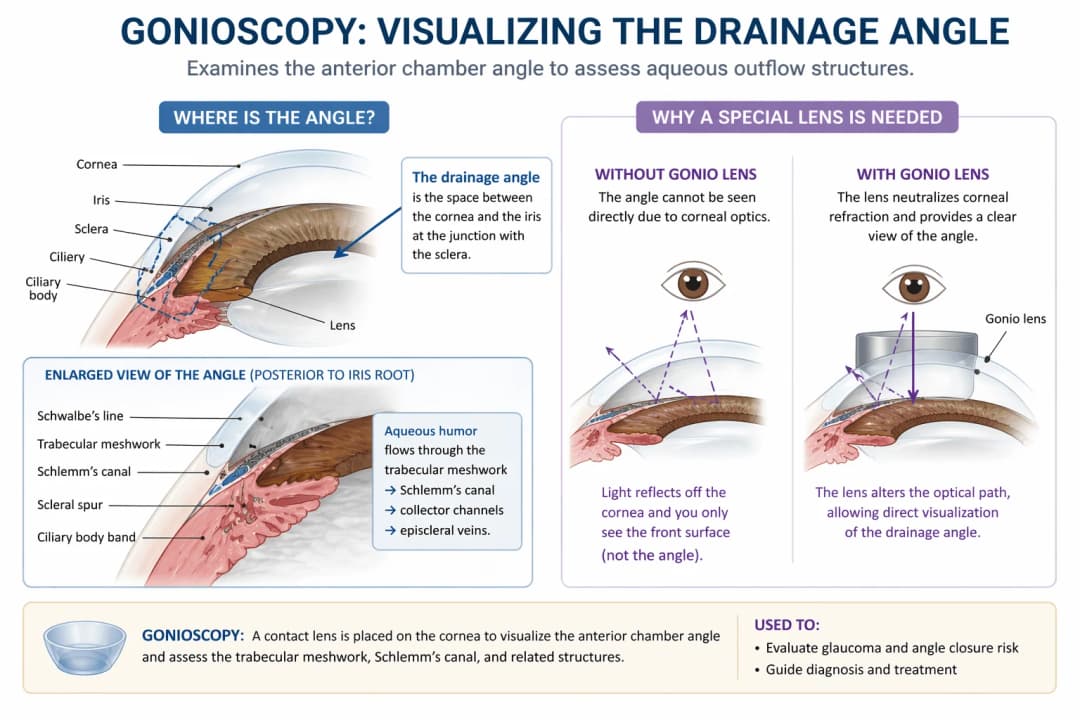
Why Gonioscopy Is Needed
The Drainage Angle
The "angle" is where the iris (colored part) meets the cornea (clear front surface). This area contains the trabecular meshwork-the drain for aqueous humor (eye fluid).
Why you can't see it directly:
- Light reflects off the cornea (total internal reflection)
- Special lens bypasses this optical limitation
- Allows direct viewing of angle structures
Clinical Importance
Gonioscopy helps:
- Classify glaucoma type (open vs. closed angle)
- Assess risk for angle-closure glaucoma
- Detect abnormal blood vessels or pigment
- Guide treatment decisions
- Monitor changes over time
What Gonioscopy Shows
Normal Angle Structures
From cornea to iris root:
- Schwalbe's line-edge of cornea
- Trabecular meshwork-the drain itself
- Scleral spur-landmark structure
- Ciliary body band-muscle tissue
- Iris root-where iris attaches
Grading the Angle
Doctors use grading systems (Shaffer, Scheie) to describe how "open" the angle is:
| Grade | Description | Risk |
|---|---|---|
| 4 | Wide open | Lowest |
| 3 | Open | Low |
| 2 | Moderately narrow | Moderate |
| 1 | Very narrow | Higher |
| 0 (Slit/Closed) | Closed | Angle-closure possible |
Abnormal Findings
- Narrow or closed angle-risk of angle-closure glaucoma
- Peripheral anterior synechiae (PAS)-scarring closing the angle
- Increased pigmentation-may indicate pigment dispersion
- Neovascularization-abnormal blood vessels (serious)
- Angle recession-from previous trauma
- Tumors or cysts (rare)
The Procedure
Before the Exam
- No special preparation needed
- Inform doctor of eye allergies
- Contact lenses should be removed
During Gonioscopy
What to expect:
- Numbing drops applied to your eye
- Special lens placed gently on eye surface (with gel or fluid)
- Slit lamp used to illuminate and view angle
- Doctor rotates lens to examine full 360 degrees
- Takes 2-5 minutes per eye
- You may feel slight pressure but no pain
Types of Gonioscopy Lenses
Direct Gonioscopy
- Koeppe lens
- Patient lies back
- Often used in operating room
Indirect Gonioscopy (Most Common in Office)
- Goldmann, Zeiss, Posner lenses
- Patient sits at slit lamp
- Mirrors allow viewing of angle
After the Exam
- Mild blurring from gel/numbing drops (temporary)
- Can resume normal activities
- Don't rub eye for a few minutes
- Contact lenses can usually be reinserted after 30 minutes
Who Needs Gonioscopy
Indicated For
- All new glaucoma patients-essential for classification
- Glaucoma suspects-elevated eye pressure or suspicious optic nerves
- Before dilating pupils-in those at risk for angle closure
- Monitoring narrow angles-periodic assessment
- After eye trauma-checking for angle damage
- Evaluating unusual findings-blood in angle, pigment, etc.
Risk Factors for Narrow Angles
- Farsightedness (hyperopia)
- Older age
- Female sex
- Asian or Inuit ancestry
- Family history of angle closure
- Small eyes
Gonioscopy Findings and Treatment Implications
Open Angle
- Standard glaucoma medications effective
- Trabecular meshwork accessible for laser
- No immediate risk of angle closure
Narrow Angle
- May need laser peripheral iridotomy (LPI)
- Caution with certain medications
- Monitor for closure
- May need cataract surgery earlier
Closed Angle
- LPI indicated
- May need urgent treatment if acute closure
- Certain medications contraindicated
Abnormal Vessels (Neovascularization)
- Indicates serious underlying condition
- Often from diabetic retinopathy or vein occlusion
- Needs treatment of underlying cause
- May need panretinal photocoagulation
Related Tests
Gonioscopy is often performed with:
- Tonometry-measuring eye pressure
- Pachymetry-corneal thickness
- Visual field testing-peripheral vision
- OCT-optic nerve imaging
Alternatives and Adjuncts
- Anterior segment OCT-can image angle without contact
- Ultrasound biomicroscopy (UBM)-images behind iris
- These don't replace gonioscopy but provide additional information
Frequently Asked Questions
Does gonioscopy hurt?
No. The eye is numbed with drops, so you feel only slight pressure from the lens. There's no pain during the examination.
Why do I need gonioscopy if I'm already getting eye pressure checked?
Tonometry measures pressure but doesn't show why pressure might be elevated. Gonioscopy reveals the drainage angle's structure-essential for proper diagnosis and treatment planning.
How often do I need gonioscopy?
Frequency depends on your condition:
- New glaucoma diagnosis: at initial evaluation
- Narrow angles: periodically (yearly or as recommended)
- Stable open-angle glaucoma: may not need repeated often
- Any change in status: should be rechecked
Can gonioscopy scratch my eye?
Complications are rare. The lens is designed for safe contact with the numbed eye. Occasionally minor surface irritation can occur but heals quickly.
What does it mean if I have narrow angles?
Narrow angles mean you're at risk for angle-closure glaucoma. Your doctor may recommend preventive treatment (laser iridotomy) or careful monitoring, and you should be cautious about certain medications.
Can I drive after gonioscopy?
Usually yes. The numbing drops wear off within 30-60 minutes. If your pupils were dilated for a full exam, you may have light sensitivity affecting driving.
References
Medical Disclaimer: This information is for educational purposes only and does not replace professional medical advice, diagnosis, or treatment. If you have questions about glaucoma or gonioscopy, please consult a qualified healthcare provider.
Sources:
- StatPearls. Angle-Closure Glaucoma. NCBI Bookshelf.
- Alward WLM. A History of Gonioscopy. Optom Vis Sci. 2011;88(1):29-35.
- Prum BE Jr, et al. Primary Angle Closure Preferred Practice Pattern. Ophthalmology. 2016;123(1):P1-P40.
- Wikipedia. Gonioscopy.