

Pneumatic Retinopexy
An office-based procedure for selected retinal detachments using an intraocular gas bubble plus laser or freezing to seal the tear.
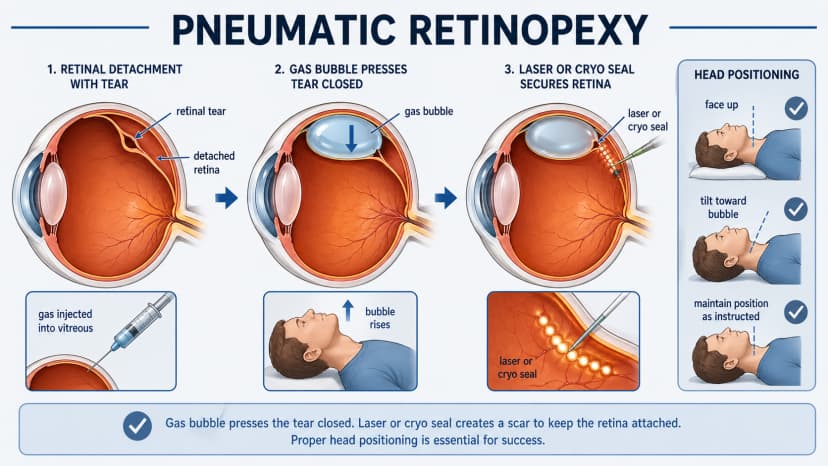
Pneumatic retinopexy is an in-office procedure for selected cases of retinal detachment. A small bubble of long-acting gas is injected into the eye, where it floats upward and pushes the detached retina back against the wall of the eye. The retinal tear is sealed at the same visit or shortly afterward using laser retinopexy/photocoagulation or freezing (cryotherapy). For appropriately chosen patients, pneumatic retinopexy can avoid a trip to the operating room, but success depends heavily on careful case selection and strict head positioning.
Key Takeaways
- Pneumatic retinopexy is an office procedure for selected retinal detachments - typically those with a single tear or tight cluster of tears in the upper retina and in patients who can position their head reliably
- A gas bubble injection plus laser or cryotherapy is the core of the procedure; positioning is critical
- Single-procedure anatomical success in well-selected cases is approximately 75-80%; secondary procedures bring final attachment to >95%
- Compared to vitrectomy or scleral buckle, pneumatic retinopexy can have faster recovery and lower per-event cost, with comparable long-term vision in selected patients
- Strict procedure-specific head positioning for several days is the most important post-procedure factor in success
What a Retinal Detachment Is and Why Treatment Is Urgent
A rhegmatogenous retinal detachment (the most common type) begins with a retinal tear. Vitreous fluid passes through the tear into the space between the retina and the underlying tissue, and the retina lifts away from its normal position. The detached retina cannot function properly, and if the macula detaches, central vision is lost.
All forms of retinal detachment treatment share two goals:
- Reattach the retina by closing the path that fluid takes under it
- Seal the tear so fluid cannot continue to enter
Pneumatic retinopexy uses a gas bubble to push the retina back into place (achieving the first goal) while laser or cryotherapy seals the underlying tear (the second). The bubble dissolves over weeks; by then the laser or cryo scar holds the retina down.
How Pneumatic Retinopexy Is Done
Pre-Procedure
- Confirmation of the diagnosis with dilated fundoscopic exam and often B-scan ultrasound if the view is limited
- Identification of all retinal tears and assessment of detachment extent
- Discussion of expected positioning and risks
- Numbing drops and an iodine prep for sterility
The Procedure
- The patient sits upright in the office or in an ophthalmology procedure room
- Topical anesthetic plus a small subconjunctival or periocular anesthetic injection numbs the eye
- A small amount (typically about 0.3-0.6 mL) of long-acting gas - usually SF6 (sulfur hexafluoride), which expands roughly 2-3× and resolves in about 2 weeks, or C3F8 (perfluoropropane), which expands roughly 4× and persists 6-8 weeks (occasionally up to 10) - is injected into the vitreous cavity
- The bubble floats upward in the vitreous and presses against the detached retina, pushing it back into contact with the wall of the eye
- Cryotherapy (freezing) of the retinal tear may be performed at the same visit, either before or after the gas injection
- Laser photocoagulation of the tear is more often done at a follow-up visit a few days later, once the retina has flattened against the wall and the laser can take effect
The procedure takes 15-30 minutes. The patient leaves the office the same day with strict positioning instructions.
After the Procedure
- The patient must keep their head in a specific position - typically tilted forward and to one side - for several days to a week so that the gas bubble continues to press on the retinal tear
- Eye drops include topical antibiotics and sometimes steroids
- Activity restrictions: no air travel, no driving until vision recovers, no rapid altitude changes (the gas bubble expands at altitude)
- Multiple short follow-up visits in the first week to confirm reattachment and check the laser/cryo scar
Patient Selection - The Single Biggest Determinant of Success
Pneumatic retinopexy works well for the right detachment and not for others. The most successful cases have:
- A single retinal tear, or multiple breaks all within 1 clock-hour of each other and located in the superior 8 clock-hours of the retina (between the 8 o'clock and 4 o'clock positions) - the classical "8-hour rule"
- Tears in the upper half of the retina so a gas bubble can naturally press on them; breaks in the inferior 4 clock-hours are generally not amenable to pneumatic retinopexy because a gas bubble cannot float onto them
- No proliferative vitreoretinopathy (PVR) - scarring on or under the retina that prevents simple reattachment
- Phakic eyes (with their own natural lens) in some original series; pseudophakic eyes can be treated but with somewhat lower success in some studies
- Patients who can position reliably - who understand the instructions and are physically and cognitively able to maintain the required posture
Detachments less suited to pneumatic retinopexy:
- Multiple tears in different sectors of the retina
- Tears in the lower retina (a gas bubble cannot easily press downward)
- Significant vitreous hemorrhage obscuring the view
- Established PVR
- Giant retinal tears
- Patients who cannot maintain positioning (e.g., due to neck arthritis, dementia, severe respiratory disease that prevents prone positioning)
Outcomes
In well-selected patients, pneumatic retinopexy gives:
- Single-procedure anatomical success of approximately 75-80% in well-selected cases (PIVOT trial, modern series)
- Final attachment rate >95% when reoperation (usually vitrectomy or scleral buckle) is included
- Visual outcomes can be comparable to vitrectomy for similar baseline cases - particularly in selected detachments treated promptly
- Recovery faster than scleral buckle; comparable to or slightly faster than vitrectomy
- No surgical incision and no hospital stay, with the trade-off being strict positioning at home
The PIVOT trial (2019) compared pneumatic retinopexy with vitrectomy for primary retinal detachment in selected patients and found comparable functional outcomes, with pneumatic retinopexy producing somewhat better final visual acuity in macula-off detachments and lower rates of cataract progression.
Risks
- Failure to reattach the retina - leading to need for additional surgery, usually vitrectomy or scleral buckle. The most common "complication" of pneumatic retinopexy.
- New retinal tears - created by the bubble or the underlying retinal pathology; typically managed with additional laser/cryo and a second pneumatic retinopexy or by progressing to vitrectomy
- Cataract progression - typically slower than after vitrectomy; the bubble itself can accelerate cataract in phakic eyes but less than in vitrectomized eyes
- Endophthalmitis - extremely rare but reported. See endophthalmitis.
- Subretinal gas migration - gas tracks beneath the retina; uncommon and usually self-resolving
- Increased intraocular pressure from gas expansion at altitude or from over-inflation; managed by avoiding air travel and treating with pressure-lowering drops if needed
- Macular hole formation - uncommon, particularly with appropriate positioning
What the Patient Notices
- The injected gas bubble is visible to the patient as a curved line or shimmering sphere in the visual field
- As the bubble shrinks over weeks, the patient watches it descend
- Vision is significantly blurred while the bubble is large; gradually clears as the bubble is absorbed
- Floaters are common immediately after the procedure
- The macula's recovery (if it had been detached) takes weeks to months even after the retina is reattached
Pneumatic Retinopexy vs. Other Treatments
| Feature | Pneumatic retinopexy | Scleral buckle | Vitrectomy |
|---|---|---|---|
| Setting | Office | Operating room | Operating room |
| Anesthesia | Local | Local or general | Local or general |
| Single-procedure success | ~75-80% | 85-92% | 85-95% |
| Cataract progression | Slower | Slower | Faster (in phakic eyes) |
| Recovery time | Fastest | Slower | Slower |
| Suitability | Selected upper-retinal tears, cooperative patients | Most primary detachments, complex cases | Most primary detachments, complex cases |
| Cost | Lowest | Moderate | Highest |
A combined scleral buckle plus vitrectomy is sometimes used for complex detachments. The choice among the three is individualized, and many surgeons offer pneumatic retinopexy first to selected patients, reserving the operating room for failures or initially unsuitable cases.
Frequently Asked Questions
Why do I have to keep my head in a specific position for days?
The gas bubble inside your eye floats upward in the vitreous and presses against the part of the retina closest to it. To keep the bubble pressing on your retinal tear, your head must be positioned so that the tear is at the highest point of the eye. The exact posture depends on where the tear is. Incorrect positioning is a common reason pneumatic retinopexy fails.
Can I fly or travel to the mountains after this?
No. The gas bubble expands as ambient pressure decreases - air travel and significant elevation gain (driving over mountain passes) can cause dangerous pressure increases inside the eye, including central retinal artery occlusion. Air travel and significant elevation gain are forbidden until the gas bubble has fully resolved: SF6 typically resolves in about 2 weeks; C3F8 typically persists 6-8 weeks (occasionally up to 10). Your surgeon will examine your eye and confirm bubble resolution before clearing you to fly. You will be given a wristband indicating intraocular gas to alert anesthesia or emergency staff.
Will I be able to see while the bubble is in my eye?
Vision in the affected eye will be significantly blurred while the bubble is large, then improves as the bubble shrinks. SF6 often resolves in about 2 weeks; C3F8 often persists 6-8 weeks and occasionally longer. Most patients can perform daily activities with one eye fully open and the other partially obscured by the bubble. Driving with only one functional eye is often not safe and depends on local rules.
What if the procedure does not work?
If the retina does not reattach, or detaches again, the next step is usually vitrectomy - typically with or without a scleral buckle. The decision is made promptly because delay can cause further damage to the macula. Most patients ultimately reach successful reattachment, though sometimes after a second or third procedure.
How does this compare to vitrectomy?
For appropriate cases, pneumatic retinopexy can give comparable functional outcomes to vitrectomy, with faster recovery, no incision, and slower cataract progression in some studies. For complex cases - multiple tears, lower-retinal tears, PVR - vitrectomy is often more reliable. The decision depends on the specific anatomy of your detachment and on practical factors like ability to position.
Why is pneumatic retinopexy not used more often?
Two reasons. First, only some retinal detachments fit the anatomical criteria. Second, success depends on patient cooperation with strict positioning - many patients cannot or will not position reliably for days. A surgeon who routinely uses pneumatic retinopexy has carefully selected patients and given thorough positioning instructions.
References
Medical Disclaimer: This information is for educational purposes only and does not replace professional medical advice. Discuss the procedure, alternatives, and risks with your eye care provider.
Sources:
- Hilton GF, Grizzard WS. Pneumatic retinopexy: a two-step outpatient operation without conjunctival incision. Ophthalmology. 1986;93(5):626-641.
- Tornambe PE, Hilton GF. Pneumatic retinopexy: a multicenter randomized controlled clinical trial comparing pneumatic retinopexy with scleral buckling. Ophthalmology. 1989;96(6):772-783.
- Hillier RJ, Felfeli T, Berger AR, et al. The Pneumatic Retinopexy versus Vitrectomy for the Management of Primary Rhegmatogenous Retinal Detachment Outcomes Randomized Trial (PIVOT). Ophthalmology. 2019;126(4):531-539.
- American Academy of Ophthalmology EyeWiki. Pneumatic Retinopexy.