

Retinal Tear
A rip in the retina, commonly from vitreous pulling during PVD. New flashes or floaters need prompt exam because fluid can turn a tear into detachment.
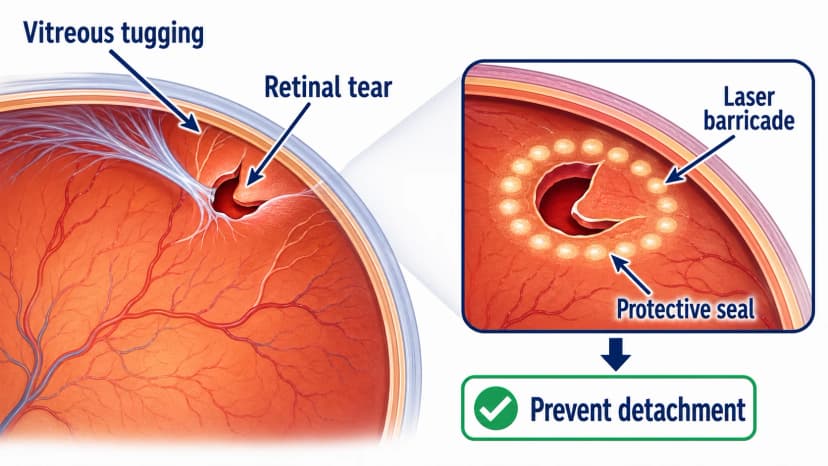
Retinal tears commonly present with a sudden increase in floaters, new flashes of light, or a peripheral shadow. The tear is a break in the thin retinal lining, usually created when the vitreous gel pulls away during a posterior vitreous detachment (PVD). Prompt evaluation is important because fluid can pass through the break and separate the retina from the underlying tissue, causing retinal detachment. Laser treatment can often seal the area before detachment develops.
Key Takeaways
- A tear is often the step before retinal detachment, so early treatment can prevent vision loss
- Warning signs are new floaters, flashes of light, or a curtain-like side shadow
- PVD is the common setting, when the vitreous gel separates and pulls on the retina
- Barricade laser creates a treatment scar around the tear so fluid cannot pass underneath
- Higher-risk eyes include high myopia, lattice degeneration, prior cataract surgery, or a tear in the other eye
- Not every tiny retinal hole needs laser, but symptomatic tears deserve prompt retina evaluation
Seek emergency eye care immediately if you experience:
- Sudden onset of many new floaters, especially a "shower" of dark spots
- New flashes of light in your peripheral vision
- A shadow or dark curtain spreading across any part of your vision
- Any combination of flashes, floaters, and shadow-this may indicate a tear has already progressed to retinal detachment
Do not wait-a retinal tear can progress to detachment within hours to days. Early treatment is far simpler and more effective than treating a full detachment.
Understanding Retinal Tears
The retina lines the inside of the back of the eye like wallpaper. It converts light into electrical signals that travel through the optic nerve to the brain, creating the images you see. In front of the retina sits the vitreous, a clear gel that fills the eye and is loosely attached to the retinal surface.
As you age-typically after age 50-the vitreous gel begins to liquefy and shrink. Eventually it separates from the retina in a process called posterior vitreous detachment (PVD). PVD is extremely common and usually benign. However, if the vitreous is abnormally adherent to the retina at certain points, the separating gel can exert traction-pulling force-on the retina. When that traction is strong enough, it tears the retinal tissue.
Once a tear forms, liquefied vitreous fluid can pass through the opening and accumulate beneath the retina, lifting it off the underlying retinal pigment epithelium (RPE). This is the mechanism by which a retinal tear progresses to a rhegmatogenous retinal detachment-the most common type of detachment.
Not every PVD causes a tear. Studies estimate that approximately 10-15% of patients with symptomatic PVD (those experiencing new floaters and flashes) will have a retinal tear at the time of examination. This is why anyone with sudden new floaters or flashes should be evaluated promptly.
Types of Retinal Breaks
Retinal breaks are broadly classified based on their mechanism and shape. Understanding the type helps your ophthalmologist determine the risk of progression and whether treatment is needed.
Horseshoe (Flap) Tears
Horseshoe tears-also called flap tears or U-tears-are the most clinically significant type of retinal break. They occur when vitreous traction pulls a flap of retina partially away from the underlying tissue while remaining attached at one edge. The flap shape resembles a horseshoe.
- Caused by active vitreous traction
- High risk of progressing to retinal detachment
- Almost always require treatment (laser or cryotherapy)
- The persistent vitreous attachment at the flap means ongoing pulling force
- Most commonly found in the superior and temporal retina
Atrophic Holes
Atrophic holes are round breaks in the retina caused by thinning of the retinal tissue rather than vitreous traction.
- Often found in areas of lattice degeneration
- No vitreous traction pulling on the edges
- Lower risk of causing detachment than horseshoe tears
- May be observed without treatment if small and asymptomatic
- More common in younger patients with myopia
Operculated Holes
An operculated hole forms when vitreous traction pulls a small piece of retina completely free, leaving a round hole with a floating "lid" (operculum) suspended in the vitreous above it.
- The vitreous traction has been relieved (the operculum is free-floating)
- Lower risk of progression than horseshoe tears
- May not require treatment since the traction is no longer active
- Decision to treat depends on size, symptoms, and associated findings
Giant Retinal Tears
A giant retinal tear extends 90 degrees (3 clock hours) or more of the retinal circumference. These are rare but serious.
- Often associated with trauma, high myopia, or hereditary vitreoretinal conditions
- Very high risk of rapid detachment
- Require urgent surgical treatment, typically vitrectomy
- May be associated with Stickler syndrome or Marfan syndrome
- The retinal flap can fold over, complicating repair
Risk Factors
Several factors increase the likelihood of developing a retinal tear.
Eye-Related Factors
- High myopia (nearsightedness)-myopic eyes are longer and have thinner retinas, making them more vulnerable to tears
- Posterior vitreous detachment (PVD)-the most common direct cause of retinal tears
- Prior cataract surgery-changes in vitreous structure after surgery increase tear risk, especially in the first year
- Lattice degeneration-areas of peripheral retinal thinning where tears are more likely to form
- Previous retinal tear in the other eye-if you had a tear in one eye, your risk in the fellow eye is higher
- Previous eye trauma or injury-blunt or penetrating trauma can directly tear the retina
Other Factors
- Age-risk increases after age 50 as PVD becomes more common
- Family history of retinal tears or retinal detachment
- Certain connective tissue disorders (Marfan syndrome, Stickler syndrome, Ehlers-Danlos syndrome)
- YAG laser capsulotomy after cataract surgery
- Acute eye inflammation or uveitis
Symptoms
Retinal tears can be entirely asymptomatic-found incidentally during a routine dilated eye exam. However, most clinically significant tears present with noticeable symptoms caused by the vitreous pulling on the retina.
Flashes of Light (Photopsia)
- Brief arcs or streaks of light, often in the peripheral vision
- More noticeable in dark environments
- Caused by mechanical stimulation of the retina as the vitreous pulls on it
- May persist for weeks even after the tear is treated
- Different from the shimmering, zigzag lines of a visual migraine aura
Sudden Increase in Floaters
- A "shower" of tiny dark spots, cobwebs, or strands
- Represent blood cells or pigment released when the retina tears
- One or two new floaters with a PVD may be normal, but many new floaters suggest a tear
- A single large dark floater may represent a small vitreous hemorrhage from a torn retinal blood vessel
Shadow or Curtain in Vision
- A dark shadow or veil appearing at the edge of your visual field
- This symptom suggests fluid has already begun to accumulate under the retina
- Indicates the tear may be progressing to retinal detachment
- This is the most urgent symptom-seek care immediately
Symptoms can develop very quickly. A retinal tear may progress to detachment within hours to days. If you notice any new flashes, a sudden shower of floaters, or a shadow in your vision, do not wait to see if symptoms improve. Contact your eye care provider or go to an emergency room the same day.
How Tears Lead to Detachment
Understanding the progression from tear to detachment explains why prompt treatment matters.
- Vitreous traction creates a tear-the separating vitreous gel pulls on the retina with enough force to break the tissue
- Liquefied vitreous enters the tear-the now-fluid vitreous gel passes through the opening in the retina
- Fluid accumulates under the retina-the subretinal fluid gradually separates the retina from the retinal pigment epithelium (RPE)
- Detachment spreads-gravity causes fluid to track downward; superior tears tend to cause faster, more extensive detachment
- Vision loss occurs-as the detachment spreads, the affected retinal area loses function; if the macula detaches, central vision is lost
Not every tear leads to detachment. Factors that increase the risk of progression include:
- Horseshoe tears (ongoing vitreous traction)
- Superior tears (gravity promotes fluid accumulation)
- Larger tears
- Symptomatic tears (those accompanied by flashes and floaters)
- Multiple tears
This is why treatment of high-risk tears is considered urgent. Sealing the tear before fluid accumulates is far more effective than repairing a full retinal detachment, which requires major surgery.
Diagnosis
If you present with symptoms suggestive of a retinal tear, your ophthalmologist will perform a thorough examination to evaluate the retina.
Dilated Fundus Examination
A dilated fundus exam is the primary diagnostic method. Dilating drops widen the pupil, allowing the doctor to examine the entire retina, including the far periphery where most tears occur. The ophthalmologist uses indirect ophthalmoscopy-a headlamp with a handheld lens-and scleral depression (gentle pressure on the outside of the eye) to bring the peripheral retina into view.
Slit-Lamp Examination
A slit-lamp exam with special lenses provides a magnified, detailed view of the retina. This helps assess the vitreous for cells, blood, or pigment (Shafer sign or "tobacco dust"), which can indicate the presence of a retinal tear even before the tear itself is visualized.
Optical Coherence Tomography (OCT)
OCT creates high-resolution cross-sectional images of the retina. While it is most useful for evaluating the macula and posterior retina, widefield OCT can sometimes detect tears, vitreous traction, or early subretinal fluid that suggests a tear is progressing.
B-Scan Ultrasound
If a vitreous hemorrhage (bleeding inside the eye) obscures the view of the retina, a B-scan ultrasound can image the retina through the blood. This is critical because a vitreous hemorrhage accompanying new flashes and floaters has a high likelihood of being caused by a retinal tear.
Treatment
The goal of treatment is prophylactic-to seal the tear and prevent retinal detachment from developing. Treatment creates a firm adhesion (scar) around the tear so that fluid cannot pass through and accumulate beneath the retina.
Laser Photocoagulation (Barricade Laser)
Laser photocoagulation is the most common and preferred treatment for retinal tears. It is performed in the office.
- A focused laser beam is applied to the retina surrounding the tear
- The laser energy creates small burns that produce a controlled inflammatory response
- Over 1-2 weeks, these burns form a strong scar (adhesion) around the tear
- The scar "welds" the retina to the underlying tissue, sealing the tear
- Two to three rows of laser spots are typically placed around the entire tear
- The procedure takes 5-15 minutes
- A contact lens is placed on the eye during treatment for visualization
- Patients may see flashes of light during the procedure
Cryotherapy (Freezing Treatment)
Cryotherapy is an alternative to laser, particularly useful when the tear is very anterior (far forward) or when media opacities (such as a cataract) make laser delivery difficult.
- A freezing probe (cryoprobe) is applied to the outside of the eye wall overlying the tear
- The freezing penetrates through the eye wall to create a controlled injury at the tear
- The resulting scar seals the retina around the tear, similar to laser
- Can be performed in the office under local anesthesia
- More inflammation and discomfort than laser treatment
- Takes approximately 1-2 weeks for adhesion to fully form
Observation
Not all retinal breaks require treatment. Your ophthalmologist may recommend monitoring rather than intervention in certain situations.
- Small atrophic holes without symptoms or vitreous traction
- Operculated holes where the traction has been completely relieved
- Asymptomatic breaks discovered incidentally in stable eyes
- Long-standing breaks with surrounding demarcation lines (pigmented borders indicating the eye has already "self-sealed" around the break)
These patients require regular follow-up to ensure the break remains stable and no new symptoms develop.
Treatment is preventive, not restorative. Laser and cryotherapy do not repair visual damage that has already occurred. They work by preventing the tear from progressing to a detachment. This is why early diagnosis and treatment are so important-treating the tear is far simpler than repairing a full retinal detachment, which requires surgery in an operating room.
After Treatment
Immediate Post-Treatment Period
- Mild discomfort or aching is normal for a few hours, especially after cryotherapy
- Vision may be slightly blurry from dilating drops used during the procedure
- You can typically return to normal activities the same day
- The laser or cryotherapy scar takes approximately 7-14 days to reach full strength
Activity Restrictions
- Avoid heavy lifting, straining, or vigorous exercise for 1-2 weeks after treatment
- These activities can increase eye pressure and potentially displace fluid through the tear before the scar has fully formed
- Your ophthalmologist will provide specific guidelines based on your situation
- After the adhesion has formed, there are generally no long-term activity restrictions
What to Watch For
Even after successful treatment, you should remain vigilant for symptoms suggesting progression.
- New or significantly increased floaters
- New flashes of light
- A shadow, curtain, or veil in your peripheral or central vision
- Any decrease in vision
If any of these occur, contact your ophthalmologist immediately, as a new tear may have formed or the treated tear may not have sealed adequately.
Follow-Up Schedule
- 1-2 weeks after treatment-to check whether the laser or cryo scar has formed adequately and the tear appears sealed
- 4-6 weeks later-to ensure stability
- 3-6 months later-continued monitoring
- Annual dilated exams ongoing-retinal tear patients remain at higher risk for new tears and detachment
Retinal Tear vs Retinal Detachment
Retinal tears and retinal detachments are related but distinct conditions. Understanding the difference is important for recognizing urgency.
| Feature | Retinal Tear | Retinal Detachment |
|---|---|---|
| What it is | A break in the retina | Separation of the retina from underlying tissue |
| Symptoms | Flashes, new floaters | Flashes, floaters, shadow/curtain, vision loss |
| Vision loss | Usually none | Progressive, potentially severe |
| Treatment | Laser or cryotherapy (office-based) | Surgery (pneumatic retinopexy, scleral buckle, or vitrectomy) |
| Treatment setting | Clinic/office | Operating room (usually) |
| Urgency | Urgent (within 24-48 hours) | Emergency (same day or next day) |
| Recovery | Minimal downtime | Weeks to months |
| Prognosis | Excellent if treated early | Variable-depends on macula involvement and timing |
A retinal tear can be a precursor to rhegmatogenous retinal detachment. Treating the tear greatly reduces the risk that fluid will pass through that tear and detach the retina, though new tears or detachment can still occur.
Prevention and Monitoring
While you cannot prevent all retinal tears, you can take steps to protect your retinal health and catch tears early.
For High-Risk Individuals
If you have risk factors for retinal tears, proactive monitoring is essential.
- Regular dilated eye exams-at least annually for patients with high myopia, lattice degeneration, or a history of tear or detachment in either eye
- Prompt evaluation of new symptoms-any new floaters, flashes, or shadows warrant same-day or next-day examination
- Protective eyewear-wear appropriate eye protection during sports or activities that risk eye trauma
- Communicate with your surgeon-if you are having cataract surgery or other eye surgery, discuss your retinal tear risk
After Posterior Vitreous Detachment
If you have been diagnosed with a PVD without a retinal tear, you remain at some risk of developing a tear during the weeks following.
- Return for repeat examination at the interval recommended by your ophthalmologist (commonly 4-6 weeks after initial PVD)
- Monitor for new or worsening symptoms during this period
- The risk of a new tear decreases significantly after 6 weeks once the PVD has fully stabilized
Frequently Asked Questions
Can a retinal tear heal on its own?
The retina does not heal or repair a tear by itself. However, the eye may form a natural adhesion (demarcation line) around a tear over time, particularly if the tear is small and not progressing. This is why some long-standing, asymptomatic holes can be observed. For new, symptomatic tears-especially horseshoe tears with active vitreous traction-treatment is recommended because the risk of progression to retinal detachment is too high to rely on natural scarring.
Is laser treatment for a retinal tear painful?
Most patients experience minimal discomfort during laser photocoagulation. You may feel brief, mild stinging sensations as each laser spot is applied, and you will see bright flashes of light. The procedure is performed with topical anesthetic (numbing eye drops) and typically takes 5-15 minutes. Cryotherapy tends to cause more aching, but local anesthesia is used. Most patients resume normal activities the same day.
How long does it take for the laser to seal a retinal tear?
The laser creates a bond that reaches full strength in approximately 7-14 days. During this time, your ophthalmologist will advise you to avoid heavy lifting, straining, or vigorous exercise. After the scar has fully matured, the seal is usually durable. A follow-up examination checks whether the tear has been adequately treated.
Can I still get a retinal detachment after my tear is treated?
Yes, although treatment greatly reduces the risk. A successfully treated tear is unlikely to cause detachment, but new tears can develop elsewhere in the retina, particularly if you have ongoing risk factors such as high myopia or lattice degeneration. This is why regular follow-up examinations and awareness of warning symptoms remain important even after treatment.
Should I be worried about floaters after a retinal tear?
Floaters that appeared at the time of your retinal tear are generally caused by blood cells, pigment, or vitreous debris released during the event. These floaters typically become less noticeable over weeks to months as they settle or the brain adapts. However, any new increase in floaters or new onset of flashes after your tear has been treated should be reported to your ophthalmologist immediately, as it could indicate a new tear.
References
Medical Disclaimer: This information is for educational purposes only and does not replace professional medical advice, diagnosis, or treatment. If you have symptoms of a retinal tear, seek prompt evaluation from an eye care professional.
Sources:
- American Academy of Ophthalmology. Retinal Tears.
- National Eye Institute. Retinal Detachment.
- American Society of Retina Specialists. Retinal Tears and Detachments.
- Byer NE. Natural history of posterior vitreous detachment with early management as the premier line of defense against retinal detachment. Ophthalmology. 1994;101(9):1503-1514.
- Coffee RE, Westfall AC, Davis GH, et al. Symptomatic posterior vitreous detachment and the incidence of delayed retinal breaks. Am J Ophthalmol. 2007;144(3):409-413.
- Wilkinson CP. Interventions for asymptomatic retinal breaks and lattice degeneration for preventing retinal detachment. Cochrane Database Syst Rev. 2014;(9):CD003170.