

Fundoscopic Examination
Direct visualization of the back of the eye (retina, optic nerve, blood vessels) using an ophthalmoscope or other instruments.
A fundoscopic examination (also called ophthalmoscopy or fundus examination) allows the doctor to directly view the structures at the back of the eye, including the retina, optic nerve, and blood vessels. This is the only place in the body where blood vessels and nerve tissue can be directly observed.
Key Takeaways
- Direct view of retina and optic nerve
- Can detect eye and systemic diseases
- May be done with or without dilation
- Different instruments available (direct, indirect, slit lamp)
- Essential part of eye examination
What Is Examined
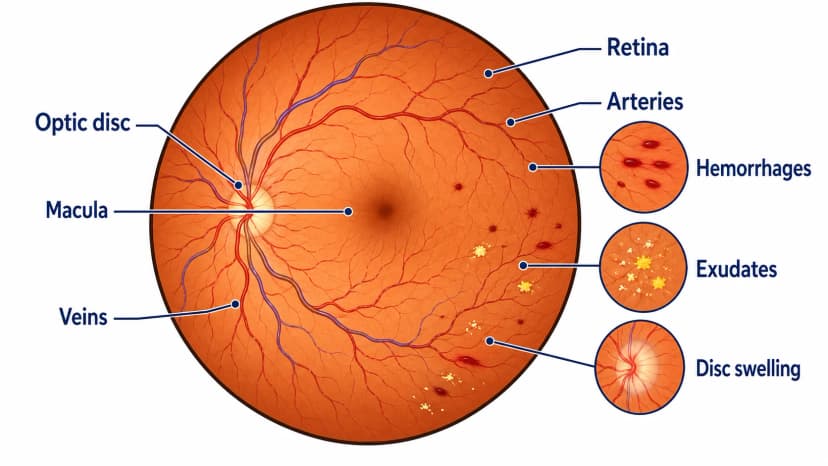
Optic Nerve (Optic Disc)
- Color (pink = healthy, pale = atrophy)
- Margins (sharp vs. blurred)
- Cup-to-disc ratio (enlarged in glaucoma)
- Swelling (disc edema, papilledema)
Retina
- Overall appearance
- Hemorrhages
- Exudates
- Pigmentary changes
- Lesions or tumors
Blood Vessels
- Arteries and veins
- Ratio and crossings
- Narrowing or dilation
- Emboli or plaques
Macula
- Central vision area
- Drusen or deposits
- Swelling or holes
Methods of Examination
Direct Ophthalmoscopy
- Handheld device held close to patient
- Magnified, upright view
- Limited field of view
- Good for optic nerve and macula
- Often used in primary care
Indirect Ophthalmoscopy
- Light source worn on examiner's head
- Handheld lens held in front of patient's eye
- Wider field of view
- Image is inverted
- Better for peripheral retina
- Requires more skill and dilation
Slit Lamp Biomicroscopy
- Using slit lamp with special lens
- Very detailed, magnified view
- Excellent for optic nerve and macula
- Standard in ophthalmology offices
Dilated vs. Undilated
Dilated Examination
- Eye drops widen the pupil
- Much better view of retina
- Essential for complete examination
- Takes 15-30 minutes for drops to work
- Causes light sensitivity and blurred near vision for hours
Undilated Examination
- Limited view, especially of periphery
- May miss important findings
- Sometimes used for quick screening
- Optic nerve often still visible
What Conditions Can Be Detected
Eye Conditions
- Glaucoma (optic nerve cupping)
- Macular degeneration
- Diabetic retinopathy
- Retinal detachment
- Optic neuritis/optic atrophy
- Papilledema
Systemic Conditions
- Diabetes (retinopathy)
- Hypertension (retinal vessel changes)
- Elevated intracranial pressure
- Blood disorders
- Infections
- Some cancers
In Neuro-Ophthalmology
Fundoscopic exam is crucial for evaluating:
- Optic neuritis-may show disc swelling
- Papilledema-bilateral disc swelling
- Ischemic optic neuropathy-disc edema, pallor
- Optic atrophy-pale disc
- Giant cell arteritis
- Signs of elevated or low intracranial pressure
Quick-Reference Findings
Optic Disc Appearance
| Finding | Possible Conditions |
|---|---|
| Swollen disc | Papilledema, optic neuritis, AION |
| Pale disc | Optic atrophy, prior AION |
| Cupped disc | Glaucoma |
| Drusen | Optic disc drusen |
Vascular Findings
| Finding | Possible Conditions |
|---|---|
| Hemorrhages | Diabetes, hypertension, vein occlusion |
| Pale retina | Artery occlusion |
| Emboli visible | Carotid disease, cardiac source |
What to Expect
Before the Exam
- May have dilating drops placed
- Wait 15-30 minutes for dilation
During the Exam
- Room lights dimmed
- Bright light shone into eye
- Asked to look in different directions
- Brief discomfort from light
After the Exam
If dilated:
- Light sensitivity for 4-6 hours
- Difficulty reading up close
- Bring sunglasses
- May need someone to drive
Frequency of Examination
- Comprehensive eye exams: Every 1-2 years for adults
- Diabetes: At least annually
- Known eye conditions: As recommended by doctor
- New symptoms: Promptly
Related Tests
- Fundus photography-photographs of fundus
- OCT-detailed cross-section imaging
- Fluorescein angiography-blood vessel imaging
Frequently Asked Questions
Is dilation always necessary?
Not always, but dilation gives a much wider and safer view of the retina and optic nerve. If the concern is papilledema, retinal tear, diabetic retinopathy, or unexplained vision loss, an undilated look is often not enough.
Why does the light feel so bright?
The retina is light-sensitive, and the examiner needs enough illumination to see small details such as vessel changes, hemorrhages, disc swelling, or optic atrophy. The glare should fade quickly after the light is removed.
Can a fundoscopic exam replace OCT or photos?
No. The exam gives direct clinical context, while OCT and photos document structure in a way that can be measured and compared over time. They work best together.
Medical Disclaimer: This information is for educational purposes only and does not replace professional medical advice, diagnosis, or treatment.
Sources:
- National Eye Institute. Get a Dilated Eye Exam.
- MedlinePlus. Ophthalmoscopy.
- American Academy of Ophthalmology. Eye Exam and Vision Testing Basics.