

Central Retinal Artery Occlusion (CRAO)
A stroke of the eye causing sudden, painless vision loss. Learn why this is an emergency and what it may indicate about your health.
Central retinal artery occlusion (CRAO) is often described as a "stroke of the eye." It occurs when the main artery supplying blood to the retina becomes blocked, causing sudden, painless, and usually severe vision loss. Like a brain stroke, CRAO is a medical emergency-and it often signals high risk for stroke and heart attack.
Key Takeaways
- "Stroke of the eye"-sudden, painless, severe vision loss
- Medical emergency-call 911 for stroke-center evaluation; any treatment window is narrow
- High stroke risk-CRAO patients have significantly elevated risk of brain stroke
- Urgent workup needed-to find the cause and prevent stroke/heart attack
- Visual prognosis often poor-most patients do not regain useful vision
- The greater emergency may be preventing stroke-not just treating the eye
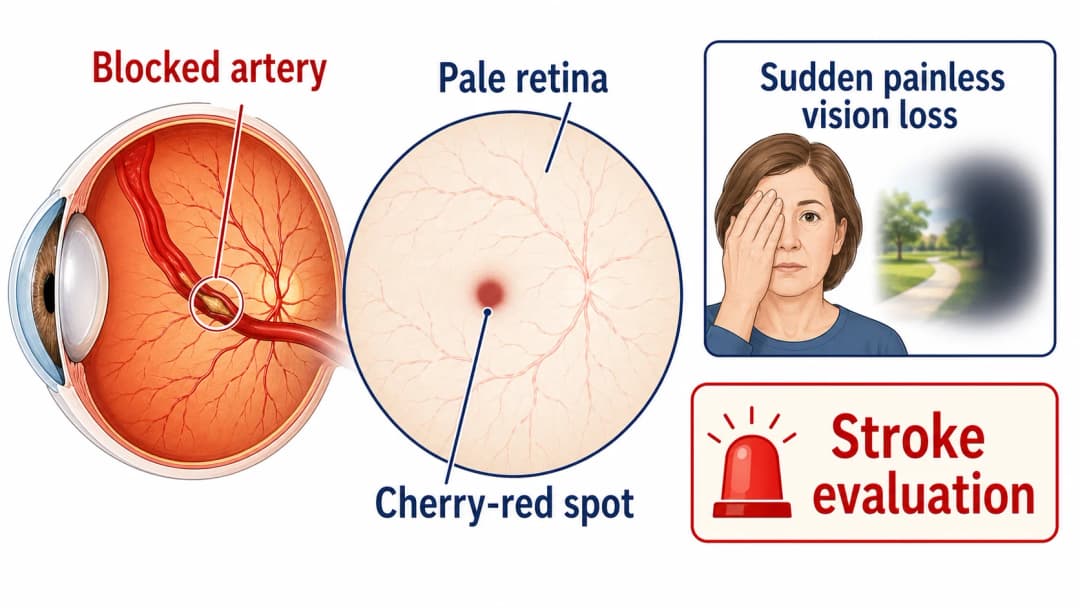
What Happens in CRAO
The Central Retinal Artery
- Main blood supply to the inner retina
- Branches off the ophthalmic artery (from the brain's blood supply)
- Enters the eye through the optic nerve
- When blocked, the retina loses oxygen and begins to die
Timeline of Damage
The retina is extremely sensitive to oxygen deprivation.
- Irreversible damage can begin quickly, sometimes within 90 minutes
- Severe irreversible damage can occur within hours
- Possible treatment windows are narrow and require immediate stroke-center evaluation
Symptoms
Classic Presentation
- Sudden vision loss-often "like a curtain came down"
- Painless
- Usually one eye
- Severe-often counting fingers or worse
- No warning in most cases (unless previous transient episodes)
Preceding Symptoms (in some patients)
- Amaurosis fugax-transient vision loss lasting seconds to minutes
- Episodes of "shade coming down" that resolved
- These are warning signs that were missed
What You Won't Have
- Pain
- Red eye
- Gradual onset
- Flashing lights (usually)
Causes
Emboli (Most Common)
Material that travels from elsewhere and lodges in the artery:
Sources:
- Carotid artery plaque (atherosclerosis)
- Heart (atrial fibrillation, valve disease, heart attack)
- Aortic arch plaque
Types:
- Cholesterol emboli (Hollenhorst plaques)
- Platelet-fibrin emboli
- Calcific emboli (from heart valves)
Thrombosis
Clot forming in place:
- Atherosclerosis of the retinal artery
- Giant cell arteritis (inflammatory)
- Hypercoagulable states
Giant Cell Arteritis (GCA)
Giant cell arteritis is an emergency cause of CRAO.
- Inflammatory disease of medium/large arteries
- Usually patients over 50 years old
- Symptoms: headache, scalp tenderness, jaw claudication, fever, weight loss
- Can cause bilateral blindness and stroke
- Requires immediate high-dose steroids when suspected
- Should be considered in CRAO patients over 50, especially with headache, jaw pain, scalp tenderness, fever, or systemic symptoms
Other Causes
- Vasospasm
- Dissection of carotid or ophthalmic artery
- Trauma
- Complications of procedures (injections, surgery)
- Sickle cell disease
Risk Factors
- Cardiovascular disease (hypertension, diabetes, hyperlipidemia)
- Smoking
- Carotid artery disease
- Cardiac disease (atrial fibrillation, valve disease)
- Age (typically over 60)
- Male sex (slightly higher risk)
- Previous TIA or stroke
- Hypercoagulable states
Diagnosis
Clinical Examination
What the Doctor Sees:
- Severely reduced visual acuity (often counting fingers or worse)
- Afferent pupillary defect (pupil doesn't react normally to light)
- Pale, white retina (ischemic)
- "Cherry red spot" at the macula (classic finding)
- Narrowed, "boxcarring" arteries
- May see embolus in artery
The "Cherry Red Spot"
- The macula appears red against the surrounding pale retina
- Occurs because the macula is thin enough to show underlying choroidal blood supply
- Classic but not always present (especially early)
Urgent Testing
Immediate:
- ESR and CRP (to rule out giant cell arteritis)
- Blood pressure
- Blood glucose
- Complete blood count
- Coagulation studies
Urgent Workup:
- Carotid ultrasound or CTA
- Echocardiogram (looking for cardiac source)
- ECG (looking for atrial fibrillation)
- Urgent stroke-center evaluation with brain imaging, head/neck vascular imaging, and cardiac evaluation; MRI with diffusion-weighted imaging and MRA are preferred when available, while CT/CTA may be used when MRI is unavailable or contraindicated
- Temporal artery biopsy (if GCA suspected)
Differential Diagnosis
- Ophthalmic artery occlusion (even more severe)
- Central retinal vein occlusion (different appearance)
- Optic neuritis
- Vitreous hemorrhage
Treatment
The Reality of Treatment
There is no proven treatment that consistently restores vision in CRAO.
Despite many attempted interventions over decades, no treatment has been proven to significantly improve visual outcomes in randomized trials. The retina is typically irreversibly damaged by the time patients seek care.
What the ER Is Actually For
CRAO is treated like an acute stroke. The emergency department visit has two urgent goals: evaluate any time-sensitive vision-saving options and reduce the risk of brain stroke or heart attack in the following days and weeks. Up to 1 in 4 patients with CRAO have another vascular event in the following month without proper workup.
The ED will:
- Arrange an urgent stroke workup (imaging of the brain and neck vessels, cardiac monitoring)
- Start antiplatelet or anticoagulant therapy when appropriate
- Screen for giant cell arteritis in anyone over 50 - if GCA is suspected, urgent IV steroids can save the other eye
Attempted Vision-Restoration Treatments (Variable Evidence)
These may be offered at specialized centers, but none are proven to reliably restore vision, and waiting for them is not a reason to delay going to the ER:
Historical / traditional:
- Ocular massage (to dislodge the embolus)
- Anterior chamber paracentesis (to lower eye pressure)
- Carbogen inhalation (to increase oxygen)
- Hyperbaric oxygen (limited availability and time-sensitive)
Experimental / center-specific:
- Intra-arterial thrombolysis (clot-busting drugs delivered directly)
- IV thrombolysis (systemic clot-busting medicine, as in brain stroke) - evidence remains limited; stroke teams may consider it for selected patients within a narrow time window after discussing risks and uncertainty
Ask your team what is available at your hospital, but remember: the primary goal of the emergency visit is stroke prevention.
What IS Critical
Stroke Prevention: The most important intervention is preventing brain stroke and heart attack:
- Urgent cardiovascular workup
- Carotid evaluation
- Cardiac evaluation
- Risk factor modification
- Antiplatelet therapy (Aspirin)
- Anticoagulation if indicated (atrial fibrillation)
- Statin therapy
If Giant Cell Arteritis Suspected:
- Immediate high-dose IV steroids
- Can prevent blindness in the other eye
- Temporal artery biopsy (doesn't delay treatment)
Prognosis
Visual Outcome
- Most patients do not regain useful vision
- Only 10-20% have significant improvement
- Final vision often counting fingers or worse
- Some patients retain peripheral vision if cilioretinal artery present
Systemic Implications
CRAO patients have significantly elevated risk of:
- Stroke-10% within days to weeks
- Myocardial infarction-higher than general population
- Cardiovascular death
CRAO should be treated with the same urgency as a TIA (mini-stroke) regarding cardiovascular workup and prevention.
Living with Vision Loss
Practical Considerations
- Register with low vision services
- Occupational therapy for daily activities
- Evaluate driving ability (usually cannot drive with severe loss in one eye)
- Protect the remaining eye
Psychological Support
- Vision loss is traumatic
- Counseling may help
- Connect with support groups
- Focus on what can be done for prevention
Prevention
For Those at Risk
- Control blood pressure
- Control diabetes
- Control cholesterol
- Stop smoking
- Take prescribed medications
- Regular cardiovascular checkups
Warning Signs
If you experience transient vision loss (amaurosis fugax):
- Call 911 immediately and ask for a stroke-capable emergency department
- This may be a warning of impending CRAO or stroke
- Urgent workup needed
Frequently Asked Questions
Is there any chance my vision will come back?
Unfortunately, most patients do not regain useful vision after CRAO. The retina suffers irreversible damage very quickly without blood flow. Some patients have modest improvement, and rarely patients with a cilioretinal artery retain some central vision.
Why do I need so many heart and brain tests?
CRAO is often caused by the same problems that cause stroke and heart attack-blocked arteries and blood clots. Finding and treating these problems can prevent a devastating brain stroke, which is actually the bigger risk after CRAO.
Should I call my eye doctor first?
No. Sudden painless vision loss or a temporary blackout in one eye should be treated as a stroke symptom first. Call 911 and ask for a stroke-capable emergency department. Ophthalmology is still important, but the emergency department can start the brain, neck-vessel, heart-rhythm, and giant-cell-arteritis workup without waiting for an office appointment.
Am I going to have a stroke?
CRAO significantly increases stroke risk, which is why urgent workup and prevention are so important. With proper evaluation and treatment of risk factors, this risk can be reduced. This is the silver lining-you've received a warning that allows preventive action.
Will my other eye be affected?
The same risk factors that caused CRAO in one eye do put the other eye at risk. This is another reason why risk factor modification and treatment are so important. If giant cell arteritis is the cause, the other eye is at high, imminent risk without treatment.
What can I do now?
Focus on what you can control: follow up with cardiology and neurology, take prescribed medications, modify risk factors (smoking, diet, exercise), and work with low vision services to maximize function with your remaining vision.
References
Medical Disclaimer: This information is for educational purposes only and does not replace professional medical advice, diagnosis, or treatment. Sudden vision loss is a medical emergency-seek immediate care.
Sources:
- StatPearls. Central Retinal Artery Occlusion. NCBI Bookshelf.
- American Heart Association. Management of Central Retinal Artery Occlusion - Top Things to Know.
- Hayreh SS. Acute retinal arterial occlusive disorders. Prog Retin Eye Res. 2011;30(5):359-394.
- Mac Grory B, et al. Management of Central Retinal Artery Occlusion: A Scientific Statement From the American Heart Association. Stroke. 2021;52(6):e282-e294.