

Central Serous Retinopathy
Fluid under the macula can blur or distort central vision, with stress and corticosteroid exposure commonly present in the history.
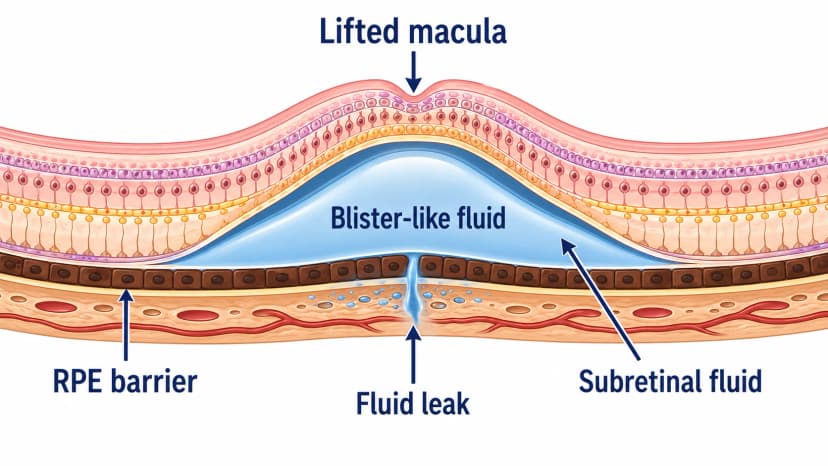
Central serous retinopathy may cause one eye to seem dimmer, straight edges to look distorted, or the center of vision to appear gray or blurred. In central serous retinopathy, also called central serous chorioretinopathy (CSCR), fluid leaks under the macula through the retinal pigment epithelium (RPE). Many acute episodes resolve over a few months. Chronic or recurrent fluid requires closer management because persistent subretinal fluid can damage the macula.
Key Takeaways
- Fluid sits under the macula, so central vision may look gray, warped, smaller, or out of focus
- Stress and corticosteroid exposure are common associations, including oral, inhaled, nasal, and topical steroid exposure
- Men ages 30-50 are affected most, though CSR is not limited to that group
- OCT usually makes the diagnosis obvious by showing the pocket of subretinal fluid
- Many acute episodes clear within 3-4 months without a procedure
- Chronic CSR lasting more than 4-6 months may need treatment to protect the macula
- Do not stop prescribed steroids on your own; the safer move is to ask the prescribing clinician about alternatives
Overview
Central serous retinopathy is a relatively common condition that tends to affect young to middle-aged adults, particularly men. Many first-time acute cases improve substantially, but recovery varies. Chronic or frequently recurring CSR can leave RPE damage, distortion, contrast loss, persistent fluid, or other lasting visual symptoms.
Symptoms
- Blurred vision in one eye (usually)
- Distorted vision (metamorphopsia) - straight lines appear bent
- Central dark or dim spot
- Objects appear smaller than normal (micropsia) in the affected eye
- Colors may appear washed out or duller in the affected eye
- Reduced contrast sensitivity
- May be asymptomatic if the fluid is not directly under the fovea
Causes and Risk Factors
The Mechanism
The retinal pigment epithelium (RPE) normally acts as a barrier, keeping fluid from the choroid (blood vessel layer) away from the retina. In CSR, this barrier breaks down at one or more points, allowing fluid to seep under the retina.
Major Risk Factors
- Stress and "type A" personality - the classic association
- Corticosteroid use - the strongest modifiable risk factor
- Oral prednisone
- Inhaled steroids (for asthma)
- Nasal steroid sprays
- Steroid creams (even on distant skin)
- Steroid joint injections
- Male sex (6:1 male-to-female ratio)
- Age 30-50
- Pregnancy (often improves after delivery)
- Obstructive sleep apnea
- Helicobacter pylori infection (association reported)
- Organ transplant (due to chronic steroid/immunosuppressive use)
If you are diagnosed with CSR, tell your doctor about ALL steroid medications you use - including inhalers, nasal sprays, skin creams, and joint injections. Stopping or switching these medications (with your prescribing doctor's guidance) is often the key to recovery.
Diagnosis
- Optical coherence tomography (OCT) - clearly shows the dome of subretinal fluid under the macula; essential for diagnosis and monitoring
- Fluorescein angiography - shows the point of leakage (classic "smokestack" or "inkblot" pattern); helps guide laser treatment if needed
- Indocyanine green (ICG) angiography - evaluates the choroidal blood flow; helpful in chronic cases
- Fundus autofluorescence - detects RPE changes, especially in chronic CSR
- Visual acuity testing - typically 20/20 to 20/40 in acute cases
Treatment
Acute CSR
Observation (first-line):
- Most acute episodes resolve spontaneously in 3-4 months
- Ask about reducing or stopping corticosteroids when the prescribing clinician says it is safe; steroid exposure is often an important modifiable factor
- Reduce stress - exercise, sleep, relaxation techniques
- Treat sleep apnea if present
- Monitor with monthly OCT
Chronic or Recurrent CSR
If fluid persists beyond 4-6 months or vision deteriorates:
Photodynamic therapy (PDT):
- One of the best-supported treatments for selected chronic or persistent CSR
- Low-fluence (half-dose) PDT is preferred to minimize side effects
- Targets the abnormal choroidal vessels causing the leak
- Fluid resolution is common in selected cases, but visual recovery varies
Focal laser photocoagulation:
- Applied directly to the leakage point
- Only used when the leak is well away from the foveal center
- Quick and effective but can create a small blind spot
- Less effective than PDT for typical CSR
- May be used in combination with PDT
- More helpful when there is associated choroidal neovascularization
Mineralocorticoid antagonists (oral):
- Eplerenone or spironolactone
- Earlier small studies suggested possible benefit, but the VICI trial found eplerenone was not superior to placebo
- Not routinely recommended as first-line therapy; PDT has stronger evidence when chronic CSR requires treatment
Prognosis
Acute CSR
- Many first-time acute cases improve substantially within 3-4 months
- Vision often improves, but full recovery is not guaranteed
- Subtle changes in color perception or contrast may persist
- Recurrence rate: 30-50% over subsequent years
Chronic CSR
- More guarded - prolonged fluid causes progressive RPE and photoreceptor damage
- Treatment can resolve fluid but some visual changes may be permanent
- Long-term monitoring is important
When to See a Doctor
See an eye doctor if you notice:
- New blurring of central vision, especially in one eye
- Distortion of straight lines
- A dim or dark spot in your central vision
- Objects looking smaller or colors looking different in one eye compared to the other
Frequently Asked Questions
Will CSR go away on its own?
Most acute episodes do resolve spontaneously within 3-4 months. However, chronic cases lasting longer than 4-6 months usually require treatment to prevent permanent retinal damage.
Can stress really cause an eye problem?
CSR has a well-recognized association with stress physiology and steroid exposure, though not all cases are stress-caused. The mechanism likely involves stress hormones (cortisol) affecting the choroidal blood vessels and RPE barrier. Stress reduction can be a useful part of management.
How long should I wait before getting treatment?
For a first episode with good visual acuity, most ophthalmologists recommend observing for 3-4 months. If fluid is still present, the vision is significantly affected, or you've had multiple recurrences, earlier treatment may be appropriate.
Can I prevent recurrences?
Avoiding corticosteroids, managing stress, treating sleep apnea, and maintaining overall health can reduce recurrence risk. However, some patients have recurrences despite these measures.
Is CSR related to macular degeneration?
CSR and macular degeneration are different conditions. However, chronic CSR can sometimes be confused with certain forms of macular degeneration, and long-standing CSR can cause retinal changes resembling those of macular degeneration. Your ophthalmologist can distinguish between them.
References
Medical Disclaimer: This information is for educational purposes only and does not replace professional medical advice, diagnosis, or treatment. If you have symptoms of central serous retinopathy, please consult a qualified healthcare provider.
Sources:
- StatPearls. Central Serous Chorioretinopathy. NCBI Bookshelf.
- Daruich A, et al. Central serous chorioretinopathy: recent findings and new physiopathology hypothesis. Prog Retin Eye Res. 2015;48:82-118.
- Liew G, et al. A comparison of the causes and risk factors of central serous chorioretinopathy. Ophthalmology. 2013;120(1):e45-e46.
- van Rijssen TJ, et al. Central serous chorioretinopathy: towards an evidence-based treatment guideline. Prog Retin Eye Res. 2019;73:100770.
- American Academy of Ophthalmology EyeWiki. Central Serous Chorioretinopathy.