
Viral Conjunctivitis (Pink Eye)
A highly contagious eye infection causing redness, tearing, and discomfort. Learn about symptoms, contagious period, treatment, and preventing spread.
Viral conjunctivitis, commonly known as "pink eye," is inflammation of the conjunctiva (the clear membrane covering the white of the eye) caused by a virus. It's highly contagious and one of the most common eye infections. While uncomfortable, viral conjunctivitis usually resolves on its own without lasting vision problems.
Key Takeaways
- Highly contagious—easily spreads through contact
- Usually self-limiting—resolves in 1-3 weeks without antibiotics
- Watery discharge typical (vs. thick discharge in bacterial)
- Often starts in one eye then spreads to the other
- Antibiotics don't help—this is a viral infection
- Good hygiene essential to prevent spreading to others
What Are the Symptoms of Viral Pink Eye?
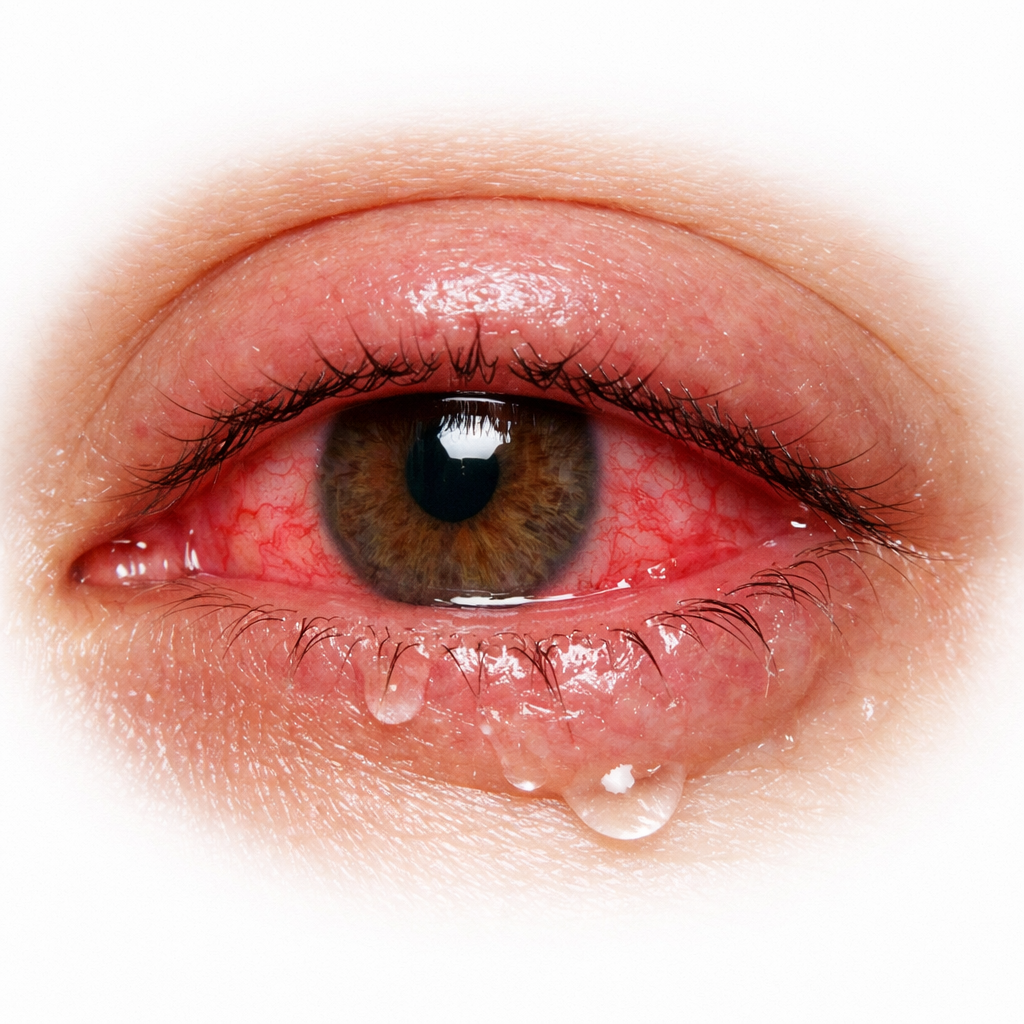
Viral conjunctivitis typically causes watery, clear discharge with redness and a gritty sensation. It often starts in one eye and spreads to the other within a few days, frequently alongside cold or upper respiratory symptoms.
Classic Presentation
- Red or pink eye (hence "pink eye")
- Watery, clear discharge (key difference from bacterial)
- Gritty or sandy sensation
- Itching (though less than allergic conjunctivitis)
- Swollen eyelids
- Light sensitivity
- Tearing
Course of Illness
- Often starts in one eye
- Spreads to second eye within days
- May be accompanied by cold symptoms
- Symptoms typically peak at days 3-5
- Generally resolves in 1-3 weeks
Associated Symptoms
- Upper respiratory symptoms (cold, sore throat)
- Swollen lymph node in front of ear (preauricular node)
- General malaise
- Occasionally fever
What Are the Types of Viral Conjunctivitis?
Several viruses can cause conjunctivitis, with adenovirus being the most common. The specific virus affects how severe the infection is, how long it lasts, and whether targeted antiviral treatment is needed.
Adenoviral (Most Common)
- Most frequent cause of viral pink eye
- Highly contagious
- Often associated with respiratory symptoms
- Can cause epidemic outbreaks
Epidemic Keratoconjunctivitis (EKC)
- Severe form of adenoviral infection
- Can affect cornea
- More prolonged course
- May leave temporary corneal haze
Herpes Simplex Virus
- Usually one eye
- May have vesicles on eyelids
- Can be recurrent
- Requires specific antiviral treatment
- Must be identified—can cause serious corneal disease
Other Viruses
- Enterovirus (acute hemorrhagic conjunctivitis)
- Varicella-zoster (shingles)
- Measles, mumps, rubella
- COVID-19 (can cause conjunctivitis)
- Avian influenza (H5N1) — see our guide on pink eye and bird flu
Is Viral Pink Eye Contagious?
Yes—viral conjunctivitis is highly contagious. You can spread it from the moment symptoms start until up to two weeks later, even after symptoms begin to improve. The virus transmits through direct contact, contaminated hands, shared items, and respiratory droplets.
Contagious Period
For a full guide on contagiousness, transmission, and return-to-work/school guidelines, see is pink eye contagious?.
You are contagious:
- As soon as symptoms start
- For up to 2 weeks after symptoms begin
- As long as eyes are red and tearing
- Even after symptoms improve (can still shed virus)
Practice strict hygiene throughout the illness.
How It Spreads
- Direct contact with infected person's secretions
- Contaminated hands touching the eye
- Shared items: towels, pillowcases, makeup
- Respiratory droplets (coughing, sneezing)
- Contaminated surfaces
- Swimming pools (especially if not properly chlorinated)
Preventing Spread
Personal Hygiene
- Wash hands frequently with soap for 20+ seconds
- Don't touch your eyes with unwashed hands
- Don't share towels, pillowcases, or eye drops
- Wash bedding and towels in hot water
- Discard eye makeup used during infection
- Don't wear contact lenses until fully recovered
Protecting Others
- Stay home from work/school while contagious
- Cover coughs and sneezes
- Clean and disinfect frequently touched surfaces
- Avoid close contact with others when possible
- Warn close contacts so they can watch for symptoms
How Is Viral Conjunctivitis Diagnosed?
Viral conjunctivitis is usually diagnosed clinically based on your symptoms and the appearance of your eyes. Lab testing is typically not needed unless the case is severe, prolonged, or herpes infection is suspected.
Clinical Examination
- Based on history and appearance
- Slit-lamp examination to assess severity
- Check for corneal involvement
- Evaluate for other causes
When Further Testing Is Needed
- Severe or prolonged cases
- Suspected herpes (requires different treatment)
- Outbreak investigation
- Diagnostic uncertainty
How Is Viral Pink Eye Treated?
There is no cure for viral conjunctivitis—it must run its course, much like the common cold. Treatment focuses on relieving symptoms with cold compresses, artificial tears, and rest. Antibiotics do not help and should be avoided unless a bacterial co-infection is suspected.
Supportive Care
There is no cure for viral conjunctivitis—treatment focuses on comfort:
- Cold compresses—reduce swelling and discomfort
- Artificial tears—lubricate and soothe
- Avoid rubbing—worsens inflammation and spreads virus
- Rest—helps immune system fight infection
- For more home care tips, see our pink eye home remedies guide
What Doesn't Help
- Antibiotics—ineffective against viruses
- Antibiotic eye drops—won't speed recovery
- Prescribing antibiotics contributes to antibiotic resistance
When Antibiotics May Be Prescribed
Sometimes doctors prescribe antibiotics when:
- Diagnosis uncertain (might be bacterial)
- Risk of secondary bacterial infection
- Severe cases
- Immunocompromised patients
For Specific Viral Types
Herpes simplex conjunctivitis:
- Antiviral medication (oral or topical)
- Must be properly diagnosed
- Follow-up important
Herpes zoster (shingles):
- Oral antiviral medication
- May need additional treatments
How Long Does Viral Pink Eye Last?
Most cases of viral conjunctivitis resolve in 1 to 3 weeks without treatment. Symptoms typically peak around days 3 to 5, then gradually improve. Some residual redness may linger after other symptoms have cleared. For a complete timeline comparison across all types, see how long does pink eye last?.
- Mild cases: 7–10 days
- Typical adenoviral: 1–2 weeks
- EKC (severe form): 2–3 weeks, sometimes longer
- Herpes simplex: Variable, depends on treatment response
- Corneal haze after EKC: May persist for weeks to months but usually resolves
When Should You See a Doctor for Viral Pink Eye?
While most viral pink eye resolves on its own, you should see a doctor if you experience significant eye pain, vision changes, or symptoms that worsen after the first week. Contact lens wearers should always seek evaluation. Not all red eyes are pink eye—see our guide on conditions mistaken for pink eye.
Initial Evaluation
See a doctor if:
- Significant eye pain (beyond mild discomfort)
- Vision changes
- Severe light sensitivity
- Symptoms in a contact lens wearer
- Uncertain diagnosis
During Illness
Return to doctor if:
- Symptoms worsening after 5-7 days
- Vision becoming blurry
- Increasing pain
- Thick yellow-green discharge develops
- Symptoms lasting more than 2-3 weeks
- Rash on face or around eyes
What Are the Potential Complications of Viral Pink Eye?
Most viral conjunctivitis resolves completely without lasting effects. However, certain forms—particularly EKC and herpes simplex—can affect the cornea and require closer monitoring. Secondary bacterial infection is uncommon but possible.
Potential Complications
-
Subepithelial infiltrates (corneal haze after EKC)
- Can blur vision temporarily
- May require steroid drops
- Usually resolves over months
-
Secondary bacterial infection (uncommon)
- Yellow-green discharge
- Requires antibiotics
-
Spread to cornea (keratitis)
- Especially with herpes viruses
- More serious, requires treatment
How Can You Tell Viral Pink Eye from Bacterial?
The key difference is the type of discharge: viral conjunctivitis produces watery, clear discharge while bacterial produces thick, yellow-green pus. Viral cases are also more likely to involve both eyes and be accompanied by cold symptoms. For a detailed side-by-side comparison, see our guide on bacterial vs viral vs allergic pink eye.
| Feature | Viral | Bacterial |
|---|---|---|
| Discharge | Watery, clear | Thick, yellow-green |
| Onset | Often one eye, then both | May start in one or both |
| Symptoms | Itching, tearing | Matting, crusting |
| Course | 1-3 weeks | May persist without treatment |
| Treatment | Supportive | Antibiotic drops |
| Contagious | Very | Yes, but less so |
Frequently Asked Questions
Can I go to work/school with pink eye?
Most workplaces and schools recommend staying home while obviously symptomatic and highly contagious (usually 5-7 days). Some may require doctor clearance. Check your specific policy.
When can I wear contacts again?
Wait until symptoms completely resolve, and replace your contact lenses, lens case, and any opened solutions. Generally wait at least 24-48 hours after all symptoms have cleared.
Will antibiotics make it go away faster?
No. Antibiotics don't work against viruses. Taking unnecessary antibiotics contributes to antibiotic resistance and won't help your symptoms.
Should I stay away from other people?
Yes, as much as reasonably possible while contagious. Practice strict hygiene if you must interact with others. Avoid touching your face and wash hands frequently.
Can I get pink eye again?
Yes. There are many viruses that cause conjunctivitis, and immunity is usually specific to the strain that infected you. You can get viral conjunctivitis multiple times in your life.
Is pink eye always contagious?
Viral and bacterial conjunctivitis are contagious. Allergic conjunctivitis is not contagious—it's a reaction to allergens, not an infection.
References
Medical Disclaimer: This information is for educational purposes only and does not replace professional medical advice, diagnosis, or treatment. If you have eye symptoms, please consult a qualified healthcare provider.
Sources:
- American Academy of Ophthalmology. Conjunctivitis (Pink Eye).
- Centers for Disease Control and Prevention. Conjunctivitis (Pink Eye).
- Azari AA, Barney NP. Conjunctivitis: a systematic review of diagnosis and treatment. JAMA. 2013;310(16):1721-1729.