

Atropine Eye Drops
An anticholinergic eye drop that dilates the pupil and paralyzes the focusing muscle. Used for cycloplegic refraction in children, amblyopia treatment, uveitis management, and low-dose myopia control.
Drug Class: Anticholinergics
Atropine is an anticholinergic (parasympatholytic) eye drop that dilates the pupil (mydriasis) and temporarily paralyzes the eye's focusing muscle (cycloplegia). It is one of the oldest and most widely used medications in ophthalmology, with applications ranging from diagnostic cycloplegic refraction in children to the treatment of uveitis and, more recently, low-dose myopia control. Atropine is the longest-acting cycloplegic agent available, with effects lasting up to two weeks.
Key Takeaways
- Dilates the pupil and paralyzes accommodation (the eye's ability to focus up close)
- Longest-acting cycloplegic - effects last 1-2 weeks, much longer than other dilating drops
- Essential for young children whose strong focusing can hide significant farsightedness during eye exams
- Low-dose formulations (0.01-0.05%) are increasingly used to slow myopia progression in children
- Treats uveitis by preventing painful ciliary muscle spasm and posterior synechiae
- Side effects are temporary - blurred near vision and light sensitivity resolve as the medication wears off
How It Works
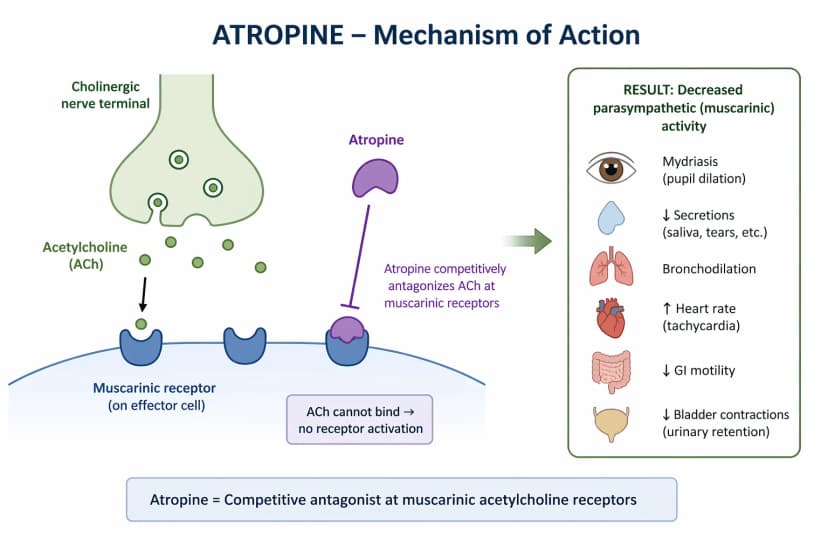
Atropine blocks the action of acetylcholine at muscarinic receptors in two key muscles inside the eye:
- Iris sphincter muscle - When blocked, the pupil dilates widely (mydriasis), allowing more light into the eye and providing a better view of the retina during examination
- Ciliary muscle - When blocked, the muscle that changes the shape of the lens for near focus is temporarily paralyzed (cycloplegia), preventing accommodation
Because atropine binds tightly to these receptors and is released slowly, its effects last much longer than other cycloplegic drops. This is both an advantage (complete, reliable cycloplegia) and a limitation (prolonged blurred vision and light sensitivity).
Available Forms and Concentrations
Atropine 1%
The strongest commercially available concentration. Produces complete cycloplegia and maximal pupil dilation. Used for:
- Cycloplegic refraction in young children (especially those under age 1) and patients with heavily pigmented (dark brown) irises, where weaker agents may not fully paralyze accommodation
- Treatment of uveitis - keeps the pupil dilated to prevent the inflamed iris from sticking to the lens (posterior synechiae) and reduces pain from ciliary muscle spasm
- Amblyopia penalization therapy - blurs the stronger eye to encourage use of the weaker eye, as an alternative to patching
- Post-operative mydriasis after certain intraocular procedures
Atropine 0.5%
An intermediate concentration occasionally used in older children when 1% is not needed but cyclopentolate alone is insufficient.
Low-Dose Atropine (0.01-0.05%)
Low-dose atropine administered as one drop at bedtime is used off-label to slow myopia (nearsightedness) progression in children. Benefit varies by concentration and population: 0.05% has shown stronger effects in some trials, while 0.01% did not outperform placebo in a U.S. PEDIG trial. Side effects are usually mild but can include light sensitivity and near blur.
- Used for myopia control in children ages 4-12 with documented progression
- Typically prescribed for 2-5 years, with monitoring by an ophthalmologist
- Available through compounding pharmacies (not yet commercially available as a branded low-dose product in the US)
Common Uses
- Cycloplegic refraction - Prescribed as home drops for 3 days before the exam in young children and patients with dark irises where in-office cyclopentolate may be insufficient
- Amblyopia penalization - An alternative to occlusion therapy (patching); blurring the stronger eye with atropine encourages the brain to use the weaker eye
- Uveitis treatment - Prevents posterior synechiae, relieves photophobia and ciliary spasm pain
- Myopia control - Low-dose nightly drops to slow nearsightedness progression in children
- Pre- and post-operative pupil dilation - When prolonged mydriasis is needed after intraocular surgery
- Diagnostic mydriasis - When shorter-acting agents like tropicamide fail to adequately dilate the pupil
How to Use
- For cycloplegic refraction: One drop of 1% atropine in each eye, once daily for 3 days before the scheduled appointment. The final drop should be given the morning of the exam
- For uveitis: Typically 1 drop of 1% atropine two to three times daily, as directed by your ophthalmologist. Frequency depends on severity of inflammation
- For amblyopia penalization: 1 drop of 1% atropine in the stronger eye, once daily or on weekends only, as prescribed
- For myopia control: 1 drop of 0.01-0.05% atropine at bedtime in both eyes
- Instillation technique: Wash hands, tilt head back, pull down the lower eyelid to form a pocket, place one drop inside, and close the eye gently for 1-2 minutes
- Punctal occlusion: After instilling the drop, press gently on the inner corner of the eye (near the nose) for 1-2 minutes. This reduces drainage into the nasal passages and minimizes systemic absorption, which is especially important in infants and young children
What to Expect
Immediate Effects
- Brief stinging or burning sensation (10-30 seconds) upon instillation
- The pupil begins to dilate within 15-30 minutes
- Near vision becomes progressively blurry as the ciliary muscle relaxes
Duration
Atropine's effects last significantly longer than other cycloplegic drops:
| Effect | Atropine 1% | Cyclopentolate 1% | Tropicamide 1% |
|---|---|---|---|
| Mydriasis (pupil dilation) | 7-14 days | 12-24 hours | 4-6 hours |
| Cycloplegia (focus paralysis) | 5-12 days | 12-24 hours | 4-6 hours |
| Best suited for | Young children, dark irises, uveitis | Routine pediatric refraction | Adult screening, quick dilation |
For Parents
- Your child's near vision will be blurry - reading, homework, and screen use will be difficult during the active period
- Light sensitivity is expected - sunglasses and a hat are helpful outdoors
- Distance vision is usually less affected, so most children can attend school
- With low-dose atropine (myopia control), side effects are minimal and most children notice no difference in their daily activities
Side Effects
Common
- Blurred near vision (expected effect, not truly a "side effect")
- Light sensitivity due to dilated pupil
- Mild stinging on instillation
Less Common
- Dry mouth
- Facial flushing (redness)
- Mild increase in heart rate (tachycardia)
- These occur from systemic absorption and are more likely in young children if punctal occlusion is not performed
Rare but Serious
Reducing systemic absorption in infants and young children: Always perform punctal occlusion (pressing on the inner corner of the eye) for 1-2 minutes after instilling atropine drops. In small children, systemic absorption can cause fever, flushing, rapid heartbeat, dry skin, and in rare cases, atropine toxicity with confusion or hallucinations. If your child develops a fever, flushed dry skin, or unusual behavior after atropine use, contact your doctor or seek emergency care.
- Fever and flushed, dry skin (especially in infants)
- Hallucinations or agitation (very rare, systemic toxicity)
- Urinary retention (mainly in elderly patients)
Precautions
- Not for use in acute angle-closure glaucoma unless specifically directed by an ophthalmologist - dilating the pupil can worsen angle closure
- Caution in elderly patients - systemic absorption may cause urinary retention, constipation, or confusion
- Inform all healthcare providers that the pupil is pharmacologically dilated. A fixed, dilated pupil from atropine can be mistaken for a neurological emergency if the treating physician is unaware
- Keep out of reach of children - accidental oral ingestion can cause serious anticholinergic toxicity
- Pregnancy: Use only if clearly needed and directed by your physician
- Atropine is the pharmacologic opposite of pilocarpine - one dilates and the other constricts the pupil. They should not be used simultaneously unless specifically prescribed
Frequently Asked Questions
How long will my child's eyes stay dilated after atropine?
With atropine 1%, the pupils typically remain dilated for 7-14 days, and focusing ability returns over 5-12 days. This is much longer than the few hours of dilation from standard eye exam drops. Plan accordingly for outdoor activities and school.
Can my child go to school while using atropine drops?
Yes, in most cases. Distance vision is usually adequate for classroom activities. Near work (reading, writing, tablets) will be difficult during the first few days of 1% atropine use. With low-dose atropine for myopia control, many children function normally at school, but light sensitivity or near blur can occur, especially at higher low-dose concentrations.
Is low-dose atropine safe for long-term myopia control?
Large clinical trials (including ATOM and LAMP) have followed children using low-dose atropine for years with generally reassuring safety data. The most common side effects are mild pupil dilation, light sensitivity, and near blur. Your ophthalmologist will monitor your child regularly during treatment and adjust concentration if side effects or rebound progression occur.
Why does the doctor ask me to press on the corner of my child's eye after the drop?
This technique, called punctal occlusion, blocks the tear drainage duct and prevents the medication from draining into the nose and being absorbed into the bloodstream. It reduces the risk of systemic side effects like flushing, dry mouth, and rapid heartbeat, which are especially important to avoid in young children.
Can atropine be used in adults?
Yes. Atropine is used in adults for uveitis treatment, diagnostic dilation when other drops are insufficient, and occasionally for post-surgical pupil management. However, for routine cycloplegic refraction in adults, shorter-acting agents like cyclopentolate or tropicamide are generally preferred because the prolonged effects of atropine are inconvenient for most adult patients.
Medical Disclaimer: This information is for educational purposes only and does not replace professional medical advice. Follow your doctor's instructions regarding this medication.
References
For current U.S. drug labeling, contraindications, boxed warnings, pregnancy/lactation language, and formulation-specific dosing, check the official label databases and your prescriber's instructions.