
Hess Chart Test
A specialized test that maps how each eye moves into the nine cardinal positions, used to characterize cranial nerve palsies and other motility disorders.
The Hess chart is a specialized test of binocular eye movements used to characterize the pattern of diplopia (double vision). It maps how each eye moves into the nine cardinal positions of gaze and produces a graphic representation that helps identify which muscle or cranial nerve is impaired. The Hess chart is most useful in the assessment of cranial nerve palsies, restrictive disorders such as thyroid eye disease, and post-traumatic motility problems.
Key Takeaways
- The Hess chart maps each eye's movements in the nine cardinal positions and compares to a normative grid
- Used primarily in the assessment of diplopia to identify the pattern of weakness or restriction
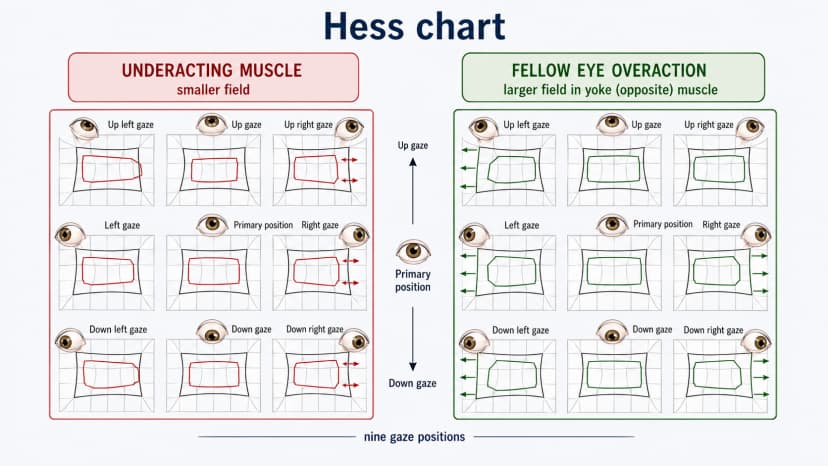
- Two charts are produced - one when each eye fixes - that together identify the underacting (paretic/affected) eye and the apparent overaction of the yoke muscle in the fellow eye, driven by Hering's law of equal innervation
- Best performed serially to track recovery or progression of cranial nerve palsies and orbital disease
- Hess and Lees screens use different dissociation methods - red-green for the Hess, perpendicular mirrored screens for the Lees; the Lees can be more reliable in patients with reduced foveal fusion or dense suppression
How the Test Works
The patient is seated in front of a Hess screen - a tangent screen marked with cardinal positions of gaze. With one eye dissociated by colored filters or mirrors, the patient indicates with a pointer where they perceive a target light to be. By comparing the perceived position to the actual position of the light, the examiner generates a chart for each eye showing the relative position of each gaze direction.
The two resulting charts (one per eye fixing) reveal:
- When the unaffected eye is fixing, the smaller (compressed) chart represents the affected (paretic/restricted) eye's underaction
- When the affected eye is forced to fix, the fellow eye's chart appears larger because of Hering's-law overaction of the yoke muscle
- The pattern of underaction identifies which muscle is weak
Common Patterns
Cranial Nerve Palsies
- Sixth nerve palsy - limited abduction; ipsilateral chart shows narrowed lateral excursion
- Third nerve palsy - variable depending on muscles affected; usually limitation of adduction, elevation, depression
- Fourth nerve palsy - limited depression in adduction; classic pattern of underaction of superior oblique with overaction of contralateral inferior rectus
Restrictive Disorders
- Thyroid eye disease - restriction (tethering) of a muscle limits movement in the direction opposite to that muscle's normal action; classically a tight (fibrotic) inferior rectus tethers the globe and limits upgaze
- Orbital fracture with muscle entrapment - focal limitation matching the entrapped muscle
Mechanical and Surgical
- Post-strabismus surgery
- Adherence syndromes
- Brown syndrome (limited elevation in adduction)
Limitations
- Requires patient cooperation and concentration
- Not useful in dense suppression
- Requires reliable diplopia perception
- Interpretation needs experience
Frequently Asked Questions
How is the Hess chart different from a Maddox rod test?
The Maddox rod measures the amount of misalignment in primary gaze and a few directions. The Hess chart maps misalignment in all nine cardinal positions and shows the pattern of muscle dysfunction. The two are complementary; the Maddox is faster, the Hess is more comprehensive.
Why are two charts produced?
Each chart corresponds to which eye is fixing. When the unaffected eye is fixing, the affected eye shows a smaller compressed field from underaction. When the affected eye is forced to fix, the fellow eye's chart appears larger because extra innervation needed to move the affected eye also drives the fellow eye's yoke muscle (Hering's law of equal innervation). The two patterns together help localize which muscle is involved.
Is the test painful or uncomfortable?
No. The patient simply looks at and points to lights on a screen. Most testing takes about 10-15 minutes total.
References
Medical Disclaimer: This information is for educational purposes only and does not replace professional medical advice.
Sources:
- Hess WR. Eine neue Untersuchungsmethode bei Doppelbildern. Arch Augenheilkd. 1908.
- Roper-Hall G. Current applications of the Hess screen. Am Orthopt J. 2006;56:32-41.
- American Academy of Ophthalmology EyeWiki. Hess Test.