

Ultrasound Biomicroscopy (UBM)
A high-frequency ultrasound that produces detailed images of the front of the eye, especially the angle, ciliary body, and structures behind the iris.
Ultrasound biomicroscopy (UBM) is a high-frequency ultrasound technique that produces detailed cross-sectional images of the very front of the eye. Standard OCT cannot see through the iris, and standard B-scan ultrasound does not resolve the small anterior-segment structures in enough detail; UBM can. It is particularly useful when the doctor needs to evaluate the drainage angle in glaucoma, the ciliary body, the back of the iris, and the structures around the lens - areas that are invisible from the front of the eye.
Key Takeaways
- UBM uses very high-frequency sound waves (35-50 MHz) to produce detailed images of the anterior segment of the eye
- It sees through the iris to image the ciliary body, posterior chamber, and zonules - areas invisible to OCT or slit-lamp examination
- The most common indication is angle assessment in suspected or confirmed angle-closure glaucoma
- Other uses include evaluation of iris/ciliary body cysts and tumors, plateau iris, lens position, and surgical planning
- The exam takes 5-10 minutes with topical anesthetic, requires gentle contact with the eye through a saline-filled cup, and is generally well tolerated
What UBM Shows That Other Tests Don't
Several anterior-segment imaging methods are routinely available:
| Test | Resolves anterior chamber | Sees through iris | Sees ciliary body | Setting |
|---|---|---|---|---|
| Slit lamp examination | Yes (front view only) | No | No | Routine clinic |
| Gonioscopy | Yes (with mirror) | No | No | Routine clinic |
| Anterior segment OCT | Yes, high resolution | No | No | Specialty clinic |
| Ultrasound biomicroscopy (UBM) | Yes | Yes | Yes | Specialty / glaucoma clinic |
| Standard B-scan ultrasound | Mainly posterior segment | Yes (sound penetrates iris) but resolution insufficient for fine anterior-segment structures | Yes (less detail) | Routine clinic |
The unique strength of UBM is the combination of high resolution and the ability to image through the iris. This makes it indispensable for problems involving the ciliary body and the structures behind the iris.
How It Works
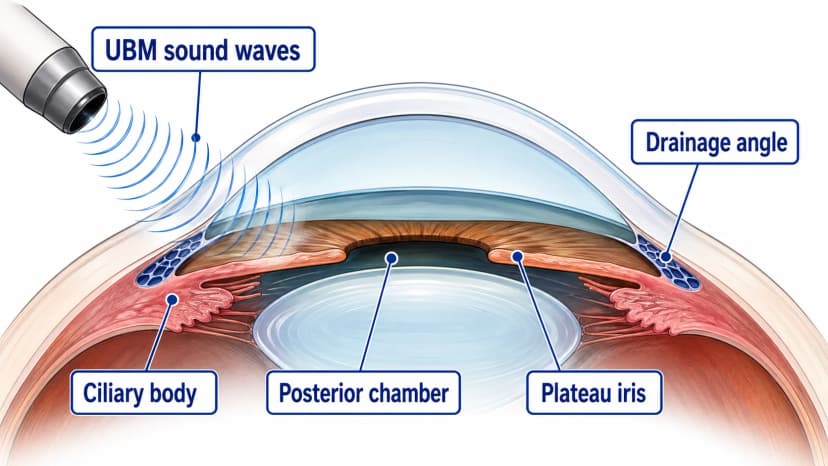
A UBM probe contains a small piezoelectric crystal that emits sound waves at 35-50 MHz - much higher than the 10-12 MHz typical of standard ocular B-scan ultrasound. The very short wavelengths give very fine resolution but penetrate only a few millimeters at 50 MHz (about 4-5 mm), with somewhat deeper penetration at 35 MHz. That is exactly the depth needed for the anterior segment.
The probe is held just above (or in light contact with) the eye, with a fluid-filled coupling cup or coupling gel between probe and tissue. The sound waves bounce off internal structures and are reconstructed into a real-time cross-sectional image, typically displayed on a monitor as the examiner moves the probe to scan around the eye.
What the Doctor Looks For
Angle Anatomy
- Angle width - measured numerically with parameters such as angle opening distance and trabecular-iris angle
- Iris position - flat, anteriorly bowed (pupillary block), or with a "plateau" configuration
- Pupillary block - iris bowed forward with apposition to the trabecular meshwork
- Plateau iris configuration - iris root pushed anteriorly by an anteriorly positioned ciliary body
- Peripheral anterior synechiae - adhesions of the iris to the angle structures
Ciliary Body
- Cysts - common; usually benign; may push the iris forward
- Tumors - melanoma, melanocytoma, other rare lesions
- Cyclodialysis cleft - separation of the ciliary body from the scleral spur, often after trauma; produces low intraocular pressure that does not resolve until the cleft is repaired
Iris and Posterior Chamber
- Iris cysts - pigment epithelial cysts behind the iris
- Iris tumors - extension behind the visible iris is otherwise difficult to assess
- Posterior chamber - fluid pockets, ICL position, sulcus-fixated lens placement
Lens and Zonules
- Subluxated or dislocated lens - assessing the integrity of the zonules
- Phakic IOL position - confirms vault and contact with adjacent structures
- After cataract surgery complications - IOL position relative to capsular bag and sulcus
Postoperative Glaucoma Surgery
- Assessment of trabeculectomy bleb anatomy
- Tube shunt position
- Cyclodialysis or wound leaks in difficult-to-evaluate eyes
Indications
Suspected or Confirmed Angle-Closure Glaucoma
The single most common reason for UBM. Helps distinguish:
- Pupillary block - the iris is bowed forward and creates a relative obstruction at the pupil
- Plateau iris - the iris root is pushed forward by an anteriorly positioned ciliary body, even when peripheral iridotomy has relieved pupillary block
- Lens-induced angle closure - a phakic eye with a thick or anteriorly positioned lens
- Aqueous misdirection (malignant glaucoma) - a rare complication, often after intraocular surgery, in which aqueous is misdirected into or behind the vitreous, the ciliary body rotates anteriorly, and the lens-iris diaphragm is pushed forward, producing very shallow anterior chamber and high pressure resistant to standard angle-closure treatment
The mechanism guides treatment: pupillary block responds to laser peripheral iridotomy; plateau iris may require iridoplasty or lens extraction; aqueous misdirection requires different management altogether.
Iris and Ciliary Body Lesions
Cysts appear sonolucent (dark/anechoic interior - sound passes through fluid with minimal reflection), while solid tumors are echogenic (filled with reflective signal). This is a key piece of information in deciding whether a lesion can be observed or needs biopsy and treatment.
Trauma
UBM evaluates suspected:
- Cyclodialysis cleft
- Iridodialysis (separation of iris root)
- Lens dislocation
- Position of an intraocular foreign body in the anterior segment
Surgical Planning and Postoperative Issues
- Sizing and postoperative assessment for a phakic IOL (ICL)
- Pre-operative angle and ciliary body assessment for complex cataract surgery
- Postoperative complications of glaucoma surgery
- Suspected vault problems with phakic lenses
What to Expect
Before the Test
- No special preparation
- Avoid heavy eye makeup on the day of the exam
- Continue your usual eye drops unless instructed otherwise
During the Test
- The patient lies down on an exam table (supine)
- Topical anesthetic drops are placed in the eye
- A small fluid-filled cup is gently placed on the eye (under the eyelid) and filled with saline; alternatively a coupling gel and small probe is used
- The probe is held over the saline and the examiner moves it to image different sectors of the anterior segment
- The patient looks in different directions as instructed
- Both eyes are usually examined
- The whole procedure typically takes 5-10 minutes
After the Test
- The eyes may feel slightly irritated for an hour or two from the cup contact
- Vision may be briefly blurry from the saline and anesthetic; clears within an hour
- Mild redness in the area where the cup rested is normal
- No vision restrictions; you can drive home if otherwise able
Side Effects and Risks
UBM is very low-risk. Possible minor side effects:
- Transient corneal abrasion from the cup or coupling - uncommon, heals within 1-2 days
- Mild conjunctival redness
- Brief discomfort during the exam
It cannot be performed safely if there is an open globe injury or recent intraocular surgery wound that has not yet healed.
UBM vs. Anterior Segment OCT
Many clinics use anterior segment OCT (AS-OCT) for routine angle imaging because it is contact-free and faster. UBM is especially useful when:
- Penetration through the iris is needed - AS-OCT cannot see behind the iris reliably
- Ciliary body assessment is required
- A lesion behind the iris needs evaluation
- Eye media are too cloudy for OCT - UBM is unaffected by corneal opacity, hyphema, or cataract
Many practices use both tests - AS-OCT for fast routine angle screening, UBM for detailed evaluation when something complex is suspected.
Frequently Asked Questions
Why was UBM ordered instead of just OCT?
OCT (including anterior segment OCT) cannot see through the iris because the iris pigment blocks the light. Many of the structures the doctor needs to see - the ciliary body, plateau iris configuration, iris cysts, lens position - sit behind the iris. UBM uses sound rather than light, so it can image structures that OCT cannot.
Will it hurt?
Most patients describe UBM as mildly uncomfortable but not painful. Topical anesthetic drops eliminate most of the sensation. The small saline cup placed against the eye produces a feeling of pressure rather than pain, and the imaging itself is silent and motion-free.
How long does the test take?
The actual scanning is usually 5-10 minutes for both eyes. Including check-in, anesthetic drops, and post-exam recovery, plan for 30 minutes at the appointment.
Are my eyes dilated for UBM?
Usually not. Most UBM exams are performed without dilation because the angle and ciliary body are best assessed with the iris in a natural state. Some specific situations (lens position evaluation, certain surgical planning) may benefit from dilation. The doctor will tell you in advance.
Will I see clearly afterward?
Vision may be slightly blurry for 30-60 minutes from the saline cup and anesthetic drops, but no longer. You can drive home in most cases. If you had dilation as well, you should plan for someone to drive you, or wait until pupil function returns.
References
Medical Disclaimer: This information is for educational purposes only and does not replace professional medical advice, diagnosis, or treatment.
Sources:
- Pavlin CJ, Harasiewicz K, Sherar MD, Foster FS. Clinical use of ultrasound biomicroscopy. Ophthalmology. 1991;98(3):287-295.
- Ishikawa H, Schuman JS. Anterior segment imaging: ultrasound biomicroscopy. Ophthalmol Clin North Am. 2004;17(1):7-20.
- American Academy of Ophthalmology EyeWiki. Ultrasound Biomicroscopy.
- Mannino G, Abdolrahimzadeh B, Calafiore S, et al. A review of the role of ultrasound biomicroscopy in glaucoma associated with rare diseases of the anterior segment. Clin Ophthalmol. 2016;10:1453-1459.