

Visual Field Deficits
Blind spots, missing areas, or gaps in your vision can indicate problems anywhere from the eye to the brain. Learn about different types of visual field loss.
Visual field deficits are missing pieces of the scene - a blind spot, a missing half, a wedge, a shadow, or a gap that shows up only on testing. This is different from general blurred vision: one area may be gone while the rest looks clear. The pattern is often the map to where the problem sits.
Key Takeaways
- The pattern is the clue-eye, optic nerve, chiasm, or brain
- Scotomas are blind spots; hemianopia means half the visual field is missing
- Field loss can hide from you because the brain fills in gaps
- Treatment ranges widely: eye drops, surgery, stroke care, tumor treatment, or rehab
Understanding Your Visual Field
Your visual field is everything you can see without moving your eyes - roughly the whole scene in front of you, center plus side vision. Different parts are handled by different structures:
- Retina (back of eye)-converts light to signals
- Optic nerve-carries signals from each eye
- Optic chiasm-where nerves partially cross
- Optic tract and radiations-pathways through brain
- Visual cortex (occipital lobe)-processes visual information
Damage at each level creates characteristic patterns of vision loss.
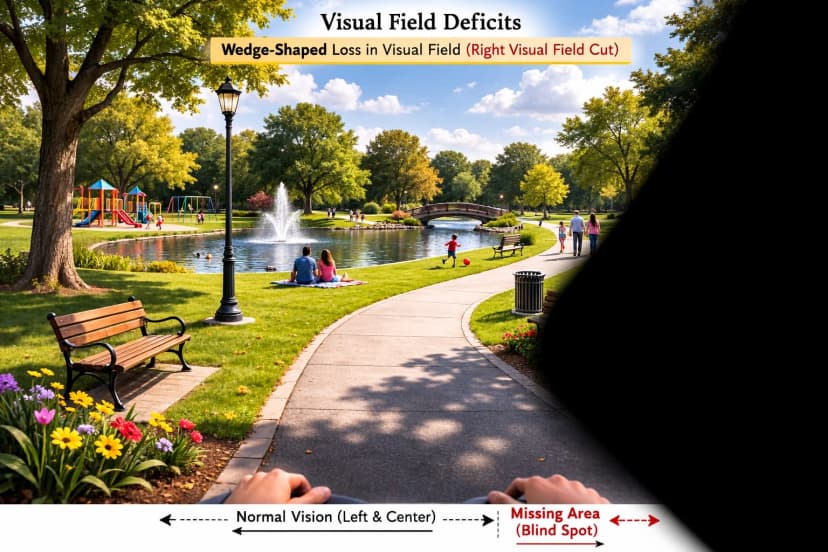
Types of Visual Field Deficits
Scotomas (Blind Spots)
- Central scotoma-blind spot in center of vision (macular or optic nerve disease)
- Paracentral scotoma-blind spot near but not at center
- Arcuate scotoma-arc-shaped defect (characteristic of glaucoma)
- Altitudinal defect-loss of upper or lower half of one eye's vision
- Cecocentral scotoma-enlarged blind spot connecting to central vision
Hemianopia (Half-Field Loss)
- Homonymous hemianopia-same side lost in both eyes (right or left)
- Indicates damage behind the optic chiasm (brain)
- Bitemporal hemianopia-outer (temporal) fields lost in both eyes
- Indicates damage at optic chiasm (often pituitary tumor)
- Binasal hemianopia-inner (nasal) fields lost (rare)
Quadrantanopia (Quarter-Field Loss)
- Superior quadrantanopia-upper quarter lost
- Inferior quadrantanopia-lower quarter lost
- Can be homonymous (same quadrant in both eyes)
Localizing the Problem
| Pattern | Location | Common Causes |
|---|---|---|
| One eye only | Eye or optic nerve | Glaucoma, AION, optic neuritis |
| Bitemporal | Optic chiasm | Pituitary tumor, craniopharyngioma |
| Homonymous hemianopia | Opposite brain hemisphere | Stroke, tumor, injury |
| Homonymous quadrantanopia | Optic radiations | Stroke, tumor |
| Bilateral with macular sparing | Occipital cortex | Stroke (posterior cerebral artery) |
Common Causes
Eye and Optic Nerve Causes
- Glaucoma-progressive nerve fiber loss causing arcuate defects
- Ischemic optic neuropathy-altitudinal defect
- Optic neuritis-central or cecocentral scotoma
- Retinal detachment-corresponding to detached area
- Branch retinal artery/vein occlusion-sectoral defect
Chiasmal Causes
- Pituitary adenoma-bitemporal hemianopia
- Craniopharyngioma-bitemporal field loss
- Meningioma-compressing chiasm
- Aneurysm-rare cause of chiasmal compression
Post-Chiasmal (Brain) Causes
- Stroke-most common cause of homonymous hemianopia
- Brain tumor-gradual onset hemianopia
- Traumatic brain injury-post-injury field loss
- Multiple sclerosis-demyelination in visual pathways
- Brain abscess or infection
When to Seek Care
Call 911 immediately if visual field loss:
- Develops suddenly
- Is accompanied by headache, especially severe
- Occurs with weakness, numbness, or speech problems
- Follows head trauma
- Progresses rapidly over hours to days
Sudden homonymous hemianopia can be a stroke symptom. Use BE-FAST: balance trouble, new eye or vision symptoms, face droop, arm weakness, speech trouble. Time is critical.
Schedule prompt evaluation for:
- Gradually progressive visual field loss
- Failed visual field screening
- Known risk factors (glaucoma, diabetes, high blood pressure)
- Any noticed "blind spots" in vision
How Visual Field Deficits Are Diagnosed
Visual Field Testing
- Automated perimetry (Humphrey)-standard computerized test
- Goldmann perimetry-manual kinetic testing
- Confrontation fields-quick bedside screening
- Frequency doubling technology (FDT)-screening tool
Eye Examination
- Visual acuity-checking central vision
- Pupil examination-looking for RAPD
- Dilated fundus exam-examining optic nerve and retina
- OCT-imaging nerve fiber layer
Neuroimaging
If pattern suggests brain cause:
Treatment Options
Treatment depends entirely on where the field loss is coming from:
For Glaucoma
- Eye drops-lower intraocular pressure
- Laser treatment-improve drainage
- Surgery-if drops insufficient
- Goal: prevent further loss (vision usually doesn't return)
For Optic Nerve Causes
- IV steroids-for optic neuritis
- Tumor removal-for compressive causes
- Risk factor management-for ischemic optic neuropathy
For Chiasmal Causes
- Surgery-to remove pituitary tumor or other mass
- Radiation-sometimes used after surgery
- Medication-some pituitary tumors respond to drugs
For Stroke/Brain Causes
- Acute stroke treatment-if within treatment window
- Prevention-blood thinners, risk factor control
- Rehabilitation-visual field expansion training
Adaptive Strategies
For permanent visual field loss:
- Scanning training-learning to look toward blind area
- Prism glasses-some patients benefit
- Reading strategies-adjusting technique for hemianopia
- Mobility training-safe navigation
- Driving evaluation-formal assessment of safety
Living with Visual Field Loss
Safety Considerations
- Be aware of your blind side
- Turn head to scan environment
- Use caution with stairs and curbs
- Consider mobility training
Reading Adaptations
- For right hemianopia: text edge may be hard to find
- For left hemianopia: beginning of lines may be missed
- Use a straight edge or finger to track lines
- E-readers with adjustable formatting help
Driving
- Many states require minimum visual field for licensure
- May need formal driving evaluation
- Some people with stable hemianopia can drive safely with training
- Discuss restrictions with your doctor
Frequently Asked Questions
Can visual field loss be reversed?
It depends on the cause. Compression from a tumor may improve after removal. Stroke-related loss sometimes improves partially. Glaucoma damage is typically permanent. Treatment focuses on preventing further loss.
Why didn't I notice my visual field loss?
The brain fills in gaps with impressive confidence. Gradual field loss is especially hard to notice, which is why many people first learn about it during formal visual field testing rather than in day-to-day life.
What's the difference between a scotoma and hemianopia?
A scotoma is an isolated blind spot (small area) while hemianopia is loss of half the visual field. Scotomas often indicate eye or optic nerve problems; hemianopia usually indicates brain involvement.
Can I still drive with visual field loss?
Possibly. Requirements vary by state and license type, and many require a certain field width. A driving evaluation can determine if you can drive safely with your specific pattern of loss.
How often should my visual field be tested?
For glaucoma: typically every 6-12 months, or more frequently if progressing. For other conditions: as needed to monitor stability or response to treatment.
References
Medical Disclaimer: This information is for educational purposes only and does not replace professional medical advice, diagnosis, or treatment. If you have concerns about visual field deficits or any symptoms, please consult a qualified healthcare provider.
Sources:
- American Academy of Ophthalmology EyeWiki. Standard Automated Perimetry.
- Walsh & Hoyt's Clinical Neuro-Ophthalmology. Miller NR, Newman NJ, eds.
- Glaucoma Research Foundation. Visual Field Testing.