

Color Vision Changes
Colors appearing washed out, altered, or different between eyes can indicate optic nerve problems or other conditions. Learn about causes of acquired color vision changes.
Color changes may be subtle: red looks dull, one eye sees colors as "washed out," or colors do not match when you compare eyes. When this starts later in life, it is different from inherited color blindness; acquired color vision changes can point to the optic nerve, retina, or visual pathways.
Key Takeaways
- New color changes are not the same as lifelong color blindness-timing matters
- Red desaturation is a classic clue in optic neuritis and other optic nerve problems
- One eye seeing colors differently points toward an eye or optic nerve issue on that side
- Washed-out color plus blur, pain, or dim vision deserves evaluation
Types of Color Vision Changes
Acquired Color Vision Deficiency
- Develops after birth
- Often affects one eye more than the other
- May be associated with vision loss
- Usually red-green axis affected (optic nerve disease)
- Can progress or improve depending on cause
Inherited Color Vision Deficiency (Color Blindness)
- Present from birth
- Affects both eyes equally
- Stable throughout life
- More common in males
- See our color vision deficiency page for detailed information
What Color Vision Changes Feel Like
People describe acquired color vision changes as:
- Colors appearing "washed out" or faded
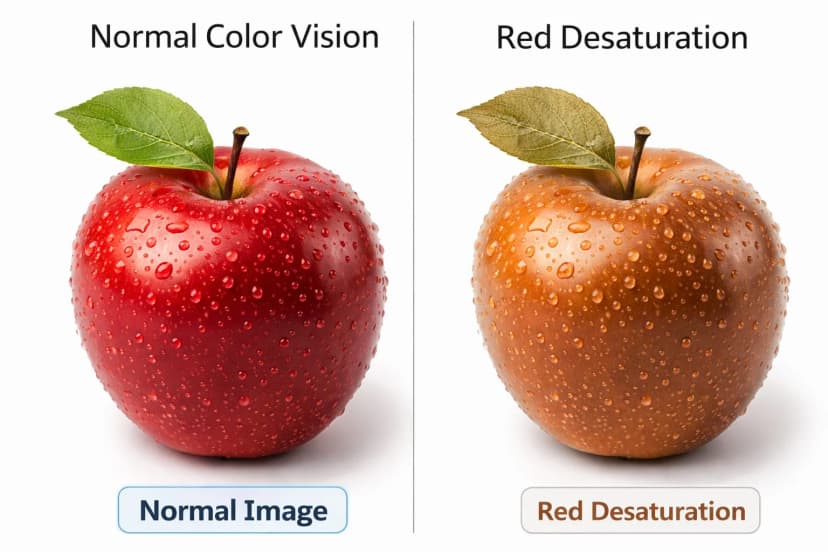
- Red appearing less bright, more orange or brown
- Colors seeming duller in one eye vs. the other
- Overall vision appearing "dimmed" or "darker"
- Colors looking different when comparing eyes
- Difficulty distinguishing certain colors
- Colors appearing different than before
Red Desaturation
This specific comparison can be clinically useful:
- Red objects appear less red, more orange or brown
- Most noticeable when comparing eyes
- Doctor may test by asking if red appears equally red in each eye
- Even a red pen cap can demonstrate this
Common Causes
Optic Nerve Disease
Optic nerve disease is an important category to consider:
Optic neuritis
- Inflammation of the optic nerve
- Red desaturation is classic finding
- Often with eye pain, especially with movement
- Vision usually recovers but color vision may remain affected
- Blood flow loss to optic nerve
- May have color vision changes
- Associated with vision loss
- Tumor or mass pressing on optic nerve
- Gradual color vision loss
- Often with other visual symptoms
Toxic/nutritional optic neuropathy
- From B12 deficiency, alcohol, tobacco, or medications
- Typically affects both eyes
- Blue-yellow axis may be affected
- Progressive optic nerve damage
- Color vision may be affected, especially blue-yellow
- Often not noticed by patients
Retinal Disease
- Central vision and color affected
- May have distortion
- Can affect color perception
- Usually with other retinal changes
Cone dystrophies
- Inherited conditions affecting color-sensing cells
- Progressive color vision loss
Other Causes
- Through optic neuritis
- Color vision changes may be first sign
Medications
- Some drugs can affect color vision
- Often reversible when stopped
- May give yellowish tinge to vision
- Colors appear less vivid
- Improves after surgery
When to Seek Care
See a doctor if you notice:
- New color vision changes
- Colors appearing different in one eye vs. the other
- Red looking washed out or orange
- Progressive color vision loss
- Color changes with other visual symptoms
Go to the emergency department the same day if color changes occur with:
- Rapid vision loss or clearly dimmer vision in one eye
- Eye pain, especially with eye movement
- New neurologic symptoms, severe headache, trouble walking, or confusion
Call 911 immediately if color change or dim vision starts suddenly with BE-FAST stroke symptoms: balance trouble, facial droop, arm weakness, speech trouble, confusion, trouble walking, or sudden severe headache. Color vision changes with pain and vision loss may indicate optic neuritis and should not wait for routine scheduling.
How Color Vision Changes Are Evaluated
Color Vision Testing
- Ishihara plates-screening for red-green deficiency
- Farnsworth D-15-arrangement test
- Farnsworth-Munsell 100 hue-detailed assessment
- Comparing eyes-asymmetry suggests optic nerve problem
Clinical Examination
- Visual acuity-central vision
- RAPD testing-relative afferent pupillary defect
- Red desaturation comparison-between eyes
- Dilated fundus exam-examining optic nerve and retina
- Visual field testing
A Simple Observation That Helps
Cover one eye at a time and compare the same red object under the same lighting. A red bottle cap, phone icon, or stop sign looking duller in one eye is useful information for the visit. Do not repeatedly test until your eyes are tired, and do not use this as a substitute for care if vision is dim, painful, or worsening.
Additional Tests
- Optical coherence tomography (OCT)-imaging optic nerve
- Visual evoked potentials (VEP)-optic nerve function
- MRI brain and orbits-if optic neuritis suspected
- Blood tests-B12, other metabolic studies
Treatment and Management
Treatment follows the cause; there is no separate "color vision medicine":
For Optic Neuritis
- IV steroids may speed recovery
- Color vision often improves but may not return to normal
- Evaluation for MS important
For Compressive Causes
- Surgery to remove mass/tumor
- Color vision may improve after decompression
For Toxic/Nutritional Causes
- Remove offending agent
- Supplement deficiencies (B12, folate)
- May improve if caught early
For Glaucoma
- Lower intraocular pressure
- Prevent further nerve damage
Adaptation Strategies
- Good lighting helps distinguish colors
- Label items if color confusion affects daily life
- Various apps can help identify colors
- Color-coded systems may need modification
Frequently Asked Questions
Is acquired color vision loss permanent?
It depends on the cause. Optic neuritis may recover partially or substantially. Color loss from long-standing glaucoma or permanent optic nerve damage is more likely to persist. Early diagnosis is important because some causes are treatable.
Can I tell if my color vision has changed?
Compare red objects between eyes. If one eye sees red as less bright, more orange or brown, this suggests an optic nerve problem in that eye. Your doctor can perform formal color vision testing.
Is color change alone enough to diagnose optic neuritis?
No. Red desaturation is a useful clue, but optic neuritis is diagnosed from the whole picture: vision level, pain with eye movement, pupils, color plates, visual fields, OCT, and often MRI brain and orbits.
Is red desaturation specific to optic nerve problems?
Red desaturation is classic for optic nerve disease, particularly optic neuritis. However, any cause of optic nerve damage can cause it. Retinal problems typically affect blue-yellow more than red-green.
Should I be concerned if I have color blindness from birth?
Inherited color blindness (present since birth, affecting both eyes equally) is not a neuro-ophthalmologic problem. It's stable and doesn't indicate disease. Acquired color vision changes (new, or different between eyes) warrant evaluation.
Can cataracts affect color vision?
Yes. Cataracts filter out blue light and give vision a yellowish tinge. Colors may seem less vivid. Color vision typically improves after cataract surgery-patients often notice colors appear much brighter.
References
Medical Disclaimer: This information is for educational purposes only and does not replace professional medical advice, diagnosis, or treatment. If you have concerns about color vision changes or any symptoms, please consult a qualified healthcare provider.
Sources:
- American Academy of Ophthalmology. Color Blindness.
- Simunovic MP. Acquired color vision deficiency. Surv Ophthalmol. 2016;61(2):132-155.
- North American Neuro-Ophthalmology Society. Optic Neuritis.