

Orbital Fracture
A break in one or more bones surrounding the eye, often from blunt trauma. Learn about types, symptoms, and when surgery is needed.
An orbital fracture is a break in one or more of the bones that form the eye socket (orbit). These fractures usually result from blunt trauma-such as a punch, ball, or motor vehicle accident. While the bony injury itself is often manageable, associated injuries to the eye and surrounding structures must be carefully evaluated and treated.
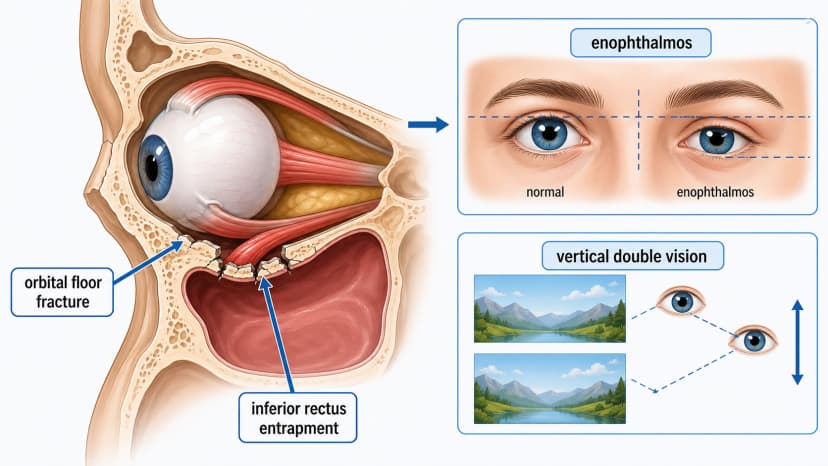
Key Takeaways
- Break in the bones surrounding the eye (orbit)
- Common causes: sports, assault, falls, motor vehicle accidents
- Associated injuries to the eye itself must be ruled out
- Blowout fracture: floor or medial wall fractures from increased orbital pressure
- Symptoms: swelling, bruising, double vision, restricted eye movement
- Surgery needed when eye muscle is trapped or significant deformity exists
Anatomy of the Orbit
The Bony Eye Socket
The orbit is formed by seven bones:
- Frontal bone (roof)
- Maxillary bone (floor)
- Zygomatic bone (lateral wall)
- Ethmoid bone (medial wall)
- Lacrimal bone (medial wall)
- Sphenoid bone (back/apex)
- Palatine bone (floor)
Weak Points
The floor and medial wall are the thinnest areas, making them most susceptible to fracture.
Types of Orbital Fractures
Blowout Fracture
Most common type of orbital fracture.
When an object larger than the orbit (fist, ball) strikes the eye, pressure is transmitted to the orbital walls. The thin floor or medial wall "blows out" into the adjacent sinus.
Contents (fat, sometimes muscle) can herniate through the fracture.
Floor blowout:
- Most common site
- Breaks into maxillary sinus
- Inferior rectus muscle may become trapped
Medial wall blowout:
- Second most common
- Breaks into ethmoid sinus
- Medial rectus muscle may be affected
Orbital Rim Fracture
- Fracture of the thick bony rim
- Usually from direct, high-energy impact
- May involve surrounding facial bones
Roof Fracture
- Less common
- High-energy trauma (motor vehicle accidents)
- Associated with brain injury
- Requires neurosurgical evaluation
Trapdoor Fracture
A trapdoor fracture is an emergency, especially in children.
The bone hinges open and snaps back, trapping muscle or soft tissue. This causes:
- Severe restriction of eye movement
- Often minimal external signs of injury
- Pain and nausea with attempted eye movement
- Requires urgent surgery to prevent permanent muscle damage
Symptoms
Common Symptoms
- Swelling of eyelids and face
- Bruising (periorbital ecchymosis/"black eye")
- Double vision (diplopia)
- Restricted eye movement
- Numbness of cheek/upper lip/teeth (infraorbital nerve injury)
- Pain, especially with eye movement
- Nosebleed (if ethmoid sinus involved)
- Sunken appearance (enophthalmos)-may be masked initially by swelling
Warning Signs
- Limited eye movement (especially looking up or down)
- Double vision
- White of eye bulges forward (may indicate fracture or other injury)
- Changes in vision
- Severe pain with eye movement
- Nausea/vomiting with eye movement (especially in children-suggests muscle entrapment)
Diagnosis
Clinical Examination
Eye examination:
- Visual acuity
- Eye movement testing (restricted movement?)
- Pupil examination
- Check for open globe injury
- Examine for hyphema
- Dilated exam if possible
Orbital examination:
- Palpate orbital rim for step-off or tenderness
- Check for enophthalmos (sunken eye)
- Assess facial sensation (infraorbital nerve)
- Look for crepitus (crackling under skin from air)
Imaging
CT Scan (Gold Standard):
- Thin-cut CT of orbits
- Shows fracture location and size
- Reveals muscle or fat herniation
- Identifies other facial fractures
- No MRI if metallic foreign body possible
Associated Injuries
Eye Injuries (Must Rule Out)
- Open globe injury (surgical emergency)
- Hyphema (blood in anterior chamber)
- Retinal detachment
- Lens dislocation
- Optic nerve injury
- Corneal abrasion
Other Injuries
- Other facial fractures (zygomatic, nasal, frontal)
- Brain injury (especially with roof fractures)
- Lacrimal system injury
Always rule out open globe before manipulating the orbit.
If open globe is suspected, protect the eye with a rigid shield and arrange emergent ophthalmologic evaluation. Do not apply pressure.
Treatment
Observation (Non-Surgical)
Many orbital fractures do not need surgery:
- Small fractures without muscle entrapment
- Minimal diplopia that's improving
- No significant enophthalmos
- Stable appearance
Conservative Management:
- Ice packs for swelling
- Nasal decongestants (reduce sinus pressure)
- Do not blow nose (forces air through fracture)
- Antibiotics (controversial but often given)
- Close follow-up
Surgical Repair
Indications for Surgery:
- Muscle entrapment with restricted movement
- Significant enophthalmos (>2mm sunken eye)
- Large fracture (>50% of floor)
- Persistent diplopia not improving
- Cosmetic deformity
Timing:
- Urgent (24-48 hours) for trapdoor fractures with muscle entrapment
- Can wait 1-2 weeks for most fractures (allows swelling to subside)
- Some recommend waiting but operating before scar tissue forms
Surgical Approach:
- Usually through eyelid or inside lower lid (conjunctival)
- Fracture is visualized
- Herniated tissue is repositioned
- Implant placed to cover defect (titanium, porous polyethylene, etc.)
Recovery
After Conservative Treatment
- Swelling improves over 1-2 weeks
- Bruising resolves over 2-3 weeks
- Double vision often improves as swelling decreases
- Follow-up to ensure no late enophthalmos
After Surgery
- Swelling and bruising expected initially
- Activity restrictions (no nose blowing, straining)
- Follow-up for wound check
- Eye movement exercises may be recommended
- Final results assessed after swelling resolves (weeks to months)
Complications
Without Treatment
- Persistent double vision
- Enophthalmos (sunken eye)
- Chronic infraorbital numbness
- Cosmetic deformity
From Surgery
- Infection
- Implant complications (migration, extrusion)
- Persistent diplopia
- Ectropion (lower lid turning out)
- Numbness
Prevention
Protective Eyewear
- Sports-specific eye protection
- Polycarbonate lenses
- Properly fitted face shields/helmets
- Seat belts (reduce MVA facial injuries)
Frequently Asked Questions
When can I blow my nose?
Avoid blowing your nose for at least 2-3 weeks after an orbital fracture. Blowing forces air through the fracture site, increasing swelling and risk of infection. Gentle wiping is okay.
Will my double vision go away?
In many cases, double vision improves as swelling resolves (over 1-2 weeks). If double vision persists beyond 2 weeks or is associated with restricted eye movement, surgical evaluation is recommended.
When is surgery necessary?
Surgery is needed if:
- Muscle is trapped (especially urgent in children)
- Eye appears sunken (or will once swelling resolves)
- Persistent double vision despite time for healing
- Large fracture unlikely to heal well without repair
How long does recovery take?
Swelling and bruising typically improve over 2-3 weeks. Final results, especially after surgery, may take 2-3 months to fully manifest. Numbness may persist longer or be permanent.
Can the fracture heal on its own?
Many orbital fractures heal without surgery if they're small, don't entrap muscle, and don't cause significant deformity. The body forms fibrous tissue over the defect. Follow-up ensures healing progresses appropriately.
References
Medical Disclaimer: This information is for educational purposes only and does not replace professional medical advice, diagnosis, or treatment. Facial trauma with suspected orbital fracture requires medical evaluation.
Sources:
- Wikipedia. Orbital blowout fracture.
- Burnstine MA. Clinical recommendations for repair of orbital facial fractures. Curr Opin Ophthalmol. 2003;14(5):236-240.
- Bord SP, Linden J. Trauma to the globe and orbit. Emerg Med Clin North Am. 2008;26(1):97-123.
- StatPearls [Internet]. Orbital Floor Fracture.