

Cherry-Red Spot
A vivid red spot at the center of a pale macula - a striking and clinically important finding pointing to retinal artery occlusion or specific metabolic diseases.
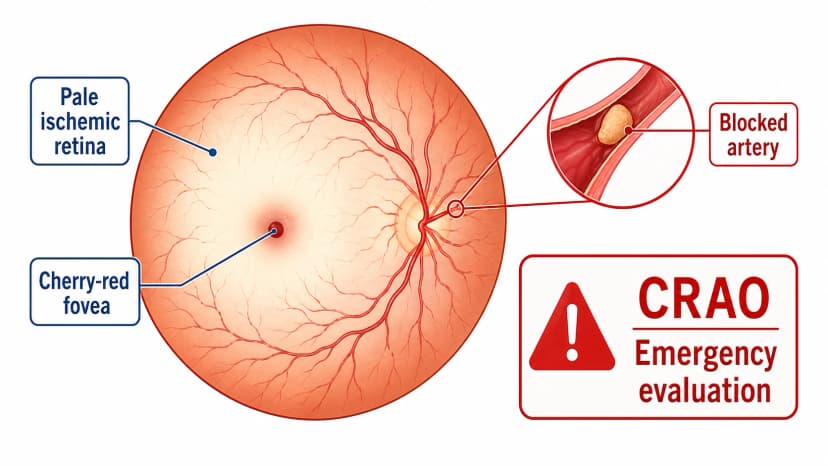
A cherry-red spot is one of the most visually striking findings in ophthalmology. The center of the macula appears as a vivid red dot against a pale, swollen surrounding retina. It is rare but instantly recognizable, and its diagnostic implications are usually urgent - the most common cause is a central retinal artery occlusion, which is a stroke of the eye and an emergency. A smaller and very different group of patients have a cherry-red spot due to inherited metabolic disease.
Key Takeaways
- The cherry-red spot is a contrast - the fovea looks bright red because the retina around it has become pale and opaque from infarction or lipid storage
- The most common cause is central retinal artery occlusion - a sudden blockage of the eye's main artery, presenting as painless severe vision loss in one eye
- CRAO with cherry-red spot is a stroke and is managed under hyperacute stroke protocols where available
- Several inherited storage diseases (Tay-Sachs, Niemann-Pick, GM1 gangliosidosis, Sandhoff disease) classically produce a cherry-red spot in infants or young children
- The finding is rare but pattern-recognizable - once seen, it is hard to forget, and it should never be ignored
Why a Cherry-Red Spot Looks Red
The macula has a unique anatomy that makes the cherry-red spot possible. The fovea, at the very center of the macula, is the thinnest part of the retina - it has no inner retinal layers, only photoreceptors and the underlying retinal pigment epithelium. The choroid (the vascular layer beneath) shows through this thin tissue and gives the fovea its normal pinkish-red appearance.
When the rest of the retina becomes pale - either from acute ischemic infarction (in retinal artery occlusion) or from accumulation of opaque material in inner retinal cells (in storage diseases) - the foveal center remains its native red color while the surroundings turn white. The sharp contrast is what produces the cherry-red appearance.
The Most Common Cause: Retinal Artery Occlusion
Central Retinal Artery Occlusion (CRAO)
A blockage of the central retinal artery - usually by an embolus from the carotid artery or heart, or from giant cell arteritis (GCA) in older patients - interrupts blood flow to the entire inner retina except a small area supplied by the cilioretinal artery in patients who happen to have one.
Within minutes to hours:
- Inner retinal cells become ischemic and turn opaque
- The thin fovea, which depends on the underlying choroidal circulation rather than retinal artery flow, retains its normal color
- The cherry-red spot becomes visible
This is a clinical emergency. Patients present with sudden, painless, severe vision loss in one eye - often described as a curtain falling or vision suddenly going dark. Treatment outcomes have historically been poor, but modern care emphasizes rapid stroke-center triage; selected patients who present very early may be considered for thrombolysis if they meet stroke-protocol criteria.
A workup follows the same logic as a brain stroke: carotid ultrasound, echocardiography, blood tests including lipid panel and HbA1c, and an evaluation for atrial fibrillation. Giant cell arteritis must be ruled out in older patients with ESR, CRP, and often temporal artery ultrasound or biopsy, because untreated GCA can cause bilateral blindness within days.
Branch Retinal Artery Occlusion (BRAO)
A blockage of one of the smaller branches of the retinal artery produces a wedge-shaped area of retinal whitening but typically does not produce a true cherry-red spot, because the macula in its entirety is not affected. A BRAO that includes the foveal branch may produce a focal area of macular whitening with a small relative red center, but this is uncommon. Cilioretinal artery occlusion produces a small wedge of macular ischemia adjacent to the disc and is a separate entity.
Combined Central Retinal Artery and Vein Occlusion
A rare but devastating event in which both arterial and venous flow are blocked. The retina is pale and hemorrhagic at the same time.
Ophthalmic Artery Occlusion
A more proximal occlusion involving the ophthalmic artery (which supplies both the retinal artery and the choroid) produces an even paler appearance with often no cherry-red spot, because the choroidal blood supply is also lost. Vision loss is even more profound.
Storage Diseases (Inherited Metabolic Causes)
A small but classical group of inherited lysosomal storage diseases produce a cherry-red spot in infants or children. The mechanism is different from CRAO: rather than acute ischemic infarction, the inner retinal cells accumulate undigested lipid material, becoming opaque and white. The fovea, which has no inner retinal layers, remains red.
Tay-Sachs Disease (GM2 gangliosidosis)
The most classically taught example. Caused by deficiency of hexosaminidase A. Presents in early infancy with progressive neurological deterioration, exaggerated startle response, and a bilateral cherry-red spot on fundoscopy. More common in Ashkenazi Jewish, French Canadian, and Cajun populations.
Sandhoff Disease
Similar to Tay-Sachs but with deficiency of both hexosaminidase A and B. Cherry-red spot may be present.
Niemann-Pick Disease, Type A
Sphingomyelinase deficiency. Hepatosplenomegaly and progressive neurodegeneration; cherry-red spot is reported in approximately one-third to one-half of affected infants with Type A. Niemann-Pick Type C (a cholesterol-trafficking defect) is a distinct disorder and is not typically associated with cherry-red spot.
GM1 Gangliosidosis
Beta-galactosidase deficiency. Cherry-red spot present in approximately half of cases, often with hepatosplenomegaly and skeletal abnormalities.
Sialidosis (Cherry-Red Spot Myoclonus Syndrome)
Neuraminidase deficiency. Cherry-red spot with progressive myoclonus and visual decline. Usually presents later in childhood or young adulthood.
Mucolipidosis Type I and Other Rarer Disorders
Various lysosomal disorders can occasionally produce a cherry-red spot, often as a clue that prompts genetic and biochemical testing.
Other (Rare) Causes
- Quinine toxicity and methanol poisoning - toxic causes of inner retinal opacification rather than primary vascular events; their cherry-red spot appearance comes from diffuse retinal whitening with sparing of the foveal pigment
- Severe blunt ocular trauma with commotio retinae
Mimics (Not True Cherry-Red Spots)
- Macular hole - the central hole, surrounded by a cuff of subretinal fluid or operculum, can be mistaken for a cherry-red spot but is not a true cherry-red spot. OCT readily distinguishes the two
How the Doctor Approaches a Cherry-Red Spot
History
The single most important question is the time course:
- Sudden, painless, monocular vision loss in an adult - treat as possible retinal artery occlusion until proven otherwise. Time from onset is critical for any acute intervention.
- Bilateral cherry-red spot in an infant or young child with neurological decline - storage disease workup
- Older patient with vision loss and headache, jaw claudication, scalp tenderness, or weight loss - giant cell arteritis (GCA) must be ruled out urgently
Examination
- Visual acuity - typically very poor (counting fingers or worse) in CRAO
- RAPD - present in monocular CRAO
- Dilated fundoscopic exam - confirms the appearance
- Look for emboli at retinal arteriole bifurcations (Hollenhorst plaques, calcific or platelet-fibrin emboli)
- Look for a sparing cilioretinal artery
Imaging
- OCT of the macula - shows hyperreflectivity and edema of the inner retina with preservation of the foveal center
- Fluorescein angiography - can demonstrate delayed or absent retinal arterial filling in CRAO
- Carotid ultrasound and echocardiography for source of embolus
Blood Tests and Systemic Workup
- ESR, CRP - urgent in any older patient with vision loss
- HbA1c, fasting glucose, lipid panel
- Coagulation profile in younger patients without obvious atherosclerotic risk
- Genetic and biochemical testing in suspected storage disease
Time-Sensitive Treatment
- Older techniques (ocular massage, anterior chamber paracentesis, breathing carbogen, IV acetazolamide) persist in some textbooks but are not recommended as standard care; AAO Preferred Practice Patterns now emphasize stroke-protocol triage
- Modern hyperacute pathway: rapid emergency-department stroke triage at a stroke-capable center. IV thrombolysis (alteplase, tenecteplase) is being investigated for CRAO and is offered at some stroke centers within strict time windows, but its benefit remains unproven and current AHA guidance does not establish a clear recommendation; treatment decisions are individualized
- Treatment of giant cell arteritis with high-dose IV steroids if suspected
- Long-term: stroke risk-factor reduction including antiplatelet therapy, statin, blood pressure control, and management of any identified embolic source
What the Cherry-Red Spot Looks Like Over Time
In CRAO, the cherry-red spot does not last forever:
- Acute phase (hours to days): vivid, classic appearance
- Subacute (days to weeks): retinal opacification fades as edema resolves
- Chronic (weeks to months): the cherry-red spot disappears; the disc becomes pale; the retinal arteries become attenuated and "ghost-like"; severe vision loss usually persists
In storage diseases, the cherry-red spot often persists or progresses, reflecting ongoing accumulation of storage material.
What the Patient Notices
In CRAO:
- Sudden, severe, painless loss of vision in one eye - often the chief complaint
- May be preceded by transient vision loss (amaurosis fugax) - episodes of brief vision loss in the days or weeks before the full event
- Sometimes the patient describes a "curtain coming down" or going completely dark in one eye
In storage disease:
- Progressive vision loss in an infant or child, often noticed by parents as failure to track or follow objects, accompanied by neurological regression
Frequently Asked Questions
Is a cherry-red spot dangerous?
Yes. In adults, it often represents a retinal artery occlusion - a stroke of the eye - and signals high risk for stroke elsewhere in the body. In children, it points to a serious genetic disease. Either way, the workup that follows is one of the most consequential in ophthalmology.
Why does the spot look like a cherry?
The bright red color of the foveal center stands out against the surrounding pale, opaque retina. The contrast looks like a small bright cherry sitting on a pale background. The foveal red color is normal - what changes is the surrounding tissue, which becomes white from infarction or storage material accumulation.
Will my vision come back?
Visual outcomes after CRAO are generally poor - most patients are left with severe permanent vision loss in the affected eye. A small minority preserve central vision because of a cilioretinal artery, which gives the macula an alternative blood supply. Time to treatment may help in the first hours, but in most cases the priority is preventing the next stroke event in the brain or other eye.
Why is a stroke evaluation being done after my eye exam?
Because a CRAO is a stroke. The same arterial sources that cause an eye stroke can cause a brain stroke. Modern guidelines treat retinal artery occlusion as a hyperacute stroke event with the same urgency, the same workup (carotids, heart rhythm, imaging), and the same prevention strategy (antiplatelet therapy, statin, blood pressure and diabetes control).
My infant was found to have a cherry-red spot - what comes next?
A cherry-red spot in an infant or child usually triggers urgent referral to genetics and metabolic specialists. Specific enzyme assays - for example, hexosaminidase A for Tay-Sachs - and broader genetic panels typically follow. The evaluation is usually faster and more focused than the workup in adult CRAO because the differential is short and the diagnostic tests are well established.
References
Medical Disclaimer: This information is for educational purposes only and does not replace professional medical advice, diagnosis, or treatment.
Sources:
- Mac Grory B, Schrag M, Biousse V, et al. Management of central retinal artery occlusion: a scientific statement from the American Heart Association. Stroke. 2021;52(6):e282-e294.
- Suvarna JC, Hajela SA. Cherry-red spot. J Postgrad Med. 2008;54(1):54-57.
- American Academy of Ophthalmology EyeWiki. Central Retinal Artery Occlusion.
- Olsen TW, Pulido JS, Folk JC, et al. Retinal and ophthalmic artery occlusions Preferred Practice Pattern. Ophthalmology. 2017;124(2):P120-P143.
- Kolodny EH. Niemann-Pick disease. Curr Opin Hematol. 2000;7(1):48-52.