
Anterior Segment OCT
A non-contact light-based imaging method that produces detailed cross-sections of the cornea, anterior chamber, and angle. Often used in glaucoma and corneal evaluation.
Anterior segment OCT (AS-OCT) is a variant of optical coherence tomography optimized for imaging the front of the eye - the cornea, anterior chamber, drainage angle, and lens. Unlike standard OCT (which targets the retina), AS-OCT uses different scan parameters to image structures up to the iris and anterior lens. It is non-contact, fast, and a common imaging adjunct for angle assessment in glaucoma, corneal pathology, and refractive surgery planning.
Key Takeaways
- AS-OCT uses light to image the front of the eye - non-contact, painless, takes seconds
- It cannot see through the iris - for ciliary body and posterior iris evaluation, ultrasound biomicroscopy is needed
- Common uses include angle assessment for angle-closure glaucoma, corneal pathology including keratoconus, refractive surgery planning, and post-LASIK flap evaluation
- Quantitative measurements include central corneal thickness, anterior chamber depth, angle opening distance, and detailed corneal mapping
- AS-OCT vs. UBM: AS-OCT is faster and contact-free; UBM gets through the iris
What AS-OCT Shows
A single AS-OCT scan provides:
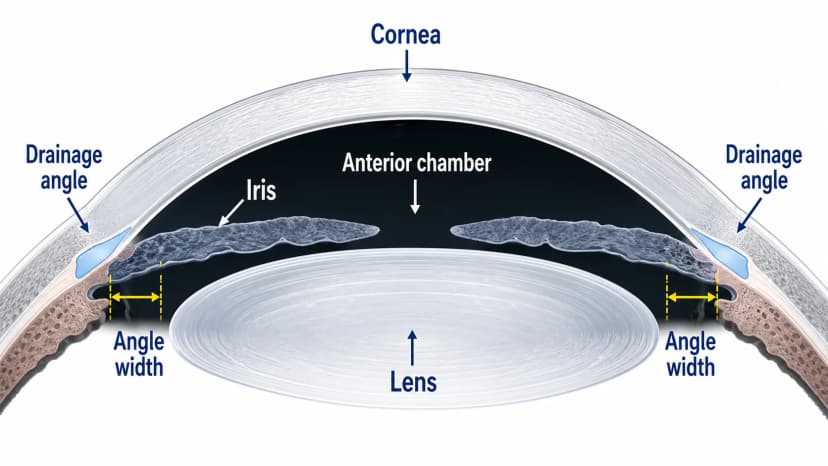
- Cornea - full thickness imaging with epithelial, stromal, and endothelial detail
- Anterior chamber - depth measurement and lens position
- Drainage angle - width measurements, open vs. closed configuration
- Iris contour - flat, bowed forward (pupillary block), or plateau pattern
- Lens position (visible portion)
What AS-OCT does not show:
- Behind the iris (ciliary body, sulcus, zonules) - near-infrared light is largely absorbed and scattered by iris pigment; newer swept-source systems penetrate better, but UBM remains the reference imaging test for structures behind the iris
- Posterior segment (retina, optic nerve) - separate OCT scan needed
- Peripheral angle in some patient configurations
Common Uses
Angle Assessment in Glaucoma
- Suspicion of narrow angles or acute angle-closure glaucoma
- Pre- and post-laser peripheral iridotomy evaluation
- Following the angle in pigmentary glaucoma, exfoliation syndrome
- Surveillance of patients at angle-closure risk
Corneal Pathology
- Keratoconus - thinning maps, posterior corneal elevation
- Fuchs dystrophy and other endothelial disease
- Post-refractive-surgery evaluation (LASIK, PRK) - flap thickness, residual stromal bed, ectasia screening
- Corneal scarring depth and extent
- Bullous keratopathy documentation
- Pre-operative planning for endothelial keratoplasty
Surgical Planning
- Phakic IOL sizing using angle-to-angle (white-to-white) measurements as a surrogate for sulcus diameter; some surgeons prefer UBM-based sulcus-to-sulcus measurement for ICL sizing
- Pre-cataract planning in difficult anatomy
- Trabeculectomy bleb evaluation
Lens and Refractive Surgery Planning
- Anterior chamber depth for IOL calculations
- Angle anatomy for ICL planning
How It Differs From Ultrasound Biomicroscopy (UBM)
| Feature | AS-OCT | UBM |
|---|---|---|
| Modality | Light | Sound (high-frequency) |
| Contact | Non-contact | Contact (saline cup or gel) |
| Resolution | Excellent for cornea/iris surface | Excellent for ciliary body |
| Sees through iris | No | Yes |
| Speed | Seconds per scan | Several minutes |
| Patient comfort | High | Tolerable, requires anesthetic |
| Setting | Routine clinic | Specialty / glaucoma clinic |
For many angle-screening questions, AS-OCT is a preferred first-line imaging test. UBM is reserved for cases where structures behind the iris need evaluation.
What to Expect
- No special preparation
- Patient sits at the machine and looks at a fixation target
- Scans take seconds per eye
- No drops needed in most cases (though dilation may be requested for specific assessments)
- No vision restrictions afterward
Frequently Asked Questions
How is this different from "regular" OCT?
Regular OCT of the retina uses settings optimized for posterior segment imaging. Dedicated AS-OCT systems often use longer-wavelength light (around 1310 nm) and deeper scan ranges for the anterior segment, while some retinal OCT machines use anterior-segment attachments or scan modes at their usual wavelength. Some machines can do both with different scan modes or attachments.
Can AS-OCT replace gonioscopy?
Not completely. AS-OCT provides quantitative angle measurements that complement gonioscopy, but gonioscopy remains the gold-standard clinical angle assessment, particularly for detecting peripheral anterior synechiae, pigmentation, and abnormal tissue. The two are often used together.
Will I need any drops?
Typically not. Some specific evaluations (e.g., pre- and post-dilation angle scans for provocative angle-closure assessment) require dilation, but routine AS-OCT does not.
References
Medical Disclaimer: This information is for educational purposes only and does not replace professional medical advice.
Sources:
- Ramos JL, Li Y, Huang D. Clinical and research applications of anterior segment optical coherence tomography - a review. Clin Exp Ophthalmol. 2009;37(1):81-89.
- American Academy of Ophthalmology EyeWiki. Anterior Segment Optical Coherence Tomography.