

Macular Edema
Fluid swelling in the macula, the pinpoint center of the retina used for reading, driving, and faces. Diabetes, vein occlusions, inflammation, and surgery are common triggers.
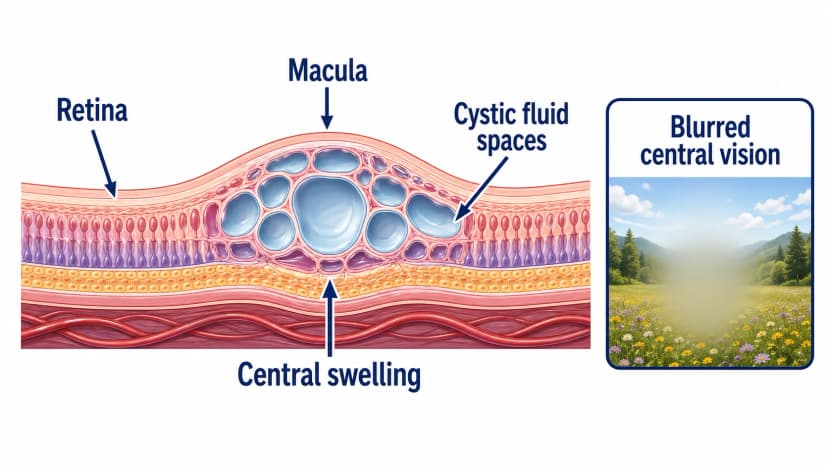
Macular edema often presents with bent straight lines, blurred reading vision, or faded central detail. Fluid collects in the macula, the central retina responsible for sharp vision, face recognition, and color detail. As the macula thickens, the retinal layers become distorted, causing central vision loss and blurred vision that may develop gradually or suddenly depending on the cause. Diabetes is the leading cause, but vein occlusions, inflammation, eye surgery, and wet AMD can also cause macular edema. OCT is the primary test for measuring the swelling and monitoring response to treatment.
Key Takeaways
- This is swelling of the central retina, not a separate disease by itself; something is making the macula leak or hold fluid
- Diabetes leads the list, but vein occlusions, eye surgery, inflammation, wet AMD, and medication effects also show up
- Vision may look blurry, wavy, faded, or hard to center on, especially for reading and faces
- OCT is the primary imaging test because it shows the swollen retinal layers in cross-section
- Treatment follows the cause: anti-VEGF injections, steroids, anti-inflammatory drops, laser, or tighter control of the underlying disease
- Old swelling can injure the macula, so timing matters; waiting for months is rarely a good plan
Understanding Macular Edema
The macula is only about 5.5 millimeters in diameter, yet it is responsible for central vision, color perception, and the fine detail needed for reading, driving, and recognizing faces. Under normal conditions, the retina is kept in a precisely dehydrated state by the blood-retinal barrier (BRB)-a system of tight junctions between retinal blood vessel cells (inner BRB) and retinal pigment epithelium cells (outer BRB) that carefully controls what enters and exits the retinal tissue.
When the blood-retinal barrier breaks down, fluid, proteins, and lipids leak from retinal capillaries and accumulate within the retinal layers. In macular edema, this fluid collects specifically in the macula, causing it to swell. The swelling disrupts the organized structure of the photoreceptor cells and can form fluid-filled spaces called cystoid spaces, which is why the condition is sometimes called cystoid macular edema (CME).
Several molecular pathways drive this process. Vascular endothelial growth factor (VEGF) is one of the most important-it increases vascular permeability and promotes fluid leakage. Inflammatory cytokines such as interleukin-6 (IL-6) and tumor necrosis factor-alpha (TNF-alpha) also contribute, particularly in inflammatory and post-surgical cases. Chronic macular edema can damage photoreceptors irreversibly, making timely treatment essential.
Inner vs. Outer Blood-Retinal Barrier
- Inner BRB: Formed by tight junctions between endothelial cells of retinal capillaries. Breakdown is the primary mechanism in diabetic macular edema and vein occlusions.
- Outer BRB: Formed by tight junctions between retinal pigment epithelium (RPE) cells. Breakdown can occur in inflammatory conditions and central serous chorioretinopathy.
When either barrier fails, fluid moves into the retinal tissue along osmotic and hydrostatic pressure gradients, resulting in edema.
Causes
Macular edema is not a disease in itself but rather a consequence of an underlying condition. Many different eye and systemic diseases can cause it.
Diabetic Macular Edema
Diabetic macular edema (DME) is the most common cause of macular edema worldwide and the leading cause of vision loss in working-age adults with diabetes. Chronic high blood sugar damages the retinal blood vessels, weakening their walls and causing them to leak. The leaked fluid accumulates in the macula, causing swelling.
DME can occur at any stage of diabetic retinopathy, from mild nonproliferative to advanced proliferative disease. It may affect one or both eyes and can develop gradually without obvious symptoms in the early stages. Approximately 7-10% of people with diabetes develop DME over their lifetime, with risk increasing with disease duration and poor glycemic control.
Retinal Vein Occlusion
Blockage of the retinal veins causes blood to back up, increasing pressure in the capillaries and leading to leakage and edema. Macular edema is the most common cause of vision loss in both:
- Central retinal vein occlusion (CRVO) - blockage of the main retinal vein, causing widespread edema and hemorrhage
- Branch retinal vein occlusion (BRVO) - blockage of a smaller branch vein, causing edema in the affected sector
Vein occlusion-related macular edema often develops suddenly and may be associated with risk factors such as hypertension, glaucoma, and cardiovascular disease.
Post-Surgical (Irvine-Gass Syndrome)
Macular edema can develop after intraocular surgery, most commonly following cataract surgery. This is known as Irvine-Gass syndrome or pseudophakic cystoid macular edema. It typically appears 4 to 12 weeks after surgery, when surgical inflammation triggers the release of prostaglandins and other inflammatory mediators that break down the blood-retinal barrier.
The incidence of clinically significant post-cataract surgery macular edema is approximately 1-2%, though subclinical edema detectable on OCT may occur in a higher percentage of patients. Risk factors include diabetes, uveitis, epiretinal membrane, and complications during surgery such as posterior capsule rupture.
Uveitis and Inflammatory Disease
Chronic or recurrent uveitis-inflammation inside the eye-is a significant cause of macular edema, particularly in younger patients. Inflammatory mediators directly damage the blood-retinal barrier and promote fluid leakage. Uveitic macular edema can be difficult to treat and tends to recur.
Conditions associated with uveitic macular edema include sarcoidosis, Behcet disease, juvenile idiopathic arthritis, multiple sclerosis-associated intermediate uveitis, and Vogt-Koyanagi-Harada disease.
Retinal Vascular Disease
Other retinal vascular diseases can cause macular edema through similar mechanisms of vascular leakage. These include radiation retinopathy, retinal telangiectasia (such as Coats disease and macular telangiectasia type 2), and retinal artery macroaneurysm. In each case, abnormal blood vessels leak fluid into the macular region.
Other Causes
- Medication-related: Topical prostaglandin analogs used for glaucoma, certain chemotherapy agents, and fingolimod (used for multiple sclerosis) can cause or worsen macular edema.
- Epiretinal membrane: Tractional forces from a membrane on the retinal surface can contribute to edema.
- Age-related macular degeneration: Wet AMD involves fluid and blood leaking from abnormal new blood vessels under the retina.
Symptoms
Macular edema may develop gradually or appear suddenly, depending on the underlying cause. Symptoms primarily affect central vision.
Central Vision Changes
- Blurred central vision - the most common and often earliest symptom, ranging from mild haziness to significant loss of detail
- Difficulty reading - small print may become hard to see even with glasses
- Trouble recognizing faces - facial features may appear unclear
Visual Distortion
- Metamorphopsia - straight lines appear wavy, bent, or irregular; this occurs because the swollen macula physically distorts the photoreceptor arrangement
- Micropsia - objects may appear smaller than they actually are
- Macropsia - less commonly, objects may appear larger
Color and Contrast
- Decreased color perception - colors may appear washed out, faded, or slightly different between the two eyes
- Reduced contrast sensitivity - difficulty distinguishing objects from their background, especially in low light
Progression Pattern
In diabetic macular edema, symptoms often develop gradually over weeks to months. In vein occlusions, onset is typically sudden. Post-surgical macular edema usually appears weeks after the procedure. In many cases, the unaffected eye compensates, and patients may not notice mild edema until it is detected on examination.
Monitor your vision regularly. Because macular edema can develop gradually and one eye may compensate for the other, check each eye separately by covering the opposite eye. If you notice any new blurring, distortion, or difficulty reading, schedule an eye examination promptly. Early detection leads to better treatment outcomes.
Diagnosis
Accurate diagnosis of macular edema requires a combination of clinical examination and imaging. Identifying the underlying cause is equally important for guiding treatment.
Visual Acuity Testing
A visual acuity test measures your central vision and establishes a baseline. Best-corrected visual acuity (BCVA) is recorded and used to track treatment response. Vision may range from normal (if edema is mild or outside the foveal center) to severely reduced.
Optical Coherence Tomography (OCT)
OCT is the key imaging test for diagnosing and monitoring macular edema. This non-invasive imaging test uses light waves to create detailed cross-sectional images of the retina, allowing your ophthalmologist to:
- Measure retinal thickness with micrometer precision-a swollen macula is objectively thicker than normal (normal central foveal thickness is approximately 250 micrometers)
- Identify cystoid spaces - fluid-filled pockets within the retinal layers
- Detect subretinal fluid - fluid beneath the retina
- Monitor treatment response - serial OCT scans track changes in thickness and fluid
- Identify structural changes - disruption of photoreceptor layers can predict visual potential
OCT is quick, painless, and is typically performed at every visit to guide treatment decisions.
Fluorescein Angiography
Fluorescein angiography involves injecting a fluorescent dye into a vein in the arm and photographing it as it travels through the retinal blood vessels. It helps:
- Identify the source of leakage - dye leaks from damaged blood vessels
- Classify the pattern - focal (from microaneurysms), diffuse (widespread capillary leakage), or cystoid (accumulation in cyst-like spaces)
- Detect ischemia - areas of poor blood flow that may influence treatment
- Guide laser treatment - if focal laser photocoagulation is planned
Fundoscopic Examination
A thorough dilated fundus exam allows the ophthalmologist to directly visualize the retina and macula. Clinical signs of macular edema include:
- Thickening and loss of the normal foveal light reflex
- Cystoid changes visible as a "petalloid" (flower-petal) pattern
- Hard exudates (yellow lipid deposits) indicating chronic leakage
- Microaneurysms, hemorrhages, and other signs of the underlying disease
- Cotton-wool spots in cases with ischemia
Treatment
Treatment of macular edema depends on the underlying cause, severity of edema, visual acuity, and individual patient factors. The goals are to reduce swelling, prevent further damage, and improve or stabilize vision.
Anti-VEGF Injections
Anti-VEGF injections are the first-line treatment for most forms of macular edema. These medications block vascular endothelial growth factor, the protein that drives vascular leakage and edema. They are injected directly into the vitreous cavity of the eye (intravitreal injection) in a brief office procedure.
Commonly used anti-VEGF agents include:
- Ranibizumab (Lucentis) - FDA-approved for DME, RVO-related edema; monthly or treat-and-extend dosing
- Aflibercept (Eylea) - FDA-approved for DME and RVO; may allow longer intervals between injections (every 8-16 weeks after loading doses)
- Bevacizumab (Avastin) - used off-label but widely prescribed due to lower cost; supported by the DRCR.net Protocol T trial
- Faricimab (Vabysmo) - a bispecific antibody targeting both VEGF-A and angiopoietin-2; FDA-approved for DME and wet AMD, with potential for longer treatment intervals (up to every 16 weeks)
- Brolucizumab (Beovu) - approved for wet AMD; may also be used in DME
What to expect: Treatment typically begins with a series of monthly injections (a loading phase), followed by ongoing injections at intervals determined by your response. Most patients require continued treatment for months to years. The injection itself takes only seconds; the eye is numbed with anesthetic drops, and most patients report minimal discomfort.
The landmark DRCR.net Protocol T trial demonstrated that for diabetic macular edema with moderate vision loss, aflibercept, bevacizumab, and ranibizumab all improved vision significantly, with aflibercept showing a greater benefit at one year in eyes with worse baseline vision (20/50 or worse).
Corticosteroid Therapy
Corticosteroids are powerful anti-inflammatory agents that reduce vascular permeability by multiple mechanisms. They are particularly useful for macular edema caused by inflammation, in patients who do not respond adequately to anti-VEGF therapy, and when a longer-acting treatment is preferred.
Sustained-release implants:
- Dexamethasone intravitreal implant (Ozurdex) - a biodegradable implant injected into the vitreous that releases dexamethasone over approximately 3-6 months. FDA-approved for macular edema due to RVO, DME, and non-infectious posterior uveitis.
- Fluocinolone acetonide intravitreal implant (Iluvien) - a tiny non-biodegradable implant that releases fluocinolone for up to 36 months. Approved for DME in patients previously treated with corticosteroids without a significant rise in eye pressure.
Risks of corticosteroid therapy:
- Elevated intraocular pressure (IOP) - occurs in approximately 30-40% of patients; usually manageable with pressure-lowering eye drops but may rarely require surgery
- Cataract progression - steroid use accelerates cataract formation in phakic (natural lens) eyes; risk increases with dose and duration, and many patients on long-term ocular steroids develop cataract progression
- Endophthalmitis - rare infection risk with any intravitreal injection
Laser Photocoagulation
Before the anti-VEGF era, laser treatment was the standard of care for macular edema. While largely replaced by injections as first-line therapy, laser still plays a role in specific situations:
- Focal laser - directed at individual leaking microaneurysms identified on fluorescein angiography; reduces focal leakage
- Grid laser - a pattern of small burns applied to areas of diffuse thickening; reduces edema in the treated area
- Modified ETDRS (Early Treatment Diabetic Retinopathy Study) technique - the standard approach for diabetic macular edema when laser is used
Laser is now most often used as an adjunct to anti-VEGF therapy, particularly when there are persistent focal leaks, or in resource-limited settings where injection therapy is not available. It may reduce the frequency of injections needed.
Treating the Underlying Cause
Addressing the root cause of macular edema is essential for long-term success:
- Diabetes: Optimizing blood sugar control (hemoglobin A1c below 7%), managing blood pressure, and controlling cholesterol all reduce the risk of DME development and progression
- Retinal vein occlusion: Managing cardiovascular risk factors (hypertension, hyperlipidemia) and evaluating for underlying conditions
- Uveitis: Controlling inflammation with systemic immunomodulatory therapy, topical and periocular steroids
- Medication-related: Discontinuing or substituting the offending medication when possible
NSAIDs for Post-Surgical Macular Edema
Non-steroidal anti-inflammatory drug (NSAID) eye drops are the primary treatment and prevention strategy for Irvine-Gass syndrome (post-surgical macular edema). Commonly used topical NSAIDs include:
These are often started before surgery and continued for 4-6 weeks afterward. They work by inhibiting cyclooxygenase (COX) enzymes, reducing prostaglandin production and inflammation. For cases that do not respond to topical NSAIDs, intravitreal anti-VEGF or corticosteroid injections may be needed.
Prognosis
The prognosis for macular edema varies widely depending on the underlying cause, duration of edema before treatment, and response to therapy.
Favorable Prognostic Factors
- Early detection and treatment before chronic structural damage occurs
- Good baseline visual acuity at the start of treatment
- Prompt response to anti-VEGF therapy (reduction in edema after first few injections)
- Effective management of the underlying condition (well-controlled diabetes, resolved inflammation)
- Absence of macular ischemia on fluorescein angiography
Less Favorable Prognostic Factors
- Chronic, longstanding edema with photoreceptor damage
- Significant macular ischemia (poor blood flow to the macula)
- Hard exudate deposits in the foveal center
- Disruption of the outer retinal layers (ellipsoid zone) on OCT
- Poor control of underlying systemic disease
General Outcomes
With modern anti-VEGF therapy, many patients experience significant visual improvement. In clinical trials for diabetic macular edema, approximately 30-40% of treated patients gained 15 or more letters (3 lines) of vision on an eye chart after one year of treatment. Most patients experience at least stabilization of vision with appropriate treatment.
Post-surgical macular edema has an excellent prognosis-most cases resolve with topical NSAID therapy, and vision typically returns to expected post-operative levels. Uveitic macular edema can be more challenging, with recurrence common when inflammation flares.
Prevention
While macular edema cannot always be prevented, several strategies significantly reduce the risk:
For People with Diabetes
- Maintain tight blood sugar control - the Diabetes Control and Complications Trial (DCCT) and UK Prospective Diabetes Study (UKPDS) showed that intensive glycemic control reduces the risk of diabetic eye complications by up to 76%
- Control blood pressure - hypertension worsens diabetic retinopathy and macular edema
- Manage cholesterol - elevated lipids contribute to hard exudate deposits in the macula
- Get annual dilated eye exams - early detection allows treatment before significant vision loss
- Do not skip appointments - consistent monitoring is key to catching changes early
For Everyone
- Report new vision changes promptly - blurred or distorted central vision deserves evaluation
- Follow post-operative instructions carefully - use prescribed anti-inflammatory drops after eye surgery as directed
- Manage cardiovascular risk factors - high blood pressure, high cholesterol, and smoking increase the risk of retinal vascular disease
- Protect your eyes from injury - ocular trauma can trigger inflammation and edema
Frequently Asked Questions
Is macular edema the same as macular degeneration?
No. Macular edema and age-related macular degeneration (AMD) are distinct conditions, although both affect the macula. Macular edema refers specifically to fluid accumulation and swelling in the macula and can be caused by many different diseases. AMD is a degenerative condition related to aging that affects the macula through different mechanisms (drusen deposits in dry AMD, abnormal blood vessel growth in wet AMD). However, wet AMD can cause fluid accumulation in the macula, which is a form of macular edema.
How many injections will I need?
The number of injections varies greatly depending on your specific condition and how your eye responds to treatment. Most patients require a series of initial monthly injections (typically 3-6), followed by ongoing treatment at extended intervals. Some patients with diabetic macular edema may need injections for several years. Your ophthalmologist will use OCT imaging and visual acuity tests at each visit to determine when the next treatment is needed. Treatment regimens are individualized-some patients eventually require fewer injections, while others need continued frequent treatment.
Are anti-VEGF injections painful?
Most patients report the procedure is far more comfortable than they expected. Before the injection, numbing (anesthetic) drops are applied to the eye, and an antiseptic solution is used to prevent infection. You may feel a brief pressure sensation during the injection, but significant pain is uncommon. The injection itself takes only a few seconds. Mild soreness, a gritty feeling, or a small red spot on the white of the eye may occur afterward and typically resolves within a day or two.
Can macular edema come back after treatment?
Yes. Macular edema frequently recurs, particularly when the underlying cause is ongoing (such as diabetes or chronic uveitis). This is why long-term monitoring and treatment are usually necessary. If you stop anti-VEGF injections too early, the edema is likely to return. Your ophthalmologist will develop a treatment plan that balances the need for ongoing therapy with the goal of extending the interval between injections as much as possible.
Will my vision return to normal?
Visual recovery depends on several factors, including how long the edema has been present, its severity, and the underlying cause. Many patients experience significant improvement with treatment-especially those who begin treatment early before chronic damage occurs. However, if macular edema has been present for a long time, permanent structural damage to the photoreceptors may limit visual recovery even after the swelling resolves. The best outcomes are achieved with early detection and consistent treatment.
References
Medical Disclaimer: This information is for educational purposes only and does not replace professional medical advice, diagnosis, or treatment. If you are experiencing blurred or distorted central vision, schedule an appointment with your ophthalmologist promptly.
Sources:
- American Academy of Ophthalmology. Macular Edema.
- National Eye Institute. Macular Edema.
- Diabetic Retinopathy Clinical Research Network (DRCR.net). Protocol T: Comparative Effectiveness of Anti-VEGF Agents for Diabetic Macular Edema. N Engl J Med. 2015;372(13):1193-1203.
- Schmidt-Erfurth U, Garcia-Arumi J, Bandello F, et al. Guidelines for the Management of Diabetic Macular Edema by the European Society of Retina Specialists (EURETINA). Ophthalmologica. 2017;237(4):185-222.
- Yonekawa Y, Kim IK. Pseudophakic Cystoid Macular Edema. Curr Opin Ophthalmol. 2012;23(1):26-32.
- Daruich A, Matet A, Moulin A, et al. Mechanisms of Macular Edema: Beyond the Surface. Prog Retin Eye Res. 2018;63:20-68.