

Prism and Cover Test
A clinical test using prisms to measure eye misalignment and determine the cause of double vision.
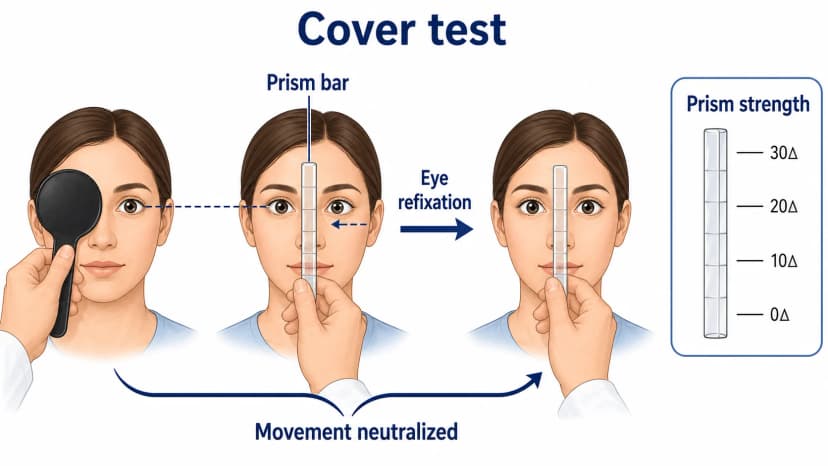
The prism and cover test is a fundamental examination technique for measuring eye misalignment (strabismus). Prisms of increasing strength are used to quantify the deviation, which guides diagnosis and treatment.
Key Takeaways
- Measures degree of eye misalignment
- Uses prisms to neutralize deviation
- Essential for double vision evaluation
- Guides prism prescription for treatment
- Performed at distance and near
Why It's Done
- Quantify eye misalignment in conditions like sixth nerve palsy, fourth nerve palsy, and third nerve palsy
- Monitor cranial nerve palsies over time
- Prescribe prism glasses for double vision
- Plan strabismus surgery
- Track changes over time in conditions like myasthenia gravis and thyroid eye disease
How It Works
Basic Principle
- Cover one eye, observe movement of other
- If eyes are misaligned, uncovered eye moves to fixate
- Prisms bend light to eliminate movement
- Prism strength = amount of misalignment
What Prisms Do
- Bend light toward their base
- Eye doesn't need to move as much
- Measure in "prism diopters"
Types of Cover Tests
Cover-Uncover Test
- Cover one eye, watch other
- Detects manifest deviation (tropia)
- Movement indicates misalignment
Alternating Cover Test
- Alternate cover between eyes
- Detects total deviation
- Breaks fusion
Prism Cover Test
- Add prisms until no movement
- Quantifies deviation in prism diopters
Measuring at Distance and Near
- Distance: looking at far target (6 meters/20 feet)
- Near: looking at close target (33 cm)
- May be different-important for diagnosis
- Measurements may also be repeated in side gaze, upgaze, downgaze, and head tilt positions when a cranial nerve palsy is suspected
Results
Horizontal Deviations
- Esotropia/esophoria-eyes turn in
- Exotropia/exophoria-eyes turn out
Vertical Deviations
- Hypertropia-eye turns up
- Hypotropia-eye turns down
Use in Prism Prescription
The measurement guides:
- How much prism to prescribe
- Which direction prism should face
- Whether prisms will help symptoms
Related Tests
- Visual field testing-may be needed if neurological cause suspected
- MRI brain and orbits-to evaluate underlying cause of strabismus
- Ice test-if myasthenia gravis suspected
- OCT-to evaluate optic nerve if associated findings
Why Repeat Measurements Matter
One prism measurement is a snapshot. In neuro-ophthalmology, the trend is often more useful:
- A microvascular cranial nerve palsy should usually improve over weeks to months.
- Myasthenia gravis can vary during the day, so measurements may not match from visit to visit.
- Thyroid eye disease often needs stable measurements before permanent prism or strabismus surgery is planned.
Frequently Asked Questions
Does the prism and cover test treat double vision?
No. It measures the misalignment. The measurement can then guide prism glasses, temporary Fresnel prism, patching, botulinum toxin, or surgery.
Why are distance and near measurements different?
Some eye alignment problems show up more at near, others more at distance. That difference helps separate convergence problems, cranial nerve palsies, and decompensated childhood strabismus.
Can the test be wrong if my double vision comes and goes?
It can miss the worst pattern if symptoms are quiet that day. Bring notes about when the double vision is worse, and tell the examiner if fatigue, reading, driving, or certain gaze directions trigger it.
Medical Disclaimer: This information is for educational purposes only and does not replace professional medical advice.
Sources:
- American Academy of Ophthalmology. Cover Tests.
- American Academy of Ophthalmology EyeWiki. Sensory and Motor Testing.