
Astigmatism
A common refractive error caused by irregular corneal curvature, resulting in blurred vision at all distances. Learn about causes and correction options.
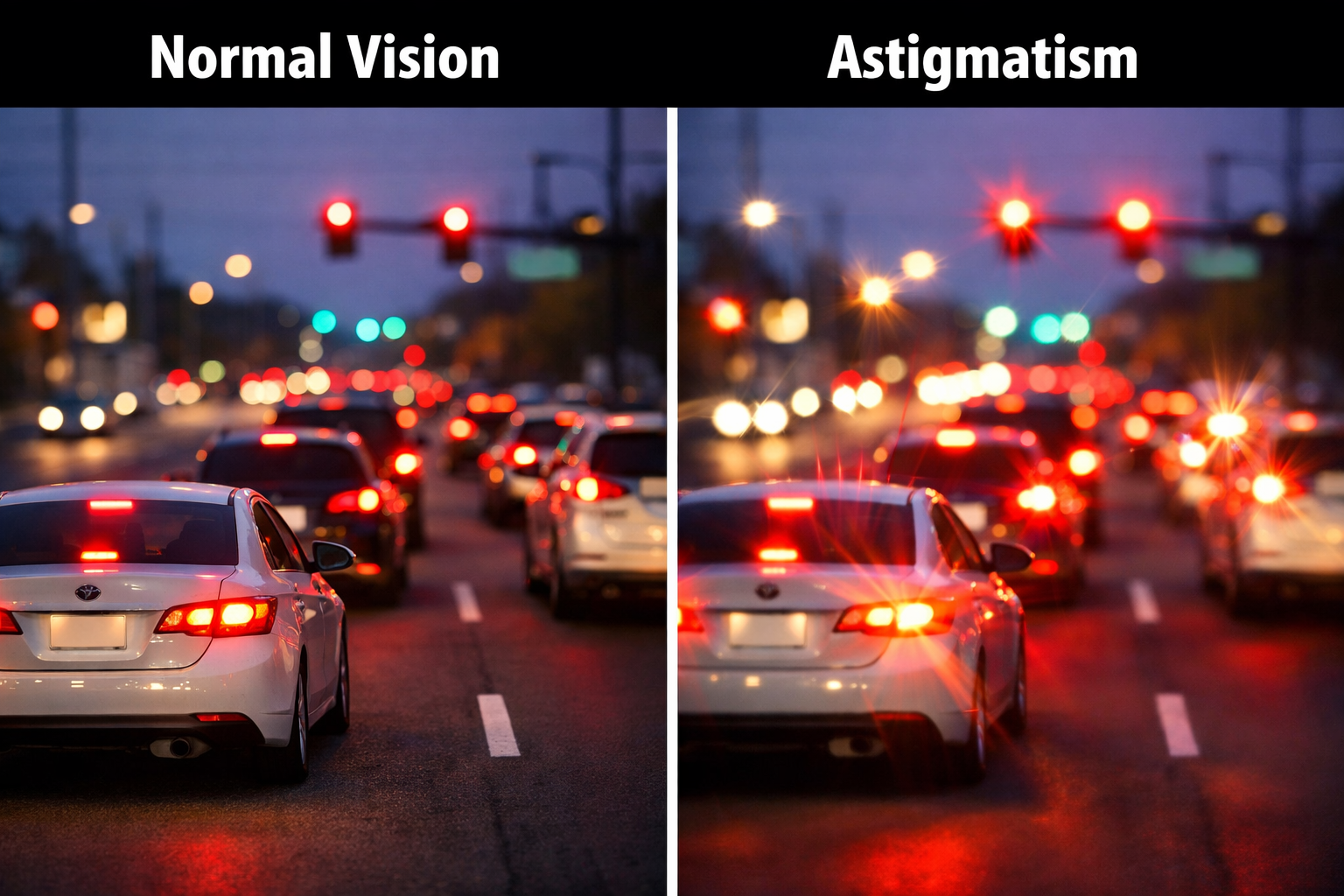
Astigmatism is a common refractive error caused by an irregularly shaped cornea or lens. Instead of being round like a basketball, the eye is shaped more like a football, causing light to focus at multiple points rather than one. This results in blurred or distorted vision at all distances.
Key Takeaways
How Astigmatism Works
Normal Eye vs. Astigmatism
Normal eye (spherical):
- Cornea is evenly curved like a basketball
- Light focuses at a single point on the retina
- Clear image forms
Astigmatic eye (toric):
- Cornea or lens has uneven curvature (like a football)
- Light focuses at multiple points
- Image is blurred or distorted
Types of Astigmatism
Regular Astigmatism (Most Common)
- The two main curvatures (meridians) are perpendicular
- Easily corrected with glasses or standard toric contacts
Irregular Astigmatism
- Curvatures are not perpendicular or vary across cornea
- Causes: keratoconus, corneal scarring, trauma
- May need rigid contacts or specialty lenses
Symptoms
Vision Symptoms
- Blurred vision at all distances
- Distorted or stretched images
- Difficulty seeing fine details
- Problems with night vision
- Halos or glare around lights
- Squinting to see clearly
Strain-Related Symptoms
- Eye strain and fatigue
- Headaches
- Difficulty with prolonged reading or screen use
- Eye discomfort
In Children
- Squinting or tilting head
- Sitting close to TV or holding books close
- Difficulty in school (can't see board clearly)
- Eye rubbing
- May not complain (don't know vision should be clearer)
Causes
Corneal Astigmatism (Most Common)
- Irregular corneal curvature
- Often present from birth
- Hereditary component
- May change slightly over time
Lenticular Astigmatism
- Irregular lens shape inside the eye
- Less common than corneal
- May change with cataract development
Acquired Causes
- Keratoconus—progressive corneal thinning
- Corneal scarring from injury or infection
- Previous eye surgery
- Pterygium (growth on cornea)
- Eyelid masses pressing on cornea
Diagnosis
Eye Examination
- Visual acuity testing—reading the eye chart
- Refraction—determining the prescription
- Keratometry—measuring corneal curvature
- Corneal topography—detailed corneal mapping
Understanding the Prescription
An astigmatism prescription has three parts:
- Sphere—myopia (-) or hyperopia (+) correction
- Cylinder—amount of astigmatism
- Axis—orientation of astigmatism (1-180 degrees)
Example: -2.00 -1.50 x 90
- -2.00 = myopia
- -1.50 = astigmatism amount
- 90 = axis orientation
Treatment Options
Wondering whether glasses or contacts are a better fit? Our glasses and contacts guide walks through the decision.
Glasses
- Most common and straightforward correction
- Cylindrical lens component corrects astigmatism
- Work well for regular astigmatism
- May notice distortion at edges of lens (especially high prescriptions)
Contact Lenses
Toric Soft Lenses
- Designed to stay oriented correctly on eye
- Available in daily, bi-weekly, and monthly options
- Work well for most regular astigmatism
Rigid Gas Permeable (RGP) Lenses
- Create a new smooth optical surface
- May provide sharper vision
- Good for irregular astigmatism
- Require adaptation period
Hybrid Lenses
- Rigid center with soft skirt
- Comfort of soft lens with optics of rigid lens
Scleral Lenses
- Large diameter lenses that vault over cornea
- Excellent for irregular astigmatism
- Very comfortable once adapted
Refractive Surgery
For stable adult astigmatism:
- Reshapes cornea with laser
- Can correct moderate astigmatism
- Quick recovery
PRK
- Surface laser treatment
- Alternative to LASIK
- Longer healing but good results
SMILE
- Newer procedure
- Less corneal surface disruption
Astigmatic Keratotomy (AK)
- Incisions to flatten steep meridian
- Often combined with cataract surgery
Toric IOLs
- Astigmatism-correcting lens implants
- Placed during cataract surgery
- Corrects astigmatism while treating cataract
Special Situations
Astigmatism with Keratoconus
Keratoconus causes progressive irregular astigmatism:
- Glasses may not correct adequately
- Rigid or scleral contacts often needed
- Corneal cross-linking may slow progression
- Severe cases may need corneal transplant
Astigmatism After Cataract Surgery
Some astigmatism may remain or change after surgery:
- May need glasses for residual astigmatism
- Limbal relaxing incisions (LRI) can reduce it
- Laser enhancement possible in some cases
- Toric IOL exchange rarely needed
Childhood Astigmatism
Important to detect and treat:
- Can cause amblyopia if significant and uncorrected
- May need full-time glasses wear
- Regular monitoring as eyes develop
- Usually stable but can change during growth
When to See a Doctor
See an eye care provider if:
- Vision is blurry at distance or near
- Frequent headaches or eye strain
- Difficulty with night driving (halos, glare)
- Child squinting or having school difficulties
- Existing astigmatism prescription no longer clear
- Vision changes that don't match typical astigmatism (may rarely indicate neurological conditions — see case report)
Frequently Asked Questions
Is astigmatism serious?
Most astigmatism is not serious—it's a common optical imperfection easily corrected with glasses or contacts. However, progressive irregular astigmatism (like keratoconus) requires monitoring and specialized treatment.
Can astigmatism get worse?
Minor changes are normal over time. Significant worsening, especially if rapid or irregular, may indicate conditions like keratoconus and should be evaluated.
Can astigmatism be cured?
Astigmatism can be corrected but not "cured." Refractive surgery can permanently reshape the cornea to reduce or eliminate astigmatism, though it may regress slightly over time.
Why do my glasses seem distorted at the edges?
Higher astigmatism corrections in glasses can cause peripheral distortion. This is normal. It may be reduced with certain lens designs (aspherical lenses) or by switching to contacts.
Can I wear regular contacts with astigmatism?
Mild astigmatism may be adequately corrected with spherical soft contacts. Moderate to higher astigmatism usually needs toric (astigmatism-correcting) lenses for clear vision.
Is astigmatism hereditary?
Yes, there's a hereditary component. If parents have astigmatism, children are more likely to develop it. However, environmental factors also play a role.
References
Medical Disclaimer: This information is for educational purposes only and does not replace professional medical advice, diagnosis, or treatment. If you have vision concerns, please consult a qualified healthcare provider.
Sources:
- American Academy of Ophthalmology. What Is Astigmatism?.
- American Optometric Association. Astigmatism.
- Read SA, et al. Corneal astigmatism and its relationship with ocular components in human eyes. Optom Vis Sci. 2014;91(2):160-167.