

Macular Degeneration (AMD)
Age-related macular degeneration is the leading cause of irreversible vision loss in adults over 50. Learn about dry and wet AMD types, symptoms by stage, diagnostic imaging, anti-VEGF treatments, AREDS2 supplements, and how to monitor your vision at home.
Age-related macular degeneration (AMD) is a progressive disease of the retina that damages the macula-the small, central area responsible for sharp, detailed vision. AMD is the leading cause of irreversible central vision loss among adults over 50 in the developed world, affecting more than 11 million people in the United States alone. The condition exists in two main forms: dry AMD (the more common, slower-progressing type) and wet AMD (less common but capable of causing rapid, severe vision loss). Understanding both forms is essential for early detection, timely treatment, and long-term vision preservation.
Key Takeaways
- AMD is the leading cause of irreversible vision loss in adults over 50 in developed countries
- Two main types exist: dry AMD (85-90% of cases, gradual progression) and wet AMD (10-15%, can cause rapid severe loss)
- Central vision is affected-peripheral (side) vision is typically preserved, so total blindness is rare
- Wet AMD is treatable with anti-VEGF injections that can stabilize or improve vision in most patients
- AREDS2 supplements reduce the risk of progression from intermediate to advanced AMD by approximately 25%
- Home monitoring with an Amsler grid can catch early conversion to wet AMD, when prompt treatment matters most
- Smoking is the strongest modifiable risk factor-quitting at any age reduces AMD risk
What Is the Macula?
The macula is a small, oval-shaped area at the center of the retina, only about 5 mm across. Despite its tiny size, the macula contains the highest concentration of cone photoreceptors in the eye and is solely responsible for:
- Central vision-what you see when you look directly at something
- Fine detail-reading, recognizing faces, threading a needle
- Color perception-distinguishing subtle differences in color
Because the macula is so densely packed with photoreceptors, even small areas of damage can produce noticeable blurred vision or blind spots. The rest of the retina handles peripheral vision, which is why people with advanced AMD retain the ability to navigate and detect motion even when they can no longer read or drive.
Types of Macular Degeneration
Dry AMD (Non-Exudative)
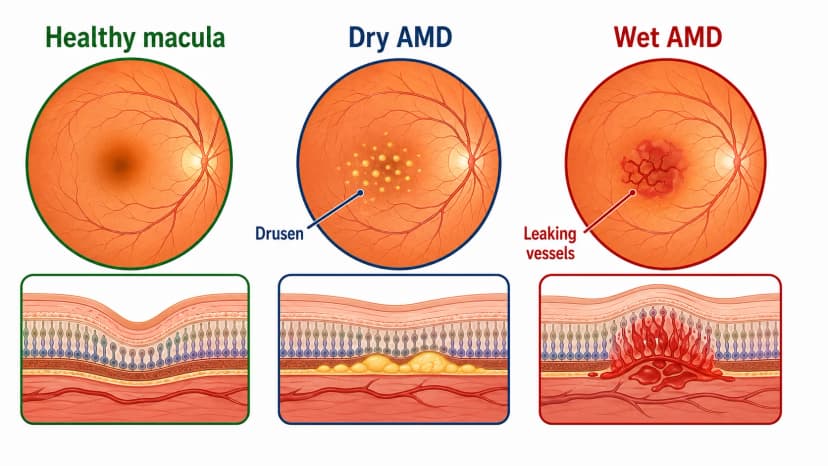
Dry AMD accounts for 85-90% of all AMD cases. It is characterized by the accumulation of drusen-small yellow-white deposits of lipid and protein-beneath the retinal pigment epithelium (RPE). The condition progresses through three stages:
- Early dry AMD: Medium-sized drusen (63-124 µm) are present, usually without noticeable vision changes
- Intermediate dry AMD: Large drusen (>125 µm) and/or pigmentary changes appear; mild central blurriness may begin
- Advanced dry AMD (Geographic Atrophy): Well-defined areas of RPE and photoreceptor loss develop, causing permanent central scotomas (blind spots)
Dry AMD progresses slowly over years to decades. However, approximately 10-15% of dry AMD cases convert to wet AMD, which can cause much more rapid vision loss.
Wet AMD (Neovascular/Exudative)
Wet AMD accounts for 10-15% of AMD cases but is responsible for nearly 90% of severe vision loss from the disease. In wet AMD, abnormal blood vessels grow from the choroid beneath the retina-a process called choroidal neovascularization (CNV). These fragile, newly formed vessels leak fluid, lipid, and blood into and under the retina, causing:
- Rapid distortion or loss of central vision
- Subretinal or intraretinal fluid accumulation
- Scarring (disciform scar) if left untreated
Wet AMD is a medical urgency. Prompt treatment with anti-VEGF injections can stabilize or improve vision in the majority of patients.
Geographic Atrophy
Geographic atrophy (GA) is the advanced stage of dry AMD, defined by sharply demarcated areas of complete RPE and photoreceptor loss. GA expands gradually over months to years, and when it reaches the foveal center, reading vision is lost. Recently approved complement inhibitors (pegcetacoplan and avacincaptad pegol) represent the first treatments that can slow GA progression.
Symptoms
Early AMD
- Often no noticeable symptoms
- Slightly longer time adapting from bright to dim lighting
- Mild difficulty with fine detail under low light
Intermediate AMD
- A blurry or hazy spot in the center of vision
- Colors may appear less vivid
- Need for brighter lighting when reading or doing close work
- Difficulty recognizing faces at a distance
Advanced AMD
Seek eye care promptly if you notice any of the following:
- Straight lines appear wavy, bent, or distorted (metamorphopsia)-the hallmark symptom of wet AMD
- A new dark or blurry spot in the center of your vision
- Rapid decline in central vision over days to weeks
- Colors appear washed out or different between the two eyes
These may signal conversion from dry to wet AMD. Early treatment produces better outcomes.
In advanced dry AMD (geographic atrophy), vision loss is gradual-a slowly expanding central blind spot. In wet AMD, vision changes can appear suddenly and progress within days if untreated.
Risk Factors
Non-Modifiable
- Age: Risk rises sharply after age 50; prevalence reaches approximately 12% in those over 80
- Genetics: Variants in complement factor H (CFH) and ARMS2/HTRA1 genes account for the majority of genetic risk; over 50 susceptibility loci have been identified
- Race: AMD is more prevalent in Caucasian populations
- Family history: Having a first-degree relative with AMD increases risk 2-4 fold
- Sex: Women have a slightly higher lifetime risk, partly due to longer life expectancy
Modifiable
- Smoking: The strongest modifiable risk factor-smokers have a 2-4 fold increased risk; even former smokers carry elevated risk for years
- Diet: Low intake of leafy greens, fish, and antioxidant-rich foods is associated with higher risk
- Hypertension and cardiovascular disease: Impaired choroidal blood flow may accelerate AMD
- Obesity: Body mass index > 30 is associated with faster progression from intermediate to advanced AMD
- UV and blue light exposure: Chronic unprotected sun exposure may contribute, though evidence is less definitive than for smoking
How AMD Is Diagnosed
Clinical Examination
- Visual acuity test: Measures central sharpness; may be normal in early stages
- Dilated fundus exam: Allows direct visualization of drusen, pigmentary changes, hemorrhage, fluid, and atrophy
- Amsler grid: A simple square grid used to detect central distortion or scotomas; patients check each eye separately
Imaging
Optical Coherence Tomography (OCT) The most important monitoring tool in AMD. OCT provides cross-sectional, micrometer-resolution images of the retina, revealing:
- Drusen size and volume
- Intraretinal and subretinal fluid (hallmark of active wet AMD)
- RPE detachments
- Geographic atrophy boundaries
OCT Angiography (OCT-A) A non-invasive technique that maps retinal and choroidal blood flow without dye injection. OCT-A can detect choroidal neovascularization before clinical signs appear, offering earlier wet AMD detection.
Fluorescein Angiography (FA) An intravenous dye test that highlights leaking blood vessels. FA remains an important reference test for classifying CNV lesions (classic, occult, or mixed) and guiding treatment decisions in wet AMD.
Fundus Autofluorescence (FAF) Images the natural fluorescence of lipofuscin in RPE cells. Areas of increased FAF signal may predict future atrophy; areas of absent signal mark established geographic atrophy. FAF is valuable for monitoring GA progression over time.
Fundus Photography High-resolution color photographs of the retina that document drusen, pigment changes, hemorrhages, and atrophic areas. Serial photographs help track disease progression at follow-up visits.
Treatment Options
For Dry AMD
No treatment has been shown to reverse dry AMD, but progression can often be slowed:
Lifestyle Modifications
- Smoking cessation (the single most impactful change)
- Diet rich in leafy greens (kale, spinach), colorful vegetables, nuts, and oily fish
- Regular aerobic exercise
- Blood pressure and weight management
- UV-protective sunglasses
AREDS2 Supplement Formula
The Age-Related Eye Disease Study 2 (AREDS2) identified a specific supplement formula that reduces the risk of progressing from intermediate to advanced AMD by approximately 25%. The recommended daily formula contains:
- Vitamin C - 500 mg
- Vitamin E - 400 IU
- Zinc - 80 mg (as zinc oxide)
- Copper - 2 mg (as cupric oxide, to prevent zinc-induced copper deficiency)
- Lutein - 10 mg
- Zeaxanthin - 2 mg
AREDS2 supplements are recommended for patients with intermediate AMD in one or both eyes, or advanced AMD in one eye. They are not recommended for early AMD or for prevention in people without AMD. Always consult your eye care provider before starting.
Complement Inhibitors for Geographic Atrophy Two complement pathway inhibitors have been approved to slow geographic atrophy progression:
- Pegcetacoplan (Syfovre) - intravitreal injection every 25-60 days
- Avacincaptad pegol (Izervay) - intravitreal injection monthly
These medications do not restore lost vision but reduce the rate of atrophy expansion by approximately 20-35% over 12 months.
For Wet AMD
Anti-VEGF Injections
Anti-VEGF therapy is the standard of care for wet AMD. These medications are delivered via intravitreal injection and work by blocking vascular endothelial growth factor (VEGF), the protein that drives abnormal blood vessel growth and leakage. Available agents include:
- Ranibizumab (Lucentis) - monthly or treat-and-extend dosing
- Aflibercept (Eylea) - every 4-8 weeks depending on formulation
- Bevacizumab (Avastin) - off-label, similar efficacy, lower cost
- Brolucizumab (Beovu) - every 8-12 weeks after loading
- Faricimab (Vabysmo) - bispecific antibody targeting both VEGF-A and Ang-2, dosing up to every 16 weeks
Treatment typically begins with monthly loading injections (usually 3), followed by a treat-and-extend protocol that gradually lengthens the interval between injections based on disease activity on OCT. Many patients require ongoing treatment for years.
Photodynamic Therapy (PDT) PDT with verteporfin is now rarely used as monotherapy but may be combined with anti-VEGF in select cases, such as polypoidal choroidal vasculopathy (PCV), a variant of wet AMD more common in Asian and African-American populations.
Self-Monitoring at Home
How to use the Amsler grid for home monitoring:
- Wear your regular reading glasses or contact lenses
- Hold the grid at a comfortable reading distance (about 12-15 inches)
- Cover one eye completely
- Focus on the central dot with the uncovered eye
- While staring at the dot, notice whether any lines appear wavy, broken, distorted, missing, or blurry
- Repeat with the other eye
Test each eye every day. If you notice any new distortion, waviness, or missing areas-even subtle changes-contact your eye care provider within 24-48 hours. Early detection of wet AMD conversion is one of the most important things you can do to protect your vision.
Smartphone-based home monitoring tools (such as the ForeseeHome device and various apps) are becoming available and may offer more sensitive detection of early changes than the paper Amsler grid alone.
Living with AMD
Low Vision Rehabilitation
Low vision rehabilitation is a specialized service that helps people maximize their remaining vision. A low vision specialist can prescribe:
- Magnifying devices (hand-held, stand, and electronic)
- High-powered reading glasses or telescopic lenses
- Closed-circuit television (CCTV) magnifiers
- Screen-reading software and large-display devices
- Task lighting optimized for contrast and brightness
Daily Adaptations
- Use large-print books, tablets with adjustable font sizes, and audiobooks
- Increase lighting throughout the home, especially in kitchens and stairways
- Use high-contrast items: bold-tipped pens, large-button phones, colored cutting boards
- Mark appliance dials and medication bottles with tactile or high-contrast labels
- Explore state and local resources for the visually impaired
Emotional Well-Being
Vision loss from AMD can lead to depression, anxiety, social isolation, and loss of independence. Important strategies include:
- Acknowledging grief and frustration as a normal response to vision loss
- Connecting with support groups (in-person and online) for people with AMD
- Staying socially active and maintaining hobbies with adaptive tools
- Speaking with a counselor or mental health professional when needed
- Learning about adapting to vision loss and understanding the realistic answer to "Am I going to go blind?"
Charles Bonnet Syndrome
Some people with significant vision loss from AMD experience Charles Bonnet syndrome-vivid visual hallucinations caused by the brain filling in missing visual information. These hallucinations are not a sign of mental illness. They are common, usually benign, and often improve over time. Understanding that this phenomenon exists can reduce fear and anxiety.
Prevention
While AMD cannot be fully prevented, the following measures reduce risk and may slow progression:
- Quit smoking-the single most effective step at any age
- Eat an AMD-friendly diet: leafy greens, berries, nuts, oily fish (salmon, sardines, mackerel), and colorful vegetables rich in lutein, zeaxanthin, and omega-3 fatty acids
- Exercise regularly-30 minutes of moderate activity most days
- Protect eyes from UV light-wear sunglasses with 100% UV-A and UV-B protection
- Manage cardiovascular risk factors-control blood pressure, cholesterol, and blood sugar
- Get regular comprehensive eye exams starting at age 50 (or earlier with family history)
Related Conditions
- Dry Age-Related Macular Degeneration (Dry AMD)
- Wet Age-Related Macular Degeneration (Wet AMD)
- Geographic Atrophy
- Diabetic Macular Edema
- Diabetic Retinopathy
- Epiretinal Membrane
- Macular Hole
- Central Serous Retinopathy
Frequently Asked Questions
Will I go completely blind from AMD?
AMD affects central vision, not peripheral vision. Even people with advanced AMD in both eyes retain side vision and can typically navigate familiar environments, walk independently, and detect movement. Complete blindness from AMD alone is very rare. Many people continue to live independently with the help of low vision rehabilitation and adaptive strategies. For more, see our guide: Am I going to go blind?
How quickly does AMD progress?
This depends on the type. Dry AMD typically progresses over years to decades, and many people with early dry AMD never develop advanced disease. Wet AMD, by contrast, can cause noticeable vision loss within days to weeks. Geographic atrophy falls in between-expanding gradually over months to years. Regular monitoring allows early detection of changes that require treatment.
Can diet and supplements prevent or treat AMD?
A healthy diet rich in leafy greens, fish, and antioxidants is associated with lower AMD risk but cannot guarantee prevention. The AREDS2 supplement formula has strong clinical evidence for slowing progression from intermediate to advanced AMD (approximately 25% risk reduction). However, AREDS2 supplements do not prevent AMD from developing in the first place, and are not recommended for people with early AMD or no AMD.
Are the eye injections painful?
The eye is anesthetized with numbing drops before each intravitreal injection, so most patients feel only brief pressure or a mild sting. Discomfort typically resolves within minutes. The benefits of preserving vision far outweigh the brief discomfort, and most patients tolerate injections well over the course of long-term treatment.
If one eye has AMD, will the other eye be affected?
Having AMD in one eye significantly increases the risk for the fellow eye. Studies show that if one eye has advanced AMD, the five-year risk of the other eye developing advanced disease is approximately 30-40%. Both eyes should be monitored regularly, and any new symptoms in the unaffected eye should be reported promptly.
What tests will my doctor use to monitor AMD?
Your ophthalmologist will typically use a combination of visual acuity testing, dilated fundus exam, OCT, and the Amsler grid at regular intervals. If wet AMD is suspected, fluorescein angiography and/or OCT angiography may be performed. Fundus autofluorescence is particularly useful for tracking geographic atrophy. The frequency of monitoring depends on the stage and type of AMD-typically every 6-12 months for early disease and every 4-8 weeks during active wet AMD treatment.
References
Medical Disclaimer: This information is for educational purposes only and does not replace professional medical advice, diagnosis, or treatment. If you have concerns about macular degeneration or any vision changes, please consult a qualified healthcare provider.
Sources:
- American Academy of Ophthalmology. Age-Related Macular Degeneration Preferred Practice Pattern. Updated 2019.
- Age-Related Eye Disease Study 2 (AREDS2) Research Group. Lutein + zeaxanthin and omega-3 fatty acids for age-related macular degeneration: the AREDS2 randomized clinical trial. JAMA. 2013;309(19):2005-2015.
- Heier JS, et al. Intravitreal aflibercept (VEGF Trap-Eye) in wet age-related macular degeneration. Ophthalmology. 2012;119(12):2537-2548.
- Khanani AM, et al. Efficacy and safety of faricimab for neovascular AMD: 2-year results from the LUCERNE trial. Ophthalmology. 2022.
- Fleckenstein M, et al. Age-related macular degeneration. Nat Rev Dis Primers. 2021;7(1):31.
- National Eye Institute. Age-Related Macular Degeneration.