

Dry Age-Related Macular Degeneration (Dry AMD)
The most common form of AMD, causing gradual central vision loss. Learn about stages, risk factors, AREDS supplements, and monitoring for progression.
Dry age-related macular degeneration (AMD) is the most common form of macular degeneration, accounting for about 80-90% of AMD cases. It causes gradual central vision loss due to deterioration of the macula-the part of the retina responsible for sharp, detailed vision. While there's no cure, progression can be slowed with proper management.
Key Takeaways
- Most common cause of vision loss in people over 50 in developed countries
- Affects central vision-needed for reading, driving, recognizing faces
- Progresses slowly over years in most cases
- AREDS2 supplements can reduce progression risk by about 25% in intermediate/advanced stages
- Can convert to wet AMD-know the warning signs
- No proven treatment for early dry AMD-lifestyle modifications and AREDS2 (intermediate stage) help; complement-inhibitor injections (pegcetacoplan, avacincaptad pegol) are FDA-approved for advanced dry AMD with geographic atrophy
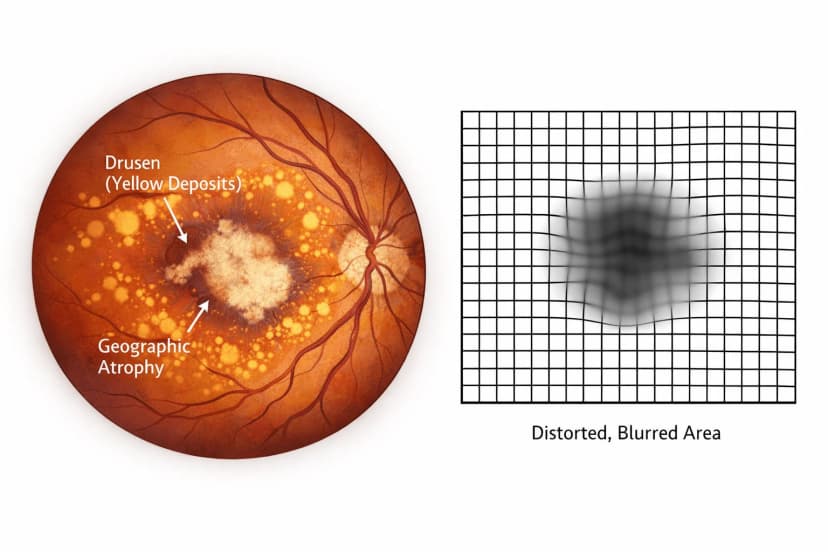
Understanding the Macula
The macula is the central part of the retina, containing the highest concentration of photoreceptors. It provides:
- Sharp central vision
- Color perception
- Ability to see fine details
- Vision for reading, driving, facial recognition
In dry AMD, the macula deteriorates over time, causing gradual central vision loss while peripheral vision typically remains intact.
Stages of Dry AMD
Early AMD
- Drusen: Small or medium yellow deposits under retina
- No pigment changes
- No vision loss
- Most people are unaware they have it
- Found incidentally during eye exam
Intermediate AMD
- Medium to large drusen
- May have pigment changes
- Some people notice mild symptoms
- Blurred vision may begin
- Difficulty in dim lighting
Advanced Dry AMD (Geographic Atrophy)
- Geographic atrophy: areas of RPE and photoreceptor loss
- Significant central vision loss
- Blind spots in central vision
- Difficulty reading, driving, recognizing faces
Symptoms
Early Disease
Often none. This is why regular eye exams are important.
As Disease Progresses
- Blurred central vision
- Need for brighter light when reading
- Difficulty adapting to dim lighting
- Printed words appear blurry
- Colors seem less vivid
- Difficulty recognizing faces
- Blank or dark spot in central vision (advanced)
- Straight lines appear wavy (may signal conversion to wet AMD)
Risk Factors
Non-Modifiable
- Age-risk increases significantly after 50
- Family history-2-3x higher risk with affected first-degree relative
- Race-more common in Caucasians
- Light eye color-slightly higher risk
- Genetics-CFH, ARMS2, and other gene variants
Modifiable
- Smoking-2-4x higher risk; most important modifiable factor
- Obesity-increased risk and faster progression
- Cardiovascular disease and hypertension
- Diet low in antioxidants and leafy greens
- Excessive sun exposure
Diagnosis
Comprehensive Eye Examination
- Visual acuity testing
- Dilated fundus exam-viewing the macula
- Amsler grid testing-detecting distortion
Imaging
OCT (Optical Coherence Tomography)
- Detailed cross-sectional macula imaging
- Identifies drusen, atrophy, fluid
- Monitors progression
- Shows areas of RPE damage
- Identifies geographic atrophy extent
- Documents drusen and pigment changes
- Allows comparison over time
- If wet AMD suspected
- Not routinely needed for dry AMD
Treatment
Early AMD
- No specific treatment proven effective
- Regular monitoring (every 1-2 years)
- Lifestyle modifications
- AREDS2 supplements not shown to help at this stage
Intermediate AMD
AREDS2 Supplements
- Proven to reduce progression risk by about 25%
- Formula: Vitamin C, Vitamin E, Zinc, Copper, Lutein, Zeaxanthin
- Do NOT contain beta-carotene (linked to lung cancer in smokers)
- Available over the counter
- Discuss with your doctor before starting
Lifestyle Modifications
- Stop smoking
- Eat leafy green vegetables
- Maintain healthy weight
- Control blood pressure
- Protect eyes from UV light
- Regular exercise
Advanced Dry AMD (Geographic Atrophy)
Newer Treatments
- Complement inhibitors (pegcetacoplan, avacincaptad pegol) FDA-approved
- Given as intravitreal injections
- Slow the rate of geographic atrophy growth
- Have not yet demonstrated improvement in visual acuity in clinical trials
- Discuss benefits, risks, and realistic expectations with a retina specialist
- Maximizes remaining vision
- Magnification devices
- Adaptive techniques
- Lighting optimization
Monitoring at Home
Amsler Grid Self-Testing
Check your Amsler grid regularly (daily or weekly):
- Use proper reading glasses or contacts
- Cover one eye
- Look at center dot
- Note any changes: wavy lines, missing areas, distortion
- Repeat with other eye
Report new distortion immediately-may indicate conversion to wet AMD.
Conversion to Wet AMD
About 10-15% of dry AMD cases convert to wet AMD, which causes faster vision loss but is treatable with injections.
Warning Signs of Conversion
- Sudden increase in distortion
- New wavy appearance of straight lines
- New blank spot in central vision
- Rapid decrease in vision
What Happens in Wet AMD
- Abnormal blood vessels grow under retina
- Vessels leak fluid and blood
- Causes rapid damage to macula
- Treatable with anti-VEGF injections
Report any sudden visual changes immediately.
Living with Dry AMD
Practical Adaptations
- Use brighter lights for reading
- Magnifying devices
- Large-print books and materials
- Screen magnification on devices
- Audiobooks and text-to-speech
- High-contrast settings
Emotional Support
- Vision loss can be emotionally challenging
- Support groups available
- Counseling may help
- Many people maintain independence with adaptations
Driving
- Central vision loss affects driving ability
- Regular vision assessments needed
- May need to modify driving habits
- Eventually may need to stop driving
Frequently Asked Questions
Will I go blind?
Dry AMD rarely causes complete blindness. It primarily affects central vision while peripheral vision is usually preserved. Most people maintain enough vision for daily activities, though reading and driving may become difficult.
Should I take AREDS2 vitamins?
If you have intermediate AMD or advanced AMD in one eye, AREDS2 supplements have been proven to reduce progression risk by about 25%. For early AMD, there's no proven benefit. Discuss with your doctor.
How often do I need eye exams?
Frequency depends on your stage:
- Early AMD: every 1-2 years
- Intermediate AMD: every 6-12 months
- Advanced AMD: as recommended (may be every few months)
Is dry AMD hereditary?
Genetics plays a significant role. If a first-degree relative has AMD, your risk is 2-3 times higher. However, lifestyle factors also matter significantly.
What's the difference between dry and wet AMD?
Dry AMD is gradual deterioration of the macula without fluid or bleeding. Wet AMD involves growth of abnormal blood vessels that leak. Wet AMD progresses faster but is treatable with injections. Dry AMD can convert to wet AMD.
Can diet really help?
Yes. Studies show that diets high in leafy green vegetables (spinach, kale), fish (omega-3 fatty acids), and colorful fruits and vegetables are associated with lower AMD risk and slower progression.
References
Medical Disclaimer: This information is for educational purposes only and does not replace professional medical advice, diagnosis, or treatment. If you have concerns about macular degeneration, please consult a qualified healthcare provider.
Sources:
- American Academy of Ophthalmology. Age-Related Macular Degeneration.
- Age-Related Eye Disease Study 2 Research Group. Lutein + zeaxanthin and omega-3 fatty acids for age-related macular degeneration. JAMA. 2013;309(19):2005-2015.
- National Eye Institute. Age-Related Macular Degeneration.
- Fleckenstein M, et al. Age-related macular degeneration. Nat Rev Dis Primers. 2021;7(1):31.