

Amsler Grid Testing
A simple home monitoring tool for detecting macular problems. Learn how to use the Amsler grid to catch vision changes early.
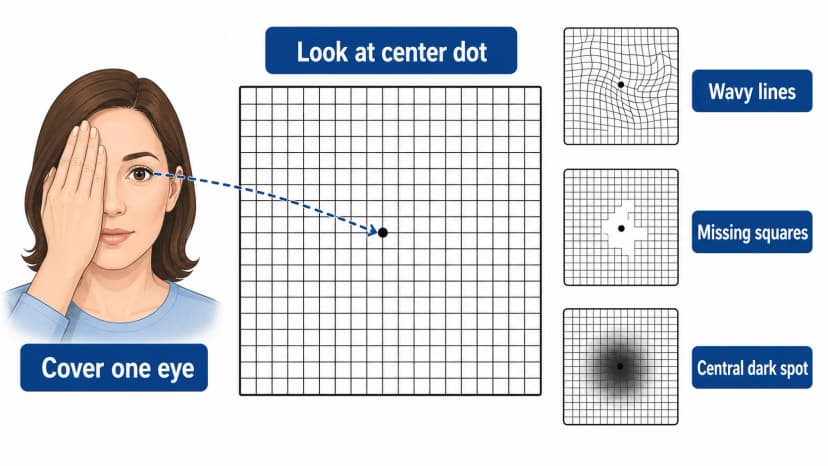
The Amsler grid is a simple but powerful tool for monitoring your central vision at home. It's a grid of horizontal and vertical lines with a central dot, used to detect distortion, blind spots, or other changes in your macula-the part of your retina responsible for detailed central vision. Regular Amsler grid testing is especially important for people with macular degeneration or at risk for macular problems.
Key Takeaways
What the Amsler Grid Detects
The Amsler grid can reveal:
- Metamorphopsia-distortion where straight lines appear wavy or bent
- Scotomas-blind spots or missing areas in the grid
- Blurred areas-sections that appear unclear
- Changes in size-areas that look larger or smaller
These changes may indicate:
- Wet AMD developing
- Macular edema
- Macular hole
- Epiretinal membrane
- Central serous retinopathy
- Other macular conditions
How to Use the Amsler Grid
Preparation
- Use the grid in good lighting
- Wear your reading glasses or contacts (the ones you use for close-up work)
- Position the grid about 12-14 inches from your eyes (normal reading distance)
- Test one eye at a time
Step-by-Step Instructions
To test your vision:
- Cover your LEFT eye completely with your hand or an eye patch
- Focus on the central dot with your RIGHT eye
- While looking at the center dot, use your peripheral vision to notice:
- Are all the lines straight?
- Are all the squares the same size?
- Are there any missing areas, dark spots, or blurry areas?
- Do any lines appear wavy, bent, or distorted?
- Repeat with the OTHER eye (cover right eye, test left eye)
What to Look For
Normal Results:
- All lines appear straight
- All squares appear the same size
- No missing or blurry areas
- Grid appears complete
Abnormal Results:
- Lines appear wavy, bent, or curved
- Squares appear different sizes
- Areas appear missing, dark, or blank
- Areas appear blurry or distorted
- Center dot is not visible
Reporting Changes
Contact your eye doctor immediately if you notice:
- New distortion (wavy lines) that wasn't there before
- New missing areas or blind spots
- Any change from your previous Amsler grid results
- Sudden worsening of distortion
For patients with dry AMD, these changes may indicate conversion to wet AMD, which requires urgent treatment.
How Often to Test
For people with macular disease:
- Daily testing recommended
- Same time each day helps establish consistency
- Record or photograph results if possible
For those at risk:
- Weekly testing
- Monthly testing at minimum
- Anytime you notice vision changes
Limitations of the Amsler Grid
While valuable, the Amsler grid:
- Cannot detect all problems-some conditions don't cause distortion
- Requires patient cooperation-must be done correctly
- Depends on patient awareness-subtle changes may be missed
- Does not replace OCT or comprehensive eye exams
- May miss very peripheral macular changes
Recording Your Results
Consider:
- Dating each test
- Marking areas of distortion on a copy of the grid
- Taking photos for comparison
- Noting which eye shows changes
- Describing what you see
This helps your doctor track changes over time.
Who Should Use the Amsler Grid
Regular Monitoring Recommended For:
- Dry AMD-to catch conversion to wet AMD
- History of wet AMD in one or both eyes
- High risk for macular degeneration
- Diabetic retinopathy
- History of macular edema
- After macular surgery or treatment
Consider Periodic Use:
- Age over 50 (AMD screening)
- Family history of macular degeneration
- High myopia
- Any concern about central vision
Getting an Amsler Grid
- Ask your eye doctor for a printed grid
- Download and print from reputable sources (AAO, NEI)
- Available in smartphone apps (ForeseeHome, others)
- Some refrigerator magnets have Amsler grids
Advanced Home Monitoring
Digital Monitoring Devices
- ForeseeHome device-FDA-approved
- More sensitive than standard Amsler grid
- Alerts to subtle changes
- Covered by some insurance for high-risk patients
Smartphone Apps
- Various apps available
- May offer reminders and tracking
- Convenience of mobile testing
- Discuss with your doctor
Frequently Asked Questions
What if I always see some distortion?
If you have existing macular disease, you may always see some distortion. What matters is change from your baseline. Note your typical findings and report any worsening or new areas of distortion.
Can I test through my regular glasses?
Yes, use whatever glasses or contacts you normally use for reading. The goal is to test your functional vision. Be consistent-always use the same correction.
What if I can't see the center dot?
If you can't see the center dot, you may have a central scotoma. This is an important finding to report to your doctor. Focus on where you know the dot should be and assess the surrounding grid.
How sensitive is the Amsler grid?
It can detect moderate to significant changes but may miss subtle early changes. This is why regular professional exams with OCT are still essential even if your Amsler grid looks normal.
Does the Amsler grid test peripheral vision?
No. The Amsler grid tests only central vision (approximately the central 10-20 degrees). Visual field testing is needed to assess peripheral vision.
Can normal aging affect Amsler grid results?
Cataracts or other conditions can affect how clearly you see the grid, but shouldn't cause the distortion pattern typical of macular disease. Any new distortion should be evaluated.
References
Medical Disclaimer: This information is for educational purposes only and does not replace professional medical advice, diagnosis, or treatment. If you notice changes on your Amsler grid, please contact your eye care provider promptly.
Sources:
- StatPearls. Amsler Grid. NCBI Bookshelf.
- National Eye Institute. Macular Edema.
- Crossland M, Rubin G. The Amsler chart: absence of evidence is not evidence of absence. Br J Ophthalmol. 2007;91(3):391-393.