

Optic Disc Edema (Swelling)
Swelling of the optic disc that can be caused by increased intracranial pressure, inflammation, or other conditions.
Optic disc edema (swelling) is a critical clinical finding where the optic nerve head appears elevated and blurred on examination. The cause must always be determined, as disc edema can indicate conditions ranging from benign to life-threatening. The term encompasses papilledema (swelling specifically from elevated intracranial pressure) as well as many other causes.
Key Takeaways
- Swelling of the optic nerve head-may appear elevated with blurred margins on examination
- Many possible causes-from elevated brain pressure to inflammation to blood vessel problems
- Must be investigated-cause determines treatment and urgency
- Papilledema specifically refers to disc swelling from elevated intracranial pressure
- Unilateral vs bilateral and vision preserved vs lost help narrow the differential diagnosis
- Imaging often required-MRI and sometimes lumbar puncture
What Disc Edema Looks Like
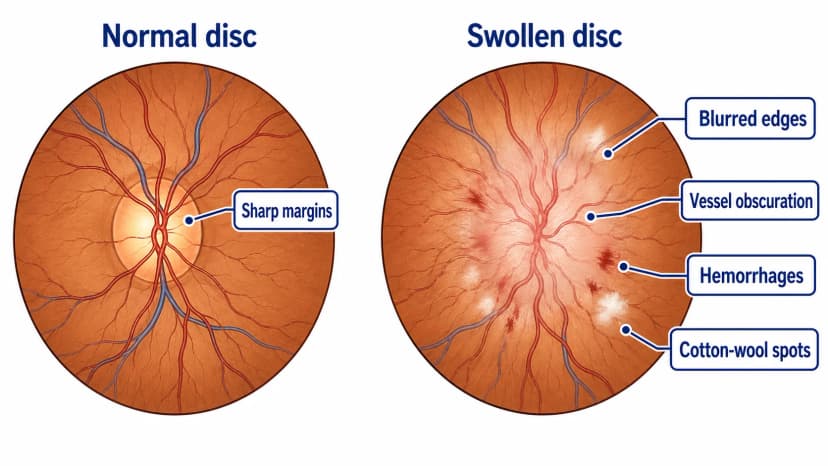
Fundoscopic Appearance
On examination of the back of the eye:
- Elevated optic disc-appears raised rather than flat
- Blurred disc margins-normally sharp edges become indistinct
- Obscured blood vessels-vessels may disappear at disc edge
- Dilated surface capillaries-small vessels on disc surface become prominent
- Loss of venous pulsations-normally present in most people
- Peripapillary hemorrhages-flame-shaped bleeding near the disc
- Cotton-wool spots-fluffy white patches near the disc
- Exudates-lipid deposits may form a "star" pattern
Staging (Frisén Scale)
| Stage | Description |
|---|---|
| 0 | Normal disc |
| 1 | Minimal blurring of nasal margin |
| 2 | Obscuration of all borders with a circumferential halo; nasal border elevated; no major vessel obscuration |
| 3 | Obscuration of major vessels leaving disc |
| 4 | Total obscuration of vessels on disc |
| 5 | Same as 4 with partial obscuration of vessels in peripapillary area |
Causes of Disc Edema
From Elevated Intracranial Pressure (Papilledema)
Papilledema-bilateral disc swelling from increased brain pressure
Causes of elevated pressure include:
- Idiopathic intracranial hypertension (IIH)-young, overweight women
- Brain tumor-mass effect blocks CSF drainage
- Cerebral venous thrombosis-blood clot in brain veins
- Hydrocephalus-blocked CSF circulation
- Meningitis-infection causing inflammation
- Intracranial hemorrhage-bleeding in or around brain
Key features of papilledema:
- Usually bilateral (both eyes)
- Vision often preserved early
- No pain
- Headache common (especially worse lying down, in morning)
- May have transient visual obscurations (brief blackouts)
- Visual field testing may show enlarged blind spot
Inflammatory Causes
- Usually unilateral
- Pain with eye movement
- Significant vision loss
- RAPD typically present
- Common in multiple sclerosis
- Disc edema with macular star (exudates in star pattern)
- Usually unilateral
- May be infectious (cat-scratch disease common)
- Sheath inflammation
- Prominent pain, milder vision loss
- MRI shows sheath enhancement
Sarcoidosis
- Granulomatous inflammation
- May be bilateral
- Systemic workup needed
Ischemic Causes
- Anterior (AION) shows disc edema
- Usually unilateral
- Sudden painless vision loss
- Older patients (>50)
- Disc often pale and swollen ("pallid edema")
- Arteritic (from giant cell arteritis)-emergency
- Non-arteritic-associated with vascular risk factors
Diabetic papillopathy
- Mild disc edema in diabetics
- Usually minimal vision loss
- Often resolves spontaneously
- Must rule out other causes
Compressive Causes
Orbital mass
- Tumor or other lesion in orbit
- May cause proptosis (bulging eye)
- Usually unilateral
- May cause compressive optic neuropathy
- Often bilateral, may be asymmetric
- Associated with Graves' disease
Infiltrative Causes
- Leukemia
- Lymphoma
- Metastatic cancer
- May cause disc swelling by infiltrating nerve
Other Causes
Optic disc drusen (pseudopapilledema)
- Buried calcium deposits in nerve
- Elevates disc, mimics edema
- No true swelling-different entity
- OCT and ultrasound help distinguish
Hypertensive retinopathy
- Severe high blood pressure
- Usually bilateral
- Other hypertensive changes present
Central retinal vein occlusion
- Disc edema from venous congestion
- Unilateral
- Significant hemorrhages throughout retina
Distinguishing Features
| Papilledema | Optic Neuritis | Ischemic | |
|---|---|---|---|
| Laterality | Bilateral | Usually unilateral | Unilateral |
| Vision | Preserved early | Significant loss | Significant loss |
| Pain | Headache, no eye pain | Eye pain with movement | Painless |
| Patient | Any age; young women (IIH) | Young adult (20-45) | Older (>50) |
| RAPD | Often absent early | Present | Present |
| Onset | Gradual | Days | Sudden |
Evaluation
History
- Vision changes (sudden vs gradual, one or both eyes)
- Pain (with eye movement? headache?)
- Other neurological symptoms
- Systemic symptoms (fever, weight loss)
- Medical history (diabetes, high blood pressure, cancer)
- Medications
Examination
- Visual acuity
- Color vision
- Pupil examination for RAPD
- Visual field testing (confrontation or formal)
- Dilated fundus examination
- Intraocular pressure
Imaging
MRI brain and orbits with contrast
- Usually first-line imaging
- Evaluates for tumors, inflammation, demyelination
- MRV (venous imaging) if venous thrombosis suspected
- Quick; good for acute bleeding
- May see optic disc drusen calcification
- Less sensitive than MRI for most causes
Additional Testing
Lumbar puncture
- If papilledema confirmed and MRI negative
- Measures opening pressure (elevated in IIH)
- Analyzes CSF for infection, inflammation
OCT
- Quantifies disc and nerve fiber layer swelling
- Helps monitor over time
- Distinguishes drusen from true edema
Visual field testing
- Documents field loss
- Monitors progression
- Enlarged blind spot common in papilledema
- Based on suspected cause
- May include: ESR/CRP (inflammation), CBC, blood glucose
- Specific tests for suspected infections or autoimmune conditions
Why Diagnosis Matters
Urgent causes of disc edema that require immediate attention:
- Brain tumor-may require surgery, radiation
- Giant cell arteritis-risk of bilateral blindness; needs immediate steroids
- Cerebral venous thrombosis-requires anticoagulation
- Meningitis-requires antibiotics/antivirals
- Severe papilledema-risk of permanent vision loss
Finding the cause of disc edema determines:
- Urgency of treatment
- Type of treatment
- Prognosis for vision
- Need for systemic treatment beyond the eyes
Frequently Asked Questions
Is disc edema the same as papilledema?
No. Papilledema is a specific term for disc swelling caused by elevated intracranial pressure. Disc edema is a broader term that includes papilledema and all other causes of optic disc swelling.
Can disc edema be normal?
No true disc edema is normal. However, some conditions like optic disc drusen can mimic the appearance of disc edema (called pseudopapilledema). Your doctor can usually distinguish these with additional testing.
Will my vision be affected permanently?
It depends on the cause and how quickly it's treated. Papilledema may not affect vision early, but can cause permanent loss if untreated. Optic neuritis usually recovers well. Ischemic optic neuropathy often has permanent vision loss.
Why do I need a lumbar puncture?
If bilateral disc edema is present with no mass on MRI, a lumbar puncture measures the pressure of fluid around your brain and can diagnose conditions like idiopathic intracranial hypertension.
How long does disc edema take to resolve?
This varies by cause. Papilledema may take weeks to months to resolve after pressure is controlled. Optic neuritis typically improves over weeks. Some causes may leave permanent disc changes.
References
Medical Disclaimer: This information is for educational purposes only and does not replace professional medical advice, diagnosis, or treatment.
Sources:
- Frisén L. Swelling of the optic nerve head: a staging scheme. J Neurol Neurosurg Psychiatry. 1982;45(1):13-18.
- Asuncion RMD, Margolin E. Papilledema. StatPearls. NCBI Bookshelf.
- Biousse V, Newman NJ. Ischemic optic neuropathies. N Engl J Med. 2015;372(25):2428-2436.
- National Eye Institute. Idiopathic Intracranial Hypertension.
- Fraser CL, White AJ. Investigation of optic disc appearance. Clin Exp Ophthalmol. 2019;47(1):27-39.