

Primary Open-Angle Glaucoma (POAG)
The most common form of glaucoma, causing gradual, painless vision loss. Learn about risk factors, diagnosis, and treatments to protect your sight.
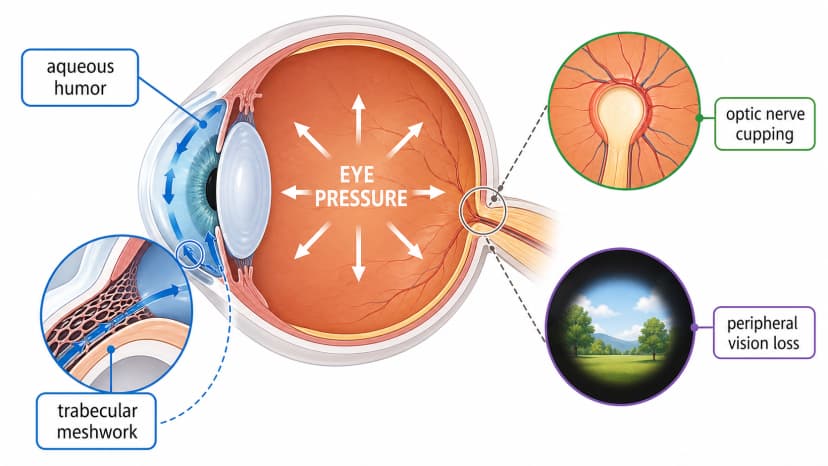
Primary open-angle glaucoma (POAG) is the most common type of glaucoma, affecting millions of people worldwide. It causes gradual damage to the optic nerve, leading to progressive peripheral vision loss and, if untreated, blindness. Because it develops slowly without pain, many people don't know they have it until significant damage has occurred.
Key Takeaways
- Often called "the silent thief of sight" because it has no early symptoms
- Elevated eye pressure is the main risk factor, but not everyone with high pressure gets glaucoma
- Damage is irreversible-but treatment can often slow progression and sometimes stabilize the disease
- Regular eye exams are essential for early detection
- Treatment lowers eye pressure through drops, laser, or surgery
Understanding Glaucoma
In glaucoma, the optic nerve-which carries visual information from the eye to the brain-becomes damaged. This damage typically causes:
- Loss of peripheral (side) vision first
- Gradual narrowing of visual field
- Central vision affected late in disease
- Eventually blindness if untreated
The exact cause isn't fully understood, but elevated intraocular pressure (IOP) is the main modifiable risk factor.
Why "Open-Angle"?
The "angle" refers to the drainage angle where the iris meets the cornea. In open-angle glaucoma:
- The drainage angle appears open and normal
- Fluid drains too slowly through the trabecular meshwork
- Pressure builds up inside the eye
- This increased pressure damages the optic nerve over time
This differs from angle-closure glaucoma, where the drainage angle is physically blocked.
Risk Factors
Major Risk Factors
- Elevated intraocular pressure (IOP)-most important modifiable factor
- Age-risk increases after 40, especially after 60
- Family history-4-9x higher risk if first-degree relative affected
- African ancestry-higher prevalence and more aggressive disease
- Hispanic ancestry-increased risk
- High myopia (nearsightedness)
Other Risk Factors
- Thin central cornea
- Diabetes
- High blood pressure or very low blood pressure
- Previous eye injury
- Long-term corticosteroid use
- Optic disc features (large cup, thin rim)
Symptoms
Early Disease
POAG typically has no symptoms in early stages:
- No pain
- No redness
- No vision changes you'd notice
- Central vision preserved initially
This is why regular screening is critical. If you have risk factors and are wondering whether you could have glaucoma, a comprehensive eye exam is the most important step.
Advanced Disease
As the disease progresses:
- Peripheral vision loss-may not notice until severe
- Tunnel vision-only central vision remains
- Difficulty seeing in dim light
- Problems with contrast
- Bumping into objects
- Eventually, central vision loss
Diagnosis
Comprehensive Eye Examination
- Measures intraocular pressure
- Normal range typically 10-21 mmHg
- Some people have damage at "normal" pressures (normal-tension glaucoma)
- Some people tolerate higher pressures without damage
- Examines the drainage angle
- Confirms angle is open (not closed)
- Rules out other types of glaucoma
- Measures corneal thickness
- Thin corneas associated with higher risk
- Affects IOP measurement accuracy
- Examines optic nerve head
- Looks for cupping, hemorrhages, RNFL defects
- Compares cup-to-disc ratio between eyes
Testing for Damage and Progression
- Maps peripheral vision
- Detects characteristic glaucoma patterns
- Monitors for progression over time
- Requires patient cooperation
OCT (Optical Coherence Tomography)
- Measures retinal nerve fiber layer thickness
- Detects structural damage before vision loss
- Compares to age-matched normal database
- Tracks changes over time
- Documents optic nerve appearance
- Allows comparison at future visits
Treatment
The goal is to lower intraocular pressure to prevent further optic nerve damage. Existing damage cannot be reversed.
Target Pressure
Your doctor will determine a target IOP based on:
- Amount of existing damage
- Baseline pressure
- Risk factors
- Rate of progression
Often a 20-30% reduction from baseline is the initial goal.
Eye Drops
Prostaglandin Analogs (most common first-line)
- Latanoprost, travoprost, bimatoprost, tafluprost
- Once daily, usually at bedtime
- Very effective at lowering IOP
- May darken iris color, lengthen eyelashes
Beta-Blockers
- Timolol, betaxolol, levobunolol
- Once or twice daily
- May affect heart rate and breathing
- Caution with asthma, heart conditions
Alpha Agonists
- Brimonidine, apraclonidine
- Two to three times daily
- May cause allergic reactions
Carbonic Anhydrase Inhibitors
- Dorzolamide, brinzolamide
- Two to three times daily
- Can cause stinging, taste changes
Rho Kinase Inhibitors
- Netarsudil
- Once daily
- May cause eye redness
Combination Drops
- Rocklatan (netarsudil/latanoprost)-dual-mechanism combination
- Simbrinza (brinzolamide/brimonidine)-carbonic anhydrase inhibitor + alpha agonist
- Improves convenience and adherence
Nitric Oxide-Donating Prostaglandin
- Vyzulta (latanoprostene bunod)-lowers IOP through dual mechanism
- Once daily dosing
Laser Treatment
Selective Laser Trabeculoplasty (SLT)
- Outpatient procedure
- Improves drainage through trabecular meshwork
- Can be repeated if needed
- May reduce or eliminate need for drops
- Increasingly used as first-line treatment
Surgery
Reserved for cases where drops and laser are insufficient:
- Creates new drainage pathway
- Most proven surgical option
- Requires careful postoperative care
Tube Shunt Surgery
- Implants drainage device
- For complex or refractory cases
Minimally Invasive Glaucoma Surgery (MIGS)
- Various newer procedures
- Less invasive than traditional surgery
- Often combined with cataract surgery
- Generally modest IOP reduction
Living with Glaucoma
Medication Adherence
- Use drops exactly as prescribed
- Don't skip doses
- Establish a routine (link to daily activity)
- Use reminders if needed
- Inform all doctors about your glaucoma medications
Regular Monitoring
Lifelong follow-up is essential:
- IOP checks
- Visual field testing
- OCT imaging
- Optic nerve examination
Lifestyle Considerations
- Regular exercise may help lower IOP
- Avoid head-down positions for extended periods
- Inform anesthesiologist before surgery
- Wear eye protection during sports
- Stop smoking
Prognosis
With early detection and proper treatment:
- Most people maintain useful vision for life
- Treatment prevents or slows progression
- Regular monitoring catches changes early
Without treatment:
- Progressive, irreversible vision loss
- Eventually leads to blindness
- One of the leading causes of blindness worldwide
Frequently Asked Questions
Can glaucoma be cured?
No. Glaucoma damage is permanent. However, treatment can significantly slow progression and may stabilize it for many patients. This is why early detection and consistent treatment are so important.
If my eye pressure is normal, can I stop treatment?
No. Continue treatment as prescribed. The goal is to keep pressure low enough to prevent damage. Stopping treatment allows pressure to rise again.
Why didn't I notice my vision loss?
POAG affects peripheral vision first, and the brain compensates well for gradual loss. The other eye also fills in for the affected eye. Central vision is preserved until late in the disease.
How often should I be tested?
Frequency depends on your risk level and disease status. Those at high risk or with diagnosed glaucoma may need exams every 3-12 months. Ask your doctor about your specific schedule.
Is glaucoma hereditary?
There's a strong genetic component. If you have a first-degree relative with glaucoma, your risk is 4-9 times higher. Family members should have regular screening exams.
Will I go blind?
With proper treatment and monitoring, most glaucoma patients maintain useful vision for life. Blindness typically occurs only with untreated or poorly controlled disease.
References
Medical Disclaimer: This information is for educational purposes only and does not replace professional medical advice, diagnosis, or treatment. If you have concerns about glaucoma, please consult a qualified healthcare provider.
Sources:
- American Academy of Ophthalmology. Primary Open-Angle Glaucoma.
- Glaucoma Research Foundation. Types of Glaucoma.
- Weinreb RN, et al. Primary open-angle glaucoma. Nat Rev Dis Primers. 2016;2:16067.
- National Eye Institute. Glaucoma.