

Ocular Sarcoidosis
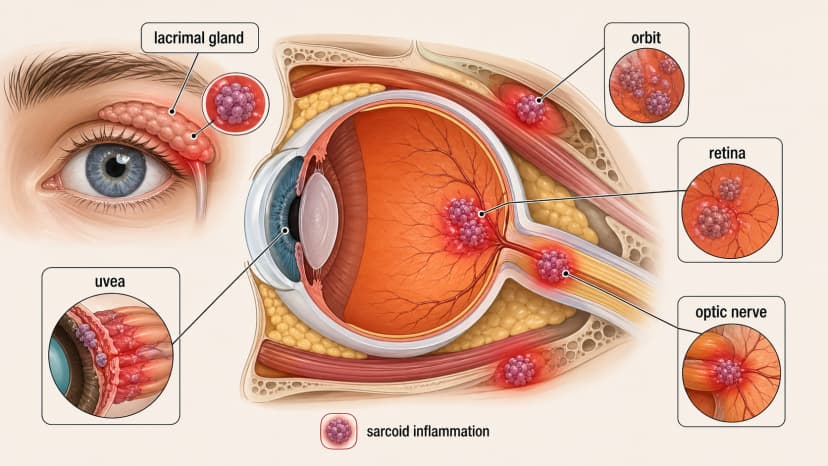
Sarcoidosis-related eye inflammation involving the uvea, lacrimal glands, optic nerve, retina, or orbit; eye findings may be the first manifestation.
Ocular sarcoidosis may be the first manifestation of systemic sarcoidosis. A red, light-sensitive eye, new floaters, dry eye from lacrimal gland involvement, or optic nerve inflammation can occur when sarcoid granulomas and related inflammation involve ocular tissues. Ocular sarcoidosis can affect nearly any eye structure, though uveitis is the most common manifestation. Roughly 25-50% of people with sarcoidosis have eye involvement. Early recognition and control of inflammation help reduce the risk of preventable vision loss.
Key Takeaways
- Eye symptoms may be the first manifestation of sarcoidosis, even before lung or skin findings are obvious
- Anterior uveitis is the usual pattern, with eye pain, redness, and photophobia
- The workup ties the eye to the rest of the body through eye exam findings, blood tests, chest imaging, and IWOS criteria
- Steroids often calm flares, but chronic disease may need methotrexate, azathioprine, mycophenolate, or another steroid-sparing medication
- Complications are not rare: cataracts, glaucoma, and cystoid macular edema need monitoring
- The course can relapse, so follow-up is an important part of treatment
Understanding Sarcoidosis
Sarcoidosis is a systemic granulomatous disease of unknown cause. It is characterized by the formation of non-caseating granulomas-small clusters of inflammatory cells-in affected organs. Unlike the granulomas seen in tuberculosis, sarcoidosis granulomas do not undergo central necrosis (caseation), which is an important pathological distinction.
The disease most commonly affects the lungs and lymph nodes, but it can involve virtually any organ, including the skin, liver, spleen, heart, nervous system, and eyes. Sarcoidosis occurs worldwide but is most prevalent in African Americans and Northern Europeans, typically presenting between ages 20 and 50.
The exact cause of sarcoidosis remains unknown. Current theories suggest that genetically susceptible individuals develop an exaggerated immune response to an environmental trigger (possibly an infectious agent or inorganic particle). This leads to accumulation of T-helper cells and macrophages that form granulomas, disrupting normal tissue architecture and function.
When sarcoidosis involves the eye-termed ocular sarcoidosis-the granulomatous inflammation can affect the uvea (iris, ciliary body, and choroid), retina, optic nerve, lacrimal glands, and orbital tissues. Eye involvement may occur with or without systemic disease elsewhere, making ophthalmological examination an important component of sarcoidosis evaluation.
How Sarcoidosis Affects the Eyes
Sarcoidosis can involve nearly every structure of the eye. The specific manifestations depend on which tissues are affected.
Anterior Uveitis
Anterior uveitis-inflammation of the iris and ciliary body-is the most common ocular manifestation of sarcoidosis, accounting for the majority of eye involvement. Sarcoid anterior uveitis is characteristically granulomatous, meaning it produces a distinct pattern of inflammation.
- Mutton-fat keratic precipitates (KPs)-large, greasy-appearing deposits on the back surface of the cornea, formed by clumps of inflammatory cells. These are a hallmark of granulomatous uveitis
- Busacca nodules-small inflammatory nodules on the iris surface
- Koeppe nodules-inflammatory nodules at the pupillary margin of the iris
- Anterior chamber cells and flare-inflammatory cells and protein in the fluid between the cornea and iris
- Posterior synechiae-adhesions between the iris and the lens, which can impair pupil function
- Iris nodules-may be visible as small bumps on the iris during slit-lamp examination
Anterior uveitis in sarcoidosis can be acute (sudden onset, self-limited) or chronic (persistent, low-grade inflammation requiring ongoing treatment). Chronic anterior uveitis is more common and more likely to cause complications.
Intermediate Uveitis
Intermediate uveitis involves inflammation primarily in the vitreous cavity (the gel-filled space in the center of the eye) and the pars plana region.
- Snowbanking-a white, plaque-like deposit of inflammatory material along the pars plana (inferior retinal periphery)
- Snowballs-white, round inflammatory aggregates floating in the inferior vitreous
- Vitreous haze-generalized clouding of the vitreous due to inflammatory cells, causing blurred vision and floaters
- Often coexists with anterior or posterior uveitis in sarcoidosis
Posterior Uveitis
Posterior uveitis involves the choroid, retina, and retinal vessels. Sarcoid posterior uveitis has several characteristic findings.
- Periphlebitis ("candle-wax drippings")-perivascular inflammation along retinal veins producing waxy, yellowish exudates that resemble dripping candle wax. This is one of the most recognizable signs of ocular sarcoidosis
- Choroidal granulomas-small, yellowish nodules in the choroid visible on examination
- Multifocal choroiditis-multiple small inflammatory lesions in the choroid
- Retinal vasculitis-inflammation of retinal blood vessels that may lead to vascular occlusion
- Cystoid macular edema (CME)-fluid accumulation in the macula, a major cause of vision loss in sarcoidosis
- Vitreous cells and haze
Optic Nerve Involvement
Sarcoidosis can directly involve the optic nerve, causing significant visual impairment.
- Disc edema-swelling of the optic nerve head, which may be unilateral or bilateral
- Optic neuropathy-granulomatous infiltration of the optic nerve, causing progressive vision loss
- Optic nerve granuloma-a visible granulomatous mass on or around the optic disc
- May mimic optic neuritis or papilledema
- Can occur as part of neurosarcoidosis (sarcoidosis affecting the nervous system)
Lacrimal Gland Involvement
The lacrimal glands-which produce tears-are commonly affected in sarcoidosis.
- Lacrimal gland enlargement-painless swelling of the glands in the upper outer eyelid area
- Reduced tear production-granulomatous infiltration damages the gland, leading to dry eye
- May be the presenting sign of sarcoidosis
- Bilateral involvement is common
Orbital Involvement
In rare cases, sarcoidosis can cause inflammation within the orbital tissues surrounding the eye.
- Proptosis-forward displacement of the eye due to orbital granulomas or inflammation
- Orbital mass-granulomatous tissue can form a discrete mass mimicking other conditions such as orbital inflammatory disease or lymphoma
- Extraocular muscle involvement-can cause double vision by restricting eye movement
- Eyelid granulomas-nodular lesions on the eyelids
Symptoms
The symptoms of ocular sarcoidosis depend on which parts of the eye are affected. Some patients have prominent symptoms, while others have minimal complaints despite active inflammation.
Common Symptoms
- Eye pain-aching or deep pain, particularly with anterior uveitis
- Photophobia-sensitivity to light, often severe with anterior uveitis
- Redness-a red or pink eye, especially circumlimbal (around the cornea)
- Blurred vision-from inflammation, macular edema, or vitreous haze
- Floaters-from vitreous cells or inflammatory debris
- Dry eyes-from lacrimal gland involvement
- Double vision-from orbital or cranial nerve involvement
Less Common Symptoms
- Decreased color vision-if the optic nerve is involved
- Visual field loss-from optic neuropathy or glaucoma
- Painless vision loss-may occur with posterior uveitis or chronic macular edema
- Tearing-paradoxically, early lacrimal gland inflammation can cause excess tearing before dry eye develops
Ocular sarcoidosis can be present with minimal or no symptoms. Some patients with active posterior inflammation or early glaucoma have no complaints until significant damage has occurred. This is why regular ophthalmological screening is often recommended for patients diagnosed with systemic sarcoidosis.
Diagnosis
Diagnosing ocular sarcoidosis requires a combination of clinical eye examination, laboratory testing, and imaging. The diagnosis can be challenging because sarcoidosis can mimic many other inflammatory conditions.
Slit-Lamp Examination
A comprehensive slit-lamp exam is the cornerstone of diagnosis. The ophthalmologist evaluates:
- The cornea for keratic precipitates (mutton-fat KPs are characteristic)
- The anterior chamber for cells, flare, and fibrin
- The iris for nodules (Busacca and Koeppe) and posterior synechiae
- The lens for early cataract formation
- Intraocular pressure (elevated in some cases, leading to glaucoma)
- The vitreous for cells, haze, snowballs, and snowbanking
Optical Coherence Tomography (OCT)
OCT provides high-resolution cross-sectional imaging of the retina and is invaluable for:
- Detecting and monitoring cystoid macular edema (CME)
- Measuring retinal thickness to assess treatment response
- Identifying epiretinal membranes or other structural changes
- Evaluating the optic nerve head for swelling
Fluorescein Angiography
Fluorescein angiography involves injecting a fluorescent dye into a vein and photographing the retinal blood vessels. In ocular sarcoidosis, it may reveal:
- Retinal vasculitis-leakage from inflamed retinal veins
- Periphlebitis-the characteristic segmental staining of veins ("candle-wax drippings")
- Cystoid macular edema-dye leakage in a petaloid (flower-shaped) pattern at the macula
- Disc leakage-staining of the optic disc indicating inflammation
- Capillary non-perfusion-areas where blood flow has been compromised
Blood Tests
Blood tests support the diagnosis but are not definitive on their own.
- Angiotensin-converting enzyme (ACE)-elevated in approximately 60% of active sarcoidosis; produced by granulomas. Sensitivity is limited, so a normal ACE does not rule out sarcoidosis
- Lysozyme-elevated in some sarcoidosis patients; another granuloma-derived enzyme
- Complete blood count (CBC)-may show lymphopenia (low lymphocyte count)
- Comprehensive metabolic panel-to assess liver and kidney function, as sarcoidosis can affect these organs; may reveal elevated calcium
- Erythrocyte sedimentation rate (ESR) and C-reactive protein (CRP)-general markers of inflammation
- Serum calcium-hypercalcemia can occur in sarcoidosis due to granuloma production of active vitamin D
Chest Imaging
Since the lungs are the most commonly affected organ in sarcoidosis, chest imaging is a critical part of the workup.
- Chest X-ray-may reveal bilateral hilar lymphadenopathy (enlarged lymph nodes at the lung roots), a classic finding in sarcoidosis
- CT scan of the chest-provides more detailed evaluation of lung parenchyma and lymph nodes, often used when chest X-ray findings are equivocal
Approximately 90% of sarcoidosis patients have abnormal chest imaging at some point in their disease course.
MRI
MRI of the brain and orbits is indicated when there is:
- Suspected optic nerve involvement
- Orbital disease causing proptosis or restricted eye movement
- Concern for neurosarcoidosis (cranial nerve palsies, meningitis, or brain lesions)
- Unexplained disc edema to differentiate from other causes
Biopsy
Tissue biopsy showing non-caseating granulomas provides the strongest diagnostic support for sarcoidosis when feasible. Biopsy may be performed on:
- Enlarged lacrimal glands
- Accessible lymph nodes
- Skin lesions
- Conjunctival nodules (when present, conjunctival biopsy has a high yield)
- Lung tissue (via bronchoscopy with transbronchial biopsy)
Biopsy is not always required if the clinical and laboratory picture is highly suggestive, but it is recommended when the diagnosis is uncertain.
International Workshop on Ocular Sarcoidosis (IWOS) Diagnostic Criteria
The IWOS criteria provide a structured approach to diagnosing ocular sarcoidosis. They categorize certainty of diagnosis into levels based on clinical findings, supportive investigations, and biopsy results:
- Definite ocular sarcoidosis-biopsy-confirmed with compatible uveitis
- Presumed ocular sarcoidosis-biopsy not performed, but bilateral hilar lymphadenopathy present with compatible uveitis
- Probable ocular sarcoidosis-biopsy not performed, no bilateral hilar lymphadenopathy, but three supportive investigations positive with compatible uveitis
- Possible ocular sarcoidosis-biopsy negative, but compatible clinical findings present with two supportive investigations positive
The IWOS criteria have significantly improved the standardized diagnosis of ocular sarcoidosis and helped avoid unnecessary invasive procedures when the clinical picture is clear.
Treatment
Treatment of ocular sarcoidosis aims to control inflammation, prevent complications, and preserve vision. The approach is tailored to the severity and location of eye involvement.
Corticosteroids
Corticosteroids are the first-line treatment for ocular sarcoidosis and are used in various forms depending on the location and severity of inflammation.
Topical corticosteroids (eye drops):
- First-line for anterior uveitis
- Prednisolone acetate 1% or difluprednate 0.05% are commonly used
- Frequency is tapered based on response (e.g., starting hourly and gradually reducing)
- Long-term use requires monitoring for steroid-induced glaucoma and cataracts
Periocular corticosteroid injections:
- Sub-Tenon or orbital floor injections of triamcinolone acetonide
- Used for intermediate or posterior uveitis unresponsive to topical drops
- Provide sustained local anti-inflammatory effect
- Risk of elevated intraocular pressure
Intravitreal corticosteroid injections:
- Triamcinolone acetonide or dexamethasone implant (Ozurdex)
- Targeted delivery to the posterior segment for macular edema or posterior uveitis
- Dexamethasone implant provides sustained release over approximately 3-6 months
- Risks include elevated intraocular pressure and cataract progression
Systemic corticosteroids:
- Oral prednisone is used for severe, bilateral, or sight-threatening ocular sarcoidosis
- Typical starting dose is 0.5-1 mg/kg/day, tapered gradually over weeks to months
- Also treats concurrent systemic sarcoidosis
- IV steroids (intravenous methylprednisolone) may be used for severe optic neuropathy or acute sight-threatening inflammation
- Long-term systemic steroids carry significant side effects (weight gain, diabetes, osteoporosis, adrenal suppression)
Steroid-Sparing Immunosuppressive Agents
Because ocular sarcoidosis is often chronic and relapsing, many patients require long-term immunosuppression beyond what corticosteroids alone can safely provide. Steroid-sparing agents allow prednisone to be tapered to a low dose or discontinued.
- Methotrexate-the most commonly used steroid-sparing agent for ocular sarcoidosis. Given weekly (oral or injection), it is effective in controlling uveitis and reducing steroid dependence. Requires monitoring of liver function and blood counts
- Azathioprine-an alternative immunosuppressant used when methotrexate is not tolerated. Requires TPMT enzyme testing before initiation and regular blood monitoring
- Mycophenolate mofetil (CellCept)-another effective steroid-sparing option, often used for posterior uveitis and macular edema. Generally well-tolerated but requires blood count monitoring
These agents typically take 2-3 months to reach full effectiveness, during which time corticosteroids bridge the gap.
Biologic Agents
For patients with refractory ocular sarcoidosis-those who do not respond adequately to corticosteroids and conventional immunosuppressants-biologic agents targeting specific components of the immune system may be used.
- Adalimumab (Humira)-an anti-TNF-alpha monoclonal antibody approved for non-infectious intermediate, posterior, and panuveitis. Given as subcutaneous injections every two weeks. Has strong evidence for uveitis management
- Infliximab (Remicade)-another anti-TNF-alpha agent, given as intravenous infusions. Often effective for severe or refractory ocular and neurosarcoidosis
- Rituximab-an anti-CD20 monoclonal antibody that depletes B cells. Used in select refractory cases, particularly when other biologics have failed
Biologic agents require screening for tuberculosis and hepatitis before initiation and carry risks of serious infection and other immune-related complications.
Treatment is often long-term. Ocular sarcoidosis frequently follows a chronic, relapsing course. Many patients require years of immunosuppressive therapy. The goal is to achieve and maintain remission using the lowest effective medication dose, minimizing side effects while preventing sight-threatening inflammation.
Complications
Without adequate treatment, ocular sarcoidosis can lead to several sight-threatening complications. Even with treatment, some complications may develop, requiring additional management.
Cataracts
Cataracts are a common complication, resulting from both chronic intraocular inflammation and prolonged corticosteroid use. Cataract surgery can be performed once inflammation is controlled for at least 3 months, though the surgical management of cataract in uveitis patients requires special considerations.
Glaucoma
Glaucoma can develop through several mechanisms:
- Steroid-induced glaucoma-elevated intraocular pressure from corticosteroid eye drops or injections
- Inflammatory glaucoma-inflammatory cells and debris clog the trabecular meshwork (the eye's drainage system)
- Synechial angle closure-posterior synechiae (iris-lens adhesions) can cause the iris to bow forward, blocking drainage
Cystoid Macular Edema (CME)
Fluid accumulation in the macula is one of the most common causes of vision loss in ocular sarcoidosis. CME can persist despite control of visible inflammation and may require targeted intravitreal treatment.
Band Keratopathy
Calcium deposits in the superficial cornea (band keratopathy) can develop in chronic anterior uveitis, causing discomfort and reduced vision. Treatment involves chelation with EDTA solution.
Optic Atrophy
Untreated or severe optic nerve involvement can lead to optic atrophy-irreversible damage to the optic nerve with permanent vision loss. This underscores the importance of aggressive treatment when the optic nerve is involved.
Other Complications
- Epiretinal membrane formation-scar tissue on the retinal surface causing distortion
- Retinal neovascularization-abnormal new blood vessel growth from chronic ischemia
- Vitreous hemorrhage-bleeding from neovascularization
- Hypotony-low eye pressure from ciliary body damage due to chronic inflammation
Prognosis
The prognosis for ocular sarcoidosis is generally favorable with appropriate treatment, but outcomes vary depending on the severity and chronicity of the disease.
Favorable Factors
- Early diagnosis and prompt treatment
- Anterior uveitis (generally responds well to topical steroids)
- Acute presentation (may resolve with a limited course of treatment)
- Good compliance with medications and follow-up
- Absence of optic nerve involvement
Unfavorable Factors
- Chronic, relapsing course (common in sarcoidosis)
- Posterior uveitis with persistent cystoid macular edema
- Optic nerve involvement with delayed treatment
- Development of glaucoma
- Steroid dependence with inability to tolerate steroid-sparing agents
Long-Term Outlook
- Many patients with ocular sarcoidosis achieve good visual outcomes with treatment
- Approximately two-thirds of patients with sarcoid uveitis maintain vision of 20/40 or better
- However, up to 10-15% of patients may develop significant visual impairment despite treatment
- The disease often follows a relapsing-remitting course, with flares requiring treatment adjustments
- Some patients achieve sustained remission and can eventually discontinue therapy, though this may take years
- Multidisciplinary management with pulmonology or rheumatology is often needed for systemic disease management
Frequently Asked Questions
Can ocular sarcoidosis cause permanent vision loss?
Yes, if untreated or inadequately treated, ocular sarcoidosis can cause permanent vision loss through complications such as glaucoma, chronic macular edema, optic nerve damage, and cataract formation. However, with early diagnosis and appropriate treatment, most patients maintain useful vision. The key is regular monitoring and prompt adjustment of therapy when inflammation is not controlled.
Will I need to take medications for life?
Not necessarily, but many patients with ocular sarcoidosis require long-term treatment. Some patients-particularly those with a single acute episode of anterior uveitis-may achieve remission and discontinue therapy. Others with chronic, relapsing disease may need immunosuppressive medications for years or even indefinitely. Your ophthalmologist and rheumatologist will work together to find the lowest effective dose and attempt medication tapering when the disease is well controlled.
I have sarcoidosis but no eye symptoms-should I see an ophthalmologist?
Yes. Ocular sarcoidosis can be present without symptoms, especially posterior inflammation or early glaucoma. All patients diagnosed with systemic sarcoidosis should have a baseline comprehensive eye examination, including a slit-lamp exam and dilated fundus exam. Follow-up eye examinations should be performed at regular intervals (typically every 6-12 months or more frequently if eye involvement is detected), even if you have no eye complaints.
Is ocular sarcoidosis contagious?
No. Sarcoidosis is not an infectious disease and cannot be transmitted from person to person. It is an immune-mediated condition in which the body's own immune system forms granulomas. While the trigger for sarcoidosis is unknown, it is not caused by a contagious organism.
What is the difference between sarcoid uveitis and other types of uveitis?
Sarcoid uveitis is granulomatous, meaning it produces a specific pattern of inflammation with large "mutton-fat" keratic precipitates, iris nodules, and characteristic findings like "candle-wax dripping" periphlebitis. Other types of uveitis-such as HLA-B27-associated uveitis-are typically non-granulomatous with smaller, fine keratic precipitates and different clinical features. The distinction matters because granulomatous uveitis narrows the differential diagnosis and prompts workup for conditions like sarcoidosis, tuberculosis, and syphilis.
References
Medical Disclaimer: This information is for educational purposes only and does not replace professional medical advice, diagnosis, or treatment. If you have symptoms of ocular sarcoidosis or have been diagnosed with sarcoidosis, consult with an ophthalmologist for comprehensive eye evaluation.
Sources:
- American Academy of Ophthalmology. Uveitis.
- Mochizuki M, Smith JR, Takase H, et al. Revised criteria of International Workshop on Ocular Sarcoidosis (IWOS) for the diagnosis of ocular sarcoidosis. Br J Ophthalmol. 2019;103(10):1418-1422.
- American Thoracic Society. Statement on sarcoidosis. Am J Respir Crit Care Med. 1999;160(2):736-755.
- Pasadhika S, Rosenbaum JT. Ocular sarcoidosis. Clin Chest Med. 2015;36(4):669-683.
- Rothova A. Ocular involvement in sarcoidosis. Br J Ophthalmol. 2000;84(1):110-116.
- National Eye Institute. Uveitis.