

Strabismus (Eye Misalignment)
A condition where the eyes don't align properly, causing one eye to turn in, out, up, or down. Can cause double vision in adults and vision development problems in children.
Strabismus is a condition in which the eyes don't line up properly. One eye may turn inward, outward, upward, or downward while the other eye looks straight ahead. It can be constant or intermittent, and affects both children and adults differently.
Key Takeaways
- Misalignment of the eyes-one eye turns while the other looks straight
- In children: Can cause amblyopia (lazy eye)
- In adults: Usually causes double vision
- Many causes-from childhood development to neurological conditions
- Treatment options include glasses, prisms, and surgery
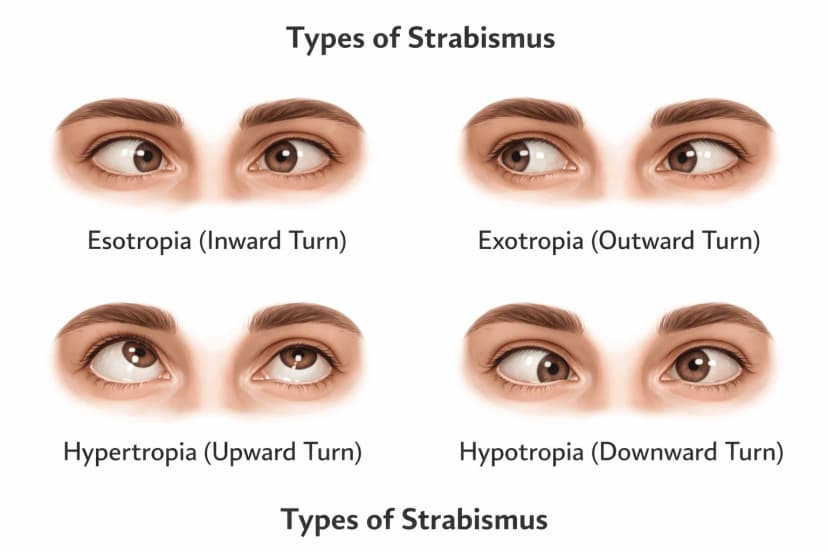
Types of Strabismus
By Direction
Esotropia (eye turns inward)
- Most common type in children
- May be present at birth or develop later
- "Cross-eyed" appearance
Exotropia (eye turns outward)
- May be constant or intermittent
- Often worse when tired or daydreaming
- "Wall-eyed" appearance
Hypertropia (eye turns upward)
- Often caused by cranial nerve problems
- May indicate fourth nerve palsy
Hypotropia (eye turns downward)
- Less common
- May be associated with orbital or muscle problems
By Pattern
Constant: Always present Intermittent: Comes and goes Alternating: Switches between eyes
Causes
In Children
- Congenital/Infantile: Present from birth
- Accommodative: Related to focusing effort
- Refractive errors: Uncorrected farsightedness
- Developmental: Unknown cause
In Adults
New-onset strabismus in adults usually has an identifiable cause:
- Cranial nerve palsies: Third, fourth, or sixth nerve
- Thyroid eye disease
- Myasthenia gravis
- Stroke or brain tumor
- Trauma
- Decompensated childhood strabismus
Symptoms
In Children
- Visible eye misalignment
- Squinting or closing one eye
- Head tilting or turning
- Poor depth perception
- May be unaware of any problem
In Adults
- Double vision (diplopia)
- Eye strain or fatigue
- Difficulty reading
- Problems with depth perception
- May tilt or turn head to reduce diplopia
Why It Matters
Children
When eyes don't align, the brain receives two different images. In children, the brain may "turn off" one eye to avoid confusion, leading to amblyopia. This can cause permanent vision loss if not treated during the critical period of visual development.
Adults
The adult brain usually cannot reliably suppress a new misalignment, so adults commonly develop double vision. This can significantly impact daily activities, work, and driving.
Diagnosis
Eye Examination
- Visual acuity testing
- Cover tests (cover-uncover, alternate cover)
- Prism cover test
- Eye movement examination
- Refraction (checking for glasses need)
- Assessment for amblyopia in children
Additional Testing
If new-onset in adults:
- Neurological examination
- MRI brain/orbits
- Blood tests (thyroid, myasthenia)
- May need eye movement examination
Treatment
Glasses
- Correct refractive errors
- Bifocals for accommodative esotropia
- Prism glasses to reduce diplopia
Patching/Occlusion
- For amblyopia in children
- Occlusion therapy
- Forces use of weaker eye
Botulinum Toxin
- Botox injection to eye muscles
- Temporary effect
- May be diagnostic or therapeutic
Surgery
- Strabismus surgery
- Adjusts the position of eye muscles
- May need more than one procedure
- Very successful in most cases
Vision Therapy
- Eye exercises
- For specific types of strabismus
- See Vision Therapy
When to Seek Care
See a doctor promptly if:
- New double vision in an adult (may indicate stroke or other serious condition)
- Eye turning noticed in a child
- Eye misalignment after head trauma
- Double vision with headache or other neurological symptoms
Prognosis
Children
- Excellent with early treatment
- Best results when treated before age 7
- May need ongoing monitoring
- Multiple surgeries sometimes needed
Adults
- Depends on underlying cause
- Prisms or surgery usually effective for alignment
- Double vision can usually be eliminated or reduced
Frequently Asked Questions
Can strabismus be cured?
In children, early treatment can often fully correct alignment and prevent amblyopia. In adults, surgery and prisms can usually restore single vision, though the underlying cause may need treatment.
Is strabismus surgery safe?
Yes, strabismus surgery has a strong safety record. It's performed on the outside of the eye (not inside), but serious complications are still possible.
Can strabismus come back after surgery?
Sometimes, especially in children who are still growing. Some patients need more than one surgery over time.
Does everyone with strabismus need surgery?
No. Many cases can be managed with glasses, prisms, or in some cases just observation. Surgery is recommended when other treatments aren't sufficient.
Medical Disclaimer: This information is for educational purposes only and does not replace professional medical advice, diagnosis, or treatment.
Sources:
- American Academy of Ophthalmology. What Is Strabismus?.
- American Association for Pediatric Ophthalmology and Strabismus. Strabismus.