

Optic Disc Cupping
What the cup-to-disc ratio in your eye exam means, why it matters for glaucoma, and how a high or asymmetric cup is interpreted.
The optic disc is the spot where the optic nerve enters the back of the eye. Its central depression is called the cup, and the ratio of cup size to total disc size - the cup-to-disc ratio (CDR) - is one of the most quoted numbers in any eye exam note. This page explains what the cup is, how the cup-to-disc ratio is measured, what numbers are typical, and why an enlarged or asymmetric cup matters.
Key Takeaways
- The optic cup is the central depression in the optic nerve head where there are no nerve fibers; it sits within the neuroretinal rim, which contains the nerve fibers
- Cup-to-disc ratio (CDR) is reported as a decimal - typical is 0.3-0.4 in the average disc, but values up to about 0.7 can be normal in physiologically large discs or in patients of African ancestry
- Glaucoma damages the neuroretinal rim, which makes the cup look larger relative to the disc - "cupping" describes this enlargement
- Asymmetry between the two eyes (>0.2 difference) is a yellow flag for glaucoma even if both individual numbers are within normal range
- Cupping is structural; the visual field, OCT, and intraocular pressure together establish whether it represents glaucoma or a normal large cup
What the Optic Cup Is
When the optic nerve fibers enter the eye, they bend backward over the rim of the optic nerve head and travel toward the brain. The center of the disc - where the central retinal artery and vein enter - has no nerve fibers. That central, slightly recessed area is the cup. The surrounding tissue, the neuroretinal rim, contains the actual nerve fibers and is what is at risk in glaucoma.
Think of the disc as a doughnut and the cup as the hole. A "small cup" (a small hole) means lots of doughnut around it - lots of nerve fibers. A "large cup" (a big hole) means less doughnut - fewer nerve fibers - unless the doughnut is just big overall, which is the source of much of the diagnostic complexity.
How the Cup-to-Disc Ratio Is Measured
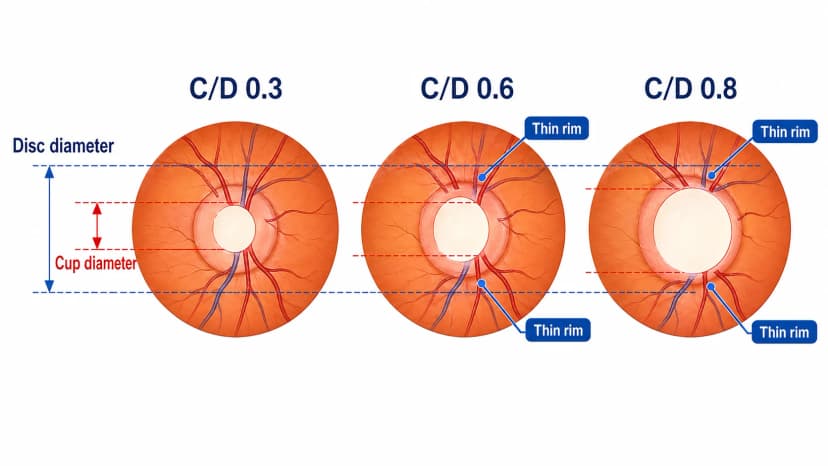
The vertical cup-to-disc ratio is the standard measurement. The clinician estimates the diameter of the cup and divides it by the diameter of the disc, both measured vertically. So a vertical CDR of 0.3 means the cup is 30% of the disc's vertical diameter.
Horizontal CDR is sometimes also reported but is less informative because glaucomatous damage tends to enlarge the cup vertically first (in the superior and inferior rim).
CDR can be estimated:
- Clinically during a fundoscopic exam or slit lamp exam with a 90D or 78D lens - this is the number that usually appears in your chart
- From a fundus photograph, which gives a more reproducible image
- By OCT using automated disc analysis software - an objective method that complements the clinician's estimate
What Numbers Are Typical
There is no single normal CDR. Typical numbers:
- 0.0-0.3 is a small to average cup - usually reassuring on its own
- 0.4-0.5 is moderate - most are normal, especially if the disc is large
- 0.6-0.7 raises concern - some people in this range have early glaucoma, while others have physiologic large cups
- ≥0.8 is unusual without optic nerve disease and prompts evaluation
The single most useful number is rarely the absolute CDR - it is the change over time and the asymmetry between the two eyes.
Asymmetry Between Eyes
Both eyes typically have very similar CDRs. An asymmetry of 0.2 or more between the two eyes (e.g., right 0.4, left 0.7) is a recognized risk marker even when both individual values are within the broad normal range.
Disc Size Matters
A large overall optic disc tends to have a large cup naturally. A small optic disc with a moderate CDR is more concerning than a large disc with the same CDR. This is why your doctor looks at the disc as a whole - its overall size, the integrity of the rim, and the pattern of any cupping - rather than at the CDR number alone.
Race and Disc Size
Optic disc size differs by ancestry. People of African descent on average have larger discs and larger cups than people of European descent, which is one reason cupping numbers must always be interpreted in context.
What Cupping Looks Like in Glaucoma
In glaucoma, nerve fibers are progressively lost. Several specific patterns of rim loss are recognized:
- Vertical cupping - preferential loss in the superior or inferior rim, making the cup taller than wide
- Notching - a focal "bite" out of the rim, especially at the inferotemporal pole; the corresponding visual field defect appears in the opposite quadrant
- Saucerization - a shallow, broadly enlarged cup
- Bayonet sign - vessels emerging from the disc make a sharp angled bend as they cross over an undermined (overhanging) neuroretinal rim into the cup, named because they resemble a bayonet on a rifle. Baring of the circumlinear vessels - vessels appear exposed at the rim because the surrounding tissue has receded - is a related glaucoma sign
- Disc hemorrhage (Drance hemorrhage) - a small splinter-shaped hemorrhage that crosses the disc margin and lies in the peripapillary nerve fiber layer; an important and often-overlooked sign that points to active glaucomatous progression
The ISNT rule (Inferior > Superior > Nasal > Temporal) describes the normal thickness pattern of the neuroretinal rim, though only about 70% of normal eyes follow it strictly. Glaucomatous discs often violate this rule before cupping numbers themselves become alarming.
Cupping Versus Pallor
A pale disc with a normal-sized cup suggests non-glaucomatous optic neuropathy - for example, optic neuritis, ischemic optic neuropathy, or compressive optic neuropathy. A cupped disc without pallor is more typical of glaucoma. Pallor plus cupping can be seen in advanced glaucoma or in compressive lesions of the optic nerve. This is why an "atypical" pattern of cupping with disc pallor often prompts neuro-ophthalmic evaluation and MRI.
Physiologic Cupping (Normal Large Cup)
Some patients are simply born with a large cup-to-disc ratio in both eyes, with healthy nerve fiber layer and normal visual fields. This is called physiologic cupping. Typical features:
- Symmetric between the two eyes
- Stable over time
- Normal OCT RNFL and ganglion cell measurements
- Normal visual fields
- Normal intraocular pressure
- Often runs in families
If everything else looks normal, a CDR of 0.6 in both eyes may be monitored without treatment.
Other Causes of an Enlarged Cup
- Prior ischemic optic neuropathy - arteritic AION and some non-arteritic cases can produce post-event cupping
- Late effects of optic neuritis - may show mild cupping with pallor
- Compressive optic neuropathy from a chiasmal mass - typically cupping with pallor and field defects that respect the vertical midline
- Severe past head trauma with traumatic optic neuropathy
- Hereditary optic neuropathies like LHON and dominant optic atrophy - cupping is not the dominant feature but can be present
How OCT Confirms or Refutes Cupping
OCT provides automated measurements that complement the doctor's visual estimate:
- Retinal nerve fiber layer (RNFL) thickness quantifies the actual nerve tissue
- Bruch's membrane opening (BMO)-based disc area standardizes how big the disc is
- Ganglion cell complex (GCC) thickness in the macula can detect early thinning that may not be obvious on disc exam
- Color-coded normative comparison - green (normal), yellow (borderline), red (outside normal) - makes interpretation easier
A normal-looking OCT in a patient with an apparently large cup is reassuring. A cup that looks moderate but with red sectors on OCT is concerning despite the unremarkable appearance.
What the Patient Notices
Cupping itself is asymptomatic. By the time a glaucoma patient notices anything, structural cupping has often been present for years. Symptoms that eventually develop include:
- Peripheral vision loss, often noticed when bumping into things or losing parts of the visual scene
- Tunnel vision in advanced disease
- Difficulty in low light or with sudden light changes
Loss of central vision is a late finding in glaucoma. Most early to moderate cupping is silent.
What to Expect After a "Cupping" Note
Finding cupping or asymmetric CDR usually triggers a more complete glaucoma evaluation:
- Intraocular pressure measurement (tonometry)
- Gonioscopy to see whether the drainage angle is open or closed
- Pachymetry (corneal thickness - affects how IOP measurements are interpreted)
- OCT of the optic nerve and macula
- Visual field testing
- Fundus photography for baseline documentation
- Repeat exam to confirm whether cupping is stable or progressive
If everything else looks normal and the cupping is symmetric and stable, the workup may end there with periodic re-checks.
Frequently Asked Questions
My report says my cup-to-disc ratio is 0.5 - should I worry?
Not necessarily. A CDR of 0.5 is borderline. Whether it is concerning depends on disc size, symmetry between the two eyes, your intraocular pressure, OCT findings, and visual field. Many people with CDR 0.5 have completely normal optic nerves on full evaluation.
Why does my chart say my cup is bigger in one eye than the other?
A meaningful asymmetry between the two cups (typically 0.2 or more) can be an early sign of glaucoma even when both individual ratios look normal in isolation. Your doctor will compare other measurements between the two eyes to interpret this.
Can the cup get smaller again?
In adults, established glaucomatous cupping usually does not meaningfully reverse. The exception is in babies and very young children with congenital glaucoma, where cupping can recede after pressure is brought back to normal. In older patients, the goal is to prevent further progression.
What is the difference between cupping and disc pallor?
Cupping describes the size of the central depression of the disc. Pallor describes the color of the rim. Glaucoma typically produces cupping without pallor. Optic neuritis and other optic neuropathies typically produce pallor without much cupping. Both together can occur in advanced disease or in compressive lesions and warrant further workup.
Why did my doctor want photos and an OCT after seeing my cup?
The cup-to-disc ratio is the doctor's estimate by eye, which can vary between visits and between examiners. Fundus photography and OCT give objective baselines so future visits can compare against today rather than relying on memory.
References
Medical Disclaimer: This information is for educational purposes only and does not replace professional medical advice, diagnosis, or treatment.
Sources:
- Jonas JB, Budde WM, Panda-Jonas S. Ophthalmoscopic evaluation of the optic nerve head. Surv Ophthalmol. 1999;43(4):293-320.
- Spaeth GL, Henderer J, Liu C, et al. The disc damage likelihood scale: reproducibility of a new method of estimating the amount of optic nerve damage caused by glaucoma. Trans Am Ophthalmol Soc. 2002;100:181-186.
- American Academy of Ophthalmology EyeWiki. Optic Disc and Glaucoma.
- Quigley HA, Dunkelberger GR, Green WR. Retinal ganglion cell atrophy correlated with automated perimetry in human eyes with glaucoma. Am J Ophthalmol. 1989;107(5):453-464.