

Retinal Vascular Disease
An umbrella term for retinal artery and vein problems that can blur vision and also point to diabetes, hypertension, cholesterol disease, or stroke risk.
Retinal vascular disease includes artery occlusions, vein occlusions, and related vessel problems that can cause sudden or gradual blurred vision. These findings also warrant attention to systemic vascular risk, including diabetes, hypertension, hyperlipidemia, sleep apnea, smoking, and stroke risk. Eye treatment and medical risk-factor evaluation are both important parts of care.
Key Takeaways
- Retinal vascular disease means blocked, leaking, or damaged retinal vessels
- Artery occlusion is an emergency, especially sudden painless vision loss
- Vein occlusions are more common, and they may cause macular edema, hemorrhages, or abnormal new vessels
- The eye finding can reveal body-wide vascular risk, including diabetes, hypertension, high cholesterol, and stroke risk
- Treatment depends on the vessel problem: emergency stroke-style evaluation, injections, laser, or risk-factor control
- Recovered vision is not guaranteed, so preventing more damage is a major goal
Types of Retinal Vascular Disease
Retinal Vein Occlusion (RVO)
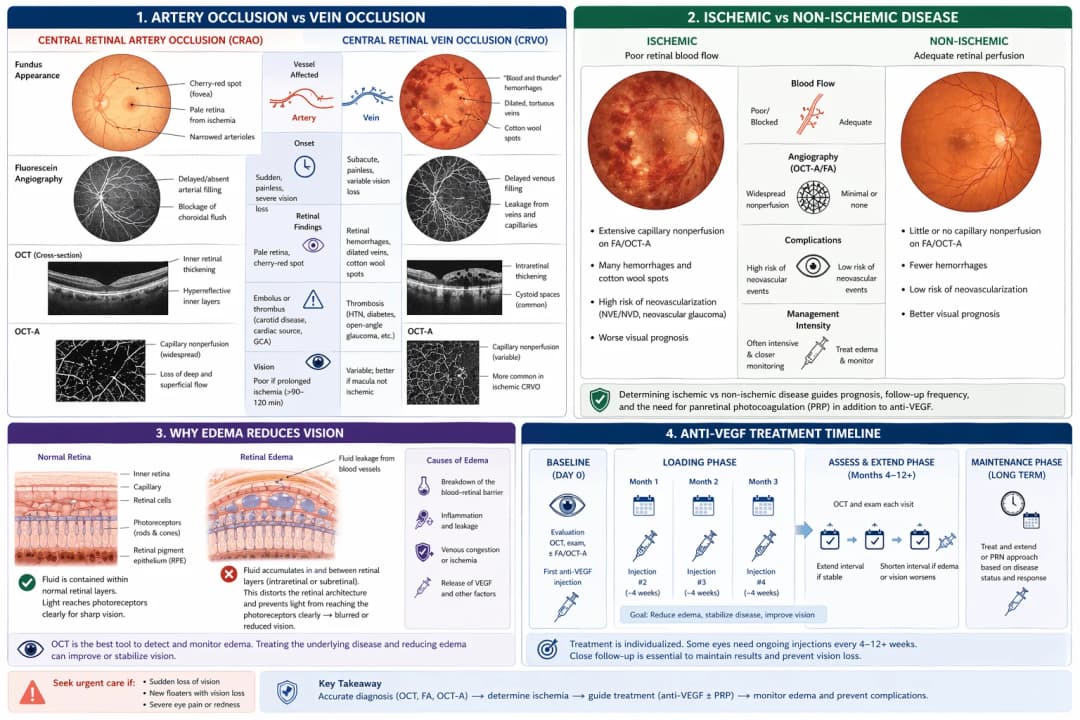
Central Retinal Vein Occlusion (CRVO):
- Blockage of main vein draining the retina
- Sudden painless vision loss
- Extensive retinal hemorrhages
- Can be mild (non-ischemic) or severe (ischemic)
Branch Retinal Vein Occlusion (BRVO):
- Blockage of a branch vein
- Often at arteriovenous crossing
- Affects part of the visual field
- Most common type of RVO
Retinal Artery Occlusion (RAO)
Central Retinal Artery Occlusion (CRAO):
- Blockage of main artery supplying retina
- Medical emergency-equivalent to an eye stroke
- Sudden, severe, painless vision loss
- Limited time window for treatment
Branch Retinal Artery Occlusion (BRAO):
- Blockage of branch artery
- Affects portion of vision
- May be less severe than CRAO
Ocular Ischemic Syndrome
- Chronic reduced blood flow to eye
- Usually from carotid artery disease
- Can cause progressive vision loss
Symptoms
Retinal Vein Occlusion
- Sudden or gradually worsening blurred vision
- Usually painless
- May notice missing areas of vision (BRVO)
- Floaters
- Vision may fluctuate
Retinal Artery Occlusion
EMERGENCY: Sudden painless vision loss
Central retinal artery occlusion (CRAO) is an eye stroke. Call 911 immediately for sudden painless vision loss or a transient blackout in one eye. Every minute counts, similar to a brain stroke; do not drive yourself or wait for an outpatient appointment.
- Sudden, severe, painless vision loss
- May be preceded by transient vision loss episodes (amaurosis fugax)
- Usually in one eye
- Vision often reduced to counting fingers or less
Risk Factors
Common to Both Vein and Artery Occlusions
- Hypertension (most important)
- Diabetes
- High cholesterol
- Smoking
- Cardiovascular disease
- Age over 50
Specific to Vein Occlusions
- Glaucoma
- Blood disorders (hypercoagulability)
- Oral contraceptives
Specific to Artery Occlusions
- Carotid artery disease
- Heart valve disease or atrial fibrillation
- Giant cell arteritis (especially in elderly)
- Systemic infections such as HIV retinopathy
How Retinal Vascular Disease Is Diagnosed
Eye Examination
- Visual acuity testing
- Pupil examination (afferent defect in CRAO)
- Dilated fundus examination
- Retinal hemorrhages (RVO)
- Pale retina with cherry-red spot (CRAO)
- Emboli visible in some cases
Imaging
Optical Coherence Tomography (OCT):
- Detects macular edema
- Monitors treatment response
- Shows blood flow patterns
- Identifies areas of poor circulation
- Guides treatment
- Non-invasive blood flow imaging
Systemic Evaluation
After diagnosis, evaluation for systemic risk factors:
- Blood pressure measurement
- Blood glucose and HbA1c
- Cholesterol panel
- Carotid ultrasound (especially for artery occlusion)
- Cardiac evaluation if indicated
- ESR and CRP if giant cell arteritis suspected
- Infectious disease workup when indicated (e.g., malaria retinopathy)
Treatment
Retinal Vein Occlusion
For macular edema (main cause of vision loss):
Anti-VEGF injections:
- Aflibercept (Eylea), ranibizumab (Lucentis), bevacizumab (Avastin)
- Reduces swelling, improves vision
- Given monthly initially, then as needed
- Most effective treatment
Steroid injections:
- Dexamethasone implant (Ozurdex)
- Triamcinolone
- For patients not responding to anti-VEGF
Laser treatment:
- For abnormal new blood vessel growth
- Less commonly used now for macular edema
Retinal Artery Occlusion
CRAO-Emergency priorities:
- Treat as an ocular stroke and seek immediate emergency evaluation
- Urgent ophthalmology and stroke-team assessment
- Thrombolytics may be considered only in select cases at experienced centers within strict time windows
- No conservative bedside maneuver has shown consistent visual benefit
Critical: Systemic workup:
- Stroke prevention is paramount
- Carotid imaging
- Cardiac evaluation
- Giant cell arteritis workup if over 50
- Blood thinners if indicated
Managing Underlying Conditions
- Blood pressure control
- Diabetes management
- Cholesterol treatment
- Smoking cessation
- Treatment of carotid disease if present
Prognosis
Retinal Vein Occlusion
- Variable depending on severity
- Non-ischemic CRVO: ~50% regain good vision
- Ischemic CRVO: poor visual prognosis
- BRVO: generally better outcomes than CRVO
- Macular edema is main cause of vision loss-treatable
Retinal Artery Occlusion
- Generally poor visual outcomes for CRAO
- Only 10-15% recover significant vision
- BRAO has better prognosis
- Systemic stroke risk is significant-prevention is crucial
Complications
- Macular edema (swelling affecting central vision)
- Neovascularization (abnormal new blood vessel growth)
- Neovascular glaucoma (in ischemic CRVO)
- Vitreous hemorrhage
- Stroke or heart attack (related systemic disease)
Prevention
- Control blood pressure
- Manage diabetes
- Treat high cholesterol
- Don't smoke
- Regular eye exams
- Regular medical checkups
Frequently Asked Questions
Is retinal vein occlusion the same as a stroke?
It's sometimes called an "eye stroke" because it involves blood vessel blockage. While not identical to brain stroke, it indicates similar risk factors and increases stroke risk. Systemic evaluation is important.
Will my vision come back?
For vein occlusions, treatment of macular edema can often improve or stabilize vision. For artery occlusions, especially CRAO, significant vision recovery is unfortunately uncommon.
Can this happen to my other eye?
Risk exists for the other eye, particularly with uncontrolled risk factors. Controlling blood pressure, diabetes, and other factors reduces this risk.
Why do I need heart and blood vessel tests?
Retinal vascular occlusions often indicate systemic vascular disease. The same process affecting your eye may affect your heart or brain. Evaluation helps prevent stroke and heart attack.
How often do I need injections?
For vein occlusions with macular edema, injections typically start monthly, then frequency is adjusted based on response. Some people need ongoing treatment; others can stop after swelling resolves.
What if I had brief vision loss that came back?
Transient vision loss (amaurosis fugax) is a warning sign of possible impending artery occlusion or stroke. This requires urgent evaluation, not reassurance that "it came back."
References
Medical Disclaimer: This information is for educational purposes only and does not replace professional medical advice, diagnosis, or treatment. If you experience sudden vision loss, seek immediate emergency care.
Sources:
- National Eye Institute. Central Retinal Vein Occlusion.
- StatPearls/NCBI Bookshelf. Branch Retinal Vein Occlusion.
- Hayreh SS. Ocular vascular occlusive disorders: natural history of visual outcome. Prog Retin Eye Res. 2014;41:1-25.
- Scott IU, et al. SCORE Study Report 5: Rubeosis. Arch Ophthalmol. 2009.
- Mac Grory B, et al. Management of Central Retinal Artery Occlusion: A Scientific Statement From the American Heart Association. Stroke. 2021;52(6):e282-e294.
- National Eye Institute. Retinal Detachment.